Have a good time learning about and watching these classic movies and if you can, buy the DVD! (You can keep movies alive and support this blog this way!)
DVD links will be added movie by movie - from where you can pick your own favorite one. (Isn't it wonderful to have your own?)
And please take a look at my other blogs too! (My Blog List below)

Search this blog

Showing posts with label mystery. Show all posts

Sunday, December 14, 2014

Night of the demon/Curse of the demon 1957 - The significant horror classic


IMDB Link
IMDB Rating: 7,6


Director: Jacques Tourneur
Main Cast: Dana Andrews, Peggy Cummins, Niall MacGinnis, Maurice Denham


"One of the finest horror films ever made, Curse of the Demon is a frightening, fast-paced, and unrelenting chiller that only gets better with passing years and repeated viewings. Directed by Jacques Tourneur from the M.R. James story Casting the Runes, Curse stars Dana Andrews as a psychologist out to disprove the black magic of co-star Niall MacGinnis. Peggy Cummings also stars as the daughter of a scientist killed by the title creature during the shocking opening. Tourneur was a master at scaring an audience by the power of suggestion, and Curse accomplished this with one exception: the producer insisted the 'demon' had to make its appearance at the beginning and ending of the film. That aside, the film is a masterful collage of fine filmmaking from its sharply written story, characters, and dialogue to Clifton Parker's spine-tingling score and the spectacular special effects, highlighted by production designer Ken Adams' terrifying demon. The performances are excellent across the board, with Andrews solid as the boorish non-believer who refuses to become convinced of the curse placed on him. MacGinnis' character is the real gem, a devilish trickster whose devious delight in the black arts hides a surprisingly bratty and less-than-sinister bad guy. This character was loosely based on the famed occultist, Aleister Crowley." - www.allmovie.com


DVD links:


Witness for the prosecution 1957 - A courtroom drama with suprise twists and shocking climax


IMDB Link
IMDB Rating: 8,5


Director: Billy Wilder
Main Cast: Tyrone Power, Marlene Dietrich, Charles Laughton, Elsa Lanchester


"Witness for the Prosecution is multi-faceted director Billy Wilder's stab at the courtroom genre, and he handles it with aplomb. Reworking Agatha Christie's stage play, based on Christie's own short story, Wilder retools the play in order to develop a humorous subtext in the interplay between the physically fragile defense attorney (Charles Laughton) and his overbearing but well-meaning nurse (real-life wife Elsa Lanchester). Laughton and Lanchaster have great chemistry and give fully realized performances that transcend the limitations of the genre. Wilder also jiggers Marlene Dietrich's role, wife of the accused, to make use of moments from her personal life, particularly the wonderful "Berlin cabaret" flashback sequence. The twists and turns of the plot are allowed to emerge unobtrusively in this methodically paced drama, and while the finale stretches credulity in order to circumvent the inevitable Production Code restrictions, Wilder's film is a completely satisfying experience anchored by a handful of memorable performances, including the last in Tyrone Power's illustrious career.
A delicious Billy Wilder mixture of humor, intrigue and melodrama, Witness for the Prosecution is distinguished by its hand-picked supporting cast: John Williams as the police inspector, Henry Daniell as Robards' law partner, Una O'Connor as the murder victim's stone-deaf maid, Torin Thatcher as the prosecutor, Ruta Lee as a sobbing courtroom spectator, and Elsa Lanchester as Robards' ever-chipper nurse (a role especially written for the film, so that Lanchester could look after Laughton on the set).
The movie was nominated for six Academy Awards, but ran up against David Lean's The Bridge on the River Kwai juggernaut, and was shut out." - www.allmovie.com


DVD links:


Saturday, November 1, 2014

Les diaboliques 1955 - The greatest film that Alfred Hitchcock never made


IMDB Link
IMDB Rating: 8,2


Director: Henri-Georges Clouzot
Main Cast: Simone Signoret, Vera Clouzot, Paul Meurisse, Charles Vanel, Jean Brochard


"French filmmaker Henri-Georges Clouzot created enough pulse-racing suspense in just two movies to take his place in history next to Alfred Hitchcock as one of the finest thriller directors ever. Clouzot followed up his remarkable 1953 action film The Wages of Fear with the dark and mysterious Diabolique (Les Diaboliques). Wages has moments of almost preternatural tension and is arguably the more interesting film, but Diabolique most captured the popular imagination. That's probably due to the film's familiar yet strikingly fresh combination of chilling atmospherics, sexual intrigue, macabre pacing, and influential 'horror' plot construction. Typical of many French films of the 1950s, Clouzot's style was influenced by American film noir; unlike the French New Wave films which followed it, Diabolique also revealed the German expressionist roots of noir. The film has been remade three times, as Reflections of Murder, House of Secrets and the pitiful 1996 Diabolique, and many of its plot twists have been recycled in countless other thrillers." - www.allmovie.com

DVD links:


Friday, October 31, 2014

Kiss me deadly 1955 - A terrific film noir with the famously enigmatic ending


IMDB Link
IMDB Rating: 7,7


Director: Robert Aldrich
Main Cast: Ralph Meeker, Albert Dekker, Paul Stewart, Juano Hernandez, Wesley Addy, Marian Carr


"Regarded by many critics as the ultimate film noir, and by many more as the finest movie adaptation of a book by Mickey Spillane, Kiss Me Deadly stars Ralph Meeker as Spillane's anti-social private eye Mike Hammer in the ultimate Cold War paranoia investigation. With macho 'bedroom dick' Hammer using any violence necessary, this darkest of 1950s films noirs sends him on a search for the 'Great Whatsit', an ominously incandescent box encompassing America's nuclear nightmares, as well as man's deepest fears about unpredictably explosive female potency. Starring Ralph Meeker as the brutal Hammer, Kiss Me Deadly is shot through with Aldrich's anarchic sensibility, from Cloris Leachman's desperate opening run along a pitch-black road to the final apocalyptic conflagration. While the film was dismissed by U.S. reviewers, the French Cahiers du cinéma critics praised Kiss Me Deadly's hysterically expressionist style and singular power, as then-critic François Truffaut declared Aldrich the revelation of 1955. Later rediscovered by American film buffs, Kiss Me Deadly has since assumed its rightful place in the film noir pantheon, and films from Alex Cox's Repo Man (1984) to Quentin Tarantino's Pulp Fiction (1994) have paid homage to that evocatively glowing container. The apocalyptic climax is doubly devastating because we're never quite certain if Hammer survives (he doesn't narrate the story, as was the case in most Mike Hammer films and TV shows). Director Robert Aldrich and scriptwriter Jack Moffit transcend Kiss Me Deadly's basic genre trappings to produce a one-of-a-kind melodrama for the nuclear age. The 1998 restoration returned the final minute-and-a-half of footage to 35mm prints, dramatically altering the film's conclusion." - www.allmovie.com

DVD links:


Wednesday, October 29, 2014

Ugetsu monogatari 1953 - A subtle blending of realistic period reconstruction and lyrical supernaturalism


IMDB Link
IMDB Rating: 8,1


Director: Kenji Mizoguchi
Main Cast: Masayuki Mori, Machiko Kyo, Kinuyo Tanaka, Mitsuko Mito


"Based on a pair of 18th century ghost stories by Ueda Akinari, the film's release continued Mizoguchi's introduction to the West, where it was nominated for an Oscar and won the the Venice Film Festival's Silver Lion award (for Best Direction). Displaying all of the hallmarks of Kenji Mizoguchi's quietly affecting style, this landmark film has been one of the most highly praised Japanese movies, garnering the admiration of such directors as Jean-Luc Godard and Jacques Rivette. Mizoguchi's fluid camerawork expands this otherworldly tragedy into a profound meditation on the transience of human life. In one of the film's most noted scenes, Genjuro relaxes in a hot spring as his beautiful spirit-lover disrobes. The camera coyly pans away, tilts downwards, and tracks along the ground. The barren ripples of ground dissolve to a Zen rock garden; then the camera tilts up to reveal the couple picnicking at a lakeside park. In this one elegant device, Mizoguchi evokes not only the passage of time but also emptiness and impermanence, as he passes the viewer through an unpeopled space. His signature lyricism frames unfolding human dramas as one small part of life's immutable ebb and flow. A brilliant summation of Mizoguchi's motifs and visual poetry, Ugetsu remains one of the masterpieces of world cinema." - www.allmovie.com

DVD links:


Tuesday, October 28, 2014

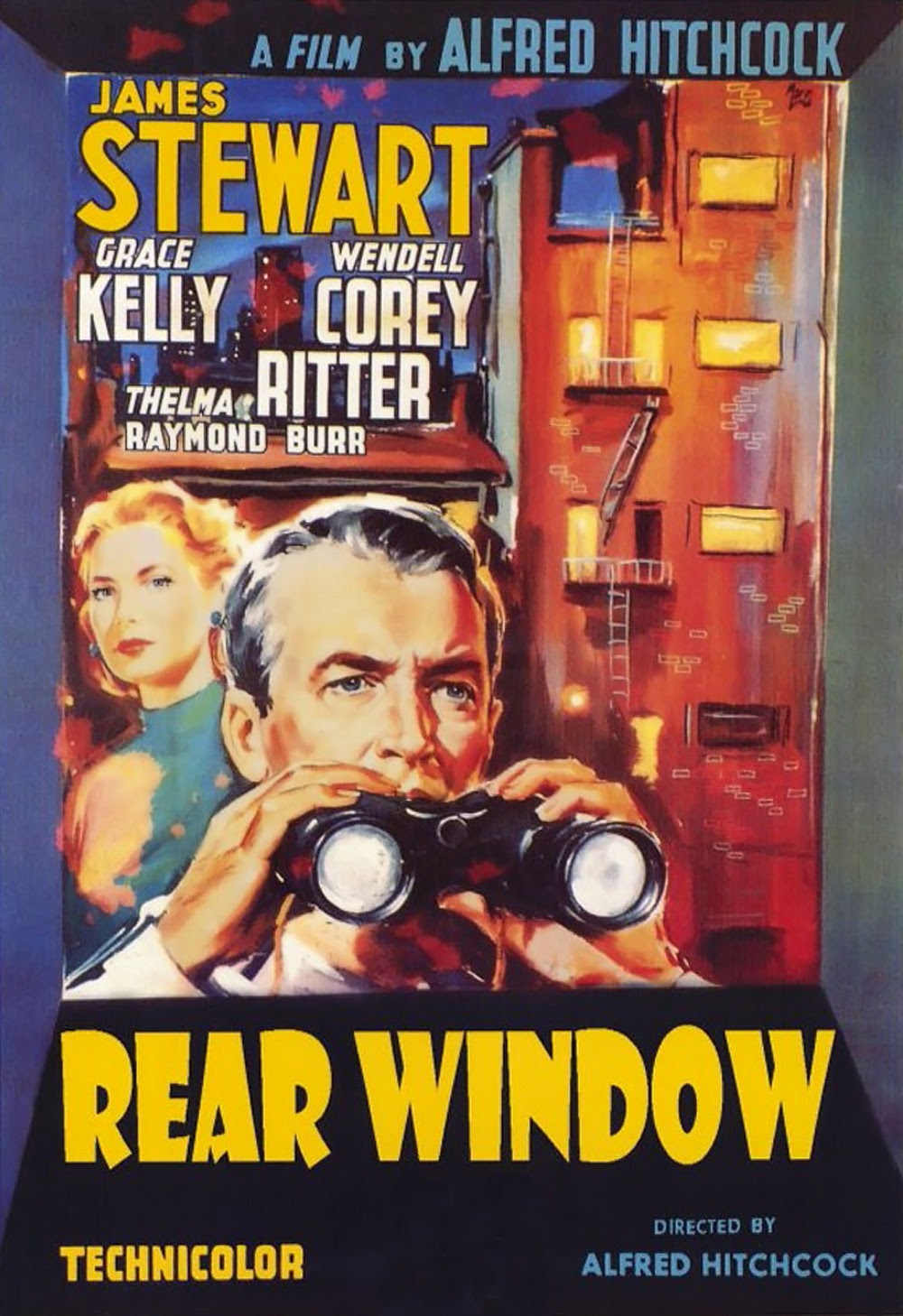
Rear window 1954 - Hitchcock's masterpiece in voyeurism


IMDB Link
IMDB Rating: 8,6


Director: Alfred Hitchcock
Main Cast: James Stewart, Grace Kelly, Wendell Corey, Thelma Ritter, Raymond Burr


"One of Alfred Hitchcock's very best efforts, Rear Window is a crackling suspense film that also ranks with Michael Powell's Peeping Tom (1960) as one of the movies' most trenchant dissections of voyeurism.
On the surface a comic thriller about a photographer and the crime he thinks took place across the courtyard, Alfred Hitchcock's Rear Window (1954) turns into an interrogation of voyeurism and movie-viewing. Keeping the camera in Jeff's apartment (except for a couple of shots near the climax), Hitchcock limits the audience's view to what Jeff can see and hear from his immobilized perch. He is free to take in the spectacle of the events in the apartments that he sees, but he is powerless to intervene. Why he looks, however, is the larger question; Hitchcock suggests not just that Jeff is channel-surfing among apartments for idle entertainment but also that the urge to peep is a more universal trait than we might care to acknowledge. What Jeff finds, moreover, becomes a fantasy projection of his own fears about his own relationship with Lisa. Jeff becomes a voyeur to escape, but his gaze is literally - and violently - turned back on him by the suspected wife-killer in his thriller narrative. Wryly entertaining as well as skillfully executed and thematically complex, the popular Rear Window earned Hitchcock an Oscar nomination for Best Director and inspired such later films as Francis Ford Coppola's The Conversation (1974) and Brian De Palma's Sisters (1973). It was remade in 1998 as a TV movie with Christopher Reeve in the James Stewart role." - www.allmovie.com

DVD links:


Tuesday, June 3, 2014

Rashomon 1950 - A highly influential world-cinema masterpiece


IMDB Link
IMDB rating: 8,4


Director: Akira Kurosawa
Main Cast: Toshiro Mifune, Machiko Kyo, Masayuki Mori, Takashi Shimura


"Rashomon's winning the Golden Lion in the 1951 Venice Film Festival is one of the key events of world cinema. Not only did it establish director Akira Kurosawa as one of the masters of the medium, but it compelled European and American audiences to look seriously at non-Western cinemas. Without Rashomon, the international critical successes of Kenji Mizoguchi, Satyajit Ray, and others are difficult to imagine. The film's structure, which replays the same event though different characters' eyes, layers ambiguity atop ambiguity. The film comes precariously close to nihilism - the denial of all objective truth and the utter senselessness of existence. Yet Kurosawa pulls back from the abyss in the film's final moments. Though most of Rashomon is adapted from two short stories by famously misanthropic Japanese author Ryunosuke Akutagawa, Kurosawa himself penned the final sequence, an elegant summation of his signature humanism. The truth may be inscrutable, even unknowable, Kurosawa argues, but hope and compassion remain. This vision struck a chord in European audiences for whom the horrors of war were still fresh and the existentialist philosophies of Jean-Paul Sartre and Albert Camus were gaining popularity. Kurosawa's dynamic editing and swaggering camerawork seemed vibrant and sophisticated for a national cinema thought at the time to be second-rate, and the film proved influential to several generations of filmmakers. Ingmar Bergman included a sequence in The Virgin Spring (1960) strongly reminiscent of the film's most memorable sequences - the woodcutter's walk through the forest - and Alain Resnais acknowledged Rashomon's influence on the bold plot structure and existential content of his art-house classic Last Year at Marienbad (1961). In both artistic achievement and historical importance, Rashomon remains one of the masterpieces of cinema." - www.allmovie.com

DVD links:


Saturday, May 24, 2014

Night and the city 1950 - There's no escape from your own trap


IMDB Link
IMDB rating: 8,0


Director: Jules Dassin
Main Cast: Richard Widmark, Gene Tierney, Googie Withers, Hugh Marlowe, Francis L. Sullivan


"An adaptation of Gerald Kersh's similarly grim source novel, Jules Dassin's Night and the City opens with cheap grifter Harry Fabian (Richard Widmark) running for his life through the streets of London. Harry wants to be big-time, and he does not care how he raises cash for his schemes. Like a junkie, he uses and steals from his girlfriend Mary (Gene Tierney), a singer at the Silver Fox, a seedy nightclub owned by the physically grotesque Phil Nosseross Francis L. Sullivan. Harry, who also works for Phil steering unsuspecting customers to the club, comes up with a plan to wrest control of professional wrestling from promoter and underworld kingpin Kristo (Herbert Lom) by manipulating Kristo through his father, retired wrestling great Gregorius (Stanislaus Zbyszko). For financial backing, Harry turns to Phil and Phil's wife Helen Googie Withers, both of whom give him the money, but only to further their own ends. When Gregorius is accidentally killed by his protege's upcoming opponent, Strangler (Mike Mazurki), and Phil realizes that Helen is leaving him for Harry, the scheme quickly unravels. Truly a glimpse of hell, Night and the City's distorted visuals and dark symbolism depict an underworld from which there is no escape and in which redemption comes at a very high price.
Director Jules Dassin, forced to leave Hollywood because of the 1950s blacklist, effectively uses his London setting to create an urban nightmare. The film is dominated by its downbeat ambience and the moral ambiguity of its characters. There is a protagonist, but he is neither a hero nor an anti-hero. As might have been expected, the film did poorly in its initial US theatrical release. The performances are consistently strong, particularly the lead performance of Richard Widmark. While never greatly popular with audiences, Night and the City presages such intense urban films as Taxi Driver and Seven; the star of the former, Robert De Niro, also starred in a subsequent remake of Night and the City." - www.allmovie.com

Download links:


(480p Blu-Ray, mkv, 629 MB) -

http://www.filefactory.com/file/6nn61ead4twz/ 

Or:

(720p Blu-Ray, 1GB) -

http://uploaded.net/file/3ewz7mf8/Night_and_the_City_1950_720p_BluRay_x264_x0r.part1.rar
http://uploaded.net/file/ada6oibh/Night_and_the_City_1950_720p_BluRay_x264_x0r.part2.rar

Thursday, May 15, 2014

The third man 1949 - Visually stunning, mysterious British Cold War thriller


IMDB Link
IMDB rating: 8,4


Director: Carol Reed
Main Cast: Joseph Cotten, Alida Valli, Orson Welles, Trevor Howard, Bernard Lee


"In this Cold War spy classic, Holly Martins (Joseph Cotten), a third-rate American pulp novelist, arrives in postwar Vienna, where he has been promised a job by his old friend Harry Lime (Orson Welles). Upon his arrival, Martins discovers that Lime has been killed in a traffic accident, and that his funeral is taking place immediately. At the graveside, Martins meets outwardly affable Major Calloway (Trevor Howard) and actress Anna Schmidt (Alida Valli), who is weeping copiously. When Calloway tells Martins that the late Harry Lime was a thief and murderer, the loyal Martins is at first outraged. Gradually, he discovers not only that Calloway was right but also that the man lying in the coffin in the film's early scenes was not Harry Lime at all - and that Lime is still very much alive (he was the mysterious 'third man' at the scene of the fatal accident). Thus the stage is set for the movie's famous climactic confrontation in the sewers of Vienna - and the even more famous final shot, in which Martins pays emotionally for doing 'the right thing'.
Producer Alexander Korda wanted Noel Coward to play the mysterious Harry Lime, but, once Orson Welles was cast in the part, the movie became a testament to his presence and impact; he's only on screen for about a quarter of the movie, but he's the actor that everyone remembers. In fact, Welles was off shooting another movie, reporting to The Third Man only late in the shooting, and he was doubled for many scenes: that was Carol Reed's assistant, future Goldfinger director Guy Hamilton, in the black trench coat running down Vienna's darkened streets, and those were director Reed's fingers reaching through the sewer grating at the chase's end. Recasting Joseph Cotten's Holly Martins as an American in turn allowed Greene to bring to the screen for the first time his antipathy toward Americans and their bright-eyed, bushy-tailed innocence in approaching the world's problems, a theme that would manifest itself even more directly in relation to Vietnam in The Quiet American.
Nominated for several Academy Awards, The Third Man won Best Cinematography for Robert Krasker." - www.allmovie.com

DVD links:


Friday, May 9, 2014

Green for danger 1946 - Atmospheric British medical thriller


IMDB Link
IMDB rating: 7,7


Director: Sidney Gilliat
Main Cast: Leo Genn, Trevor Howard, Alastair Sim


"Sidney Gilliat's Green for Danger was the most inventive murder mystery to come out of England in the eight years since Alfred Hitchcock left the country - and in a sense, it's no surprise that this would be the case as it was co-written, produced, and directed by the team of Frank Launder and Sidney Gilliat, the two authors of the screenplay for Hitchcock's last great English thriller, The Lady Vanishes. Based on Christianna Brand's novel, the 1946 movie is a fascinating variation on that venerable English creation, the drawing room thriller - in this case, the drawing room is replaced by a hospital operating theater, and instead of family members, the suspects are comprised of the surgical team, doctors and surgeons (two separate professional classes in England), and the nurses with whom they may (or may not) be involved. The movie featured one of the niftiest murders seen in a movie in years: the victim is killed on an operating table, in front of two doctors and a team of nurses who are unable to discern what has happened or why. World War II and Germany's V-1 bombings of England also figure into the plot and add to the atmosphere of uncertainty and suspense surrounding the events taking place in the hospital." - www.allmovie.com

DVD links:


The big sleep 1946 - One of the most influential detective movies


IMDB Link
IMDB rating: 8,1


Director: Howard Hawks
Main Cast: Humphrey Bogart, Lauren Bacall, John Ridgely, Martha Vickers, Dorothy Malone


"The definitive Humphrey Bogart/Lauren Bacall vehicle, The Big Sleep casts Bogart as Raymond Chandler's cynical private eye Philip Marlowe. Summoned to the home of the fabulously wealthy General Sternwood (Charles Waldron), Marlowe is hired to deal with a blackmailer shaking down the General's sensuous, thumb-sucking daughter Carmen (Martha Vickers). This earns Marlowe the displeasure of Carmen's sloe-eyed, seemingly straight-laced older sister Vivian (Bacall), who is fiercely protective of her somewhat addled sibling. As he pursues the case at hand, Marlowe gets mixed up in the murder of Arthur Geiger (Theodore von Eltz), a dealer in pornography. He also runs afoul of gambling-house proprietor Eddie Mars (John Ridgely), who seems to have some sort of hold over the enigmatic Vivian. Any further attempts to outline the plot would be futile: the storyline becomes so complicated and convoluted that even screenwriters William Faulkner, Leigh Brackett, and Jules Furthmann were forced to consult Raymond Chandler for advice (he was as confused by the plot as the screenwriters). When originally prepared for release in 1945, The Big Sleep featured a long exposition scene featuring police detective Bernie Ohls (Regis Toomey) explaining the more obscure plot details. This expository scene was ultimately sacrificed, along with several others, in favor of building up Bacall's part; for instance, a climactic sequence was reshot to emphasize sexual electricity between Bogart and Bacall, obliging Warners to replace a supporting player who'd gone on to another project. The end result was one of the most famously baffling film noirs but also one of the most successful in sheer star power." - www.allmovie.com

DVD links:


Monday, April 28, 2014

Laura 1944 - An elegantly crafted classic film noir


IMDB Link
IMDB rating: 8,2


Director: Otto Preminger
Main Cast: Gene Tierney, Dana Andrews, Clifton Webb, Vincent Price, Judith Anderson


"This adaptation of Vera Caspary's suspense novel was begun by director Rouben Mamoulien and cinematographer Lucien Ballard, but thanks to a complex series of backstage intrigues and hostilities, the film was ultimately credited to director Otto Preminger and cameraman Joseph LaShelle. Preminger's low-key approach to a story of lethal obsession allows the suggestions of sexual deviance emanating from Clifton Webb's epicene critic Lydecker, Dana Andrews's cynical yet besotted necrophiliac cop, and the pragmatic Vincent Price-Judith Anderson couple to permeate the seductively cool atmosphere. David Raksin's famously bewitching theme invokes titular mysterious beauty Gene Tierney, but it is questionable if the real woman can measure up to the power of portraiture and Lydecker's memory. 'Proper' love may triumph but it is a compromised victory. One of the most popular suspense films of the 1940s, Laura earned Oscar nominations for Best Director, Supporting Actor for Webb, Interior (now Art) Direction, and the sharp screenplay, winning the prize for Joseph LaShelle's black and white cinematography. Released the same year as Billy Wilder's caustic noir Double Indemnity, Laura was another intimation of the wave of cinematic darkness that would crest post-World War II." - www.allmovie.com

DVD links:


Cat people 1942 - A hugely influential, psychological horror classic


IMDB Link
IMDB rating: 7,5


Director: Jacques Tourneur
Main Cast: Simone Simon, Kent Smith, Tom Conway, Jane Randolph, Jack Holt


"In just a three-year period in the 1940s, producer Val Lewton created some of the most influential and intelligent psychological horror films ever made, bringing a depth to the 'B' movie that would influence any number of independent-minded Hollywood filmmakers in later years. Lewton's first, and probably best, effort was Cat People, a psychological mood piece, more reliant on suspense and suggestion than overt 'scare stuff'. Simone Simon plays an enigmatic young fashion artist who is curiously affected by the panther cage at the central park zoo. She falls in love with handsome Kent Smith, but loses him to Jane Randolph. After a chance confrontation with a bizarre stranger at a restaurant, Simon becomes obsessed with the notion that she's a Cat Woman - a member of an ancient Serbian tribe that metamorphoses into panthers whenever aroused by jealousy. She begins stalking her rival Randolph, terrifying the latter in the film's most memorable scene, set in an indoor swimming pool at midnight. Psychiatrist Tom Conway scoffs at the Cat Woman legend - until he recoils in horror after kissing Simon. If the film's main set looks familiar, it is because it was built for Orson Welles' The Magnificent Ambersons (Lewton later used the same set for his The Seventh Victim). Cat People was remade by director Paul Schrader in 1982." - www.allmovie.com

DVD links:


Wednesday, April 23, 2014

Rebecca 1940 - Hitchcock's hauntingly atmospheric masterpiece


IMDB Link
IMDB rating: 8,3


Director: Alfred Hitchcock
Main Cast: Laurence Olivier, Joan Fontaine, George Sanders, Judith Anderson, Nigel Bruce, Reginald Denny, C. Aubrey Smith, Gladys Cooper


"Producer David O. Selznick's 's second consecutive Best Picture (after the previous year's Gone With the Wind) and another enormously popular adaptation of a bestseller, this adaptation of Daphne du Maurier's novel was also the first American film directed by Alfred Hitchcock. Screenwriters Robert E. Sherwood and Joan Harrison recreated du Maurier's novel precisely, complete with the ideal casting of new star Laurence Olivier as brooding Maxim de Winter and insecure neophyte Joan Fontaine as his timid new bride. Rebecca displayed Hitchcock's unparalleled talent for ominous atmosphere, as he derived suspense from the clash between Fontaine and Judith Anderson's coldly sadistic, Rebecca-obsessed Mrs. Danvers. The elaborately appointed Manderley mansion became a character in itself, with Rebecca's expressively lit, diaphanously curtained bedroom, overlooking a suitably wild ocean, evoking her all-consuming absent presence.
Selznick's and Hitchcock's attention to detail paid off with eleven Oscar nominations, including Best Director, Best Actor, Best Actress, and Best Supporting Actress, and it won the top prize as well as an award for George Barnes's cinematography. David O. Selznick had the final cut of the picture, which was drastically altered from Hitchcock's original vision." - www.allmovie.com

DVD links:


Tuesday, April 22, 2014

They won't forget 1937 - An emotionally gripping piece of American history


IMDB Link
IMDB rating: 7,4


Director: Mervyn LeRoy
Main Cast: Claude Rains, Gloria Dickson, Edward Norris, Otto Kruger, Allyn Joslyn, Lana Turner


"This hard-hitting Warner Bros. courtroom drama begins with the usual 'Any resemblance to actual persons, living or dead, is coincidental' disclaimer. Filmgoers with long memories, however, recognized Robert Rossen and Aben Kandel's screenplay as a blow-by-blow recreation of the Leo Frank-Mary Phagan case of 1915. Phagan, a 14-year-old employee in a Marietta, GA pencil factory, was found murdered. The bulk of the evidence pointed to a black janitor (who actually confessed to the crime years after the fact), but race-baiting Atlanta newspaper publisher Tom Watson decided to go after Leo Frank, the Northern Jew who owned the factory where Mary worked. 'We can lynch a nigger any time', the politically ambitious Watson is alleged to have said, 'but when do we get a chance to hang a Yankee Jew?' Thanks largely to Watson's 'guilt by headline' campaign, and to Fulton County's cooperative solicitor general, Frank was found guilty and sentenced to death. Georgia Governor John M. Slaton, who all along smelled something fishy in the case, commuted Frank's case to life imprisonment (and was ruined politically as a result). En route to prison, Frank was abducted by a mob and lynched, an incident that boosted the prestige of the Georgia Ku Klux Klan.
Aben Kandel dramatized this appalling miscarriage of justice in his novel Death in the Deep South, which served as the basis for They Won't Forget. In Mervyn LeRoy's film version, Lana Turner (in a star-making turn) plays Mary Clay, a teen-aged typing school student who dresses garishly and flirts with every man she meets. Mary is later found murdered; the last person to see her alive was her teacher, recently arrived Northerner Robert Hale (Edward Norris). Once more, a black janitor (played as a superstitious moron by Clinton Rosemond) is the most likely suspect, but the ambitious district attorney (Claude Rains) seems sincere in his belief that Hale is guilty. Once Hale is sentenced to death, the governor, played by Paul Everton, commutes his sentence, serene in the belief that, once his career is finished, he'll be able to retire peacefully (real-life governor Slaton did not go down so benignly).
Except for the removal of the original case's anti-Semitic elements, They Won't Forget is stark, powerhouse filmmaking, one of the best of Warners' 'social protest' films of the 1930s. 25 years would pass before Hollywood would return to Southern racism with To Kill a Mockingbird in 1962. Viewed outside its historical context, They Won't Forget succeeds as a motion picture due to the passion of its director Mervyn LeRoy, and the fine performances of Claude Rains, Edward Norris, and Lana Turner. The film's socially conscious screenwriters, Robert Rossen and Abel Kandel, were hardly rewarded for their efforts: Rossen was among the first people blacklisted in the 1950s, while Kandel spent much of that era writing low-budget horror films under a pseudonym.
It was remade as the 1987 TV movie The Murder of Mary Phagan starring Jack Lemmon, Kevin Spacey, Peter Gallagher, and Charles S. Dutton (as well as as the unsuccessful 1998 Broadway musical Parade)." - www.allmovie.com

DVD links:


Thursday, May 3, 2012

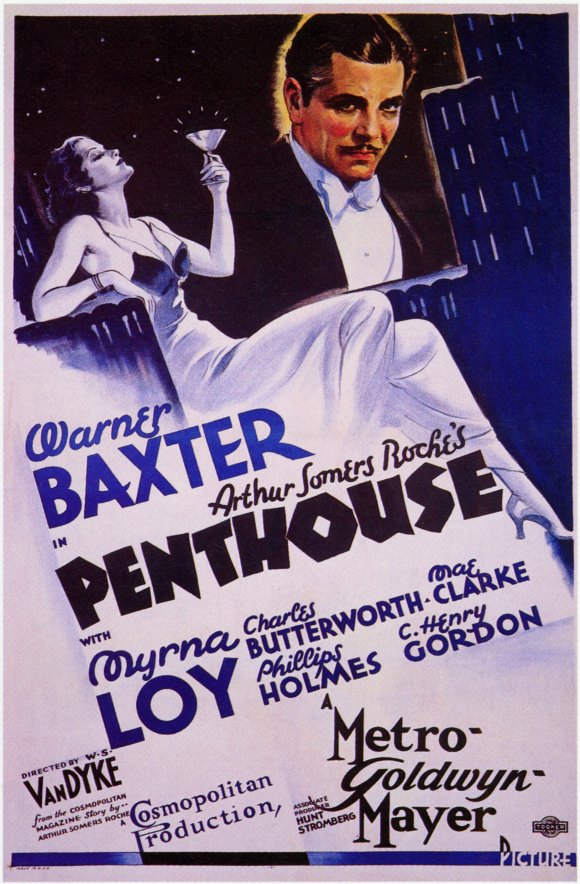
Penthouse 1933 - The gangster lawyer and his gang


IMDB Link
IMDB rating: 7,0


Director: W. S. Van Dyke
Main Cast: Warner Baxter, Myrna Loy, Charles Butterworth, Mae Clarke, Phillips Holmes


"The leads, plus some very frank dialogue and W. S. Van Dyke's breezy direction, are the main selling points for Penthouse - but also in the plus column are some great art-deco settings and a truly suspenseful denouement with a genuinely surprising (and bitter-sweet) twist, followed by a sorting out of the romantic complications that is refreshingly carnal, twist-laden, and honest.
Warner Baxter plays a lawyer who has a reputation of getting guilty men off with murders but in reality he takes those who look guilty and proves their innocents. After getting a gangster off for murder, he gets involved with a new case where a friend of his is accused of murder and the only way to break through the case is by taking up with a gangster moll (Myrna Loy).
This film was made a year before Myrna Loy catapulted to super-stardom with the Thin Man movies. At this point in her career, she was still a relatively unknown actress with a long but generally undistinguished track record. Warner Baxter, on the other hand, was the bigger star - with starring roles in 42nd Street, The Cisco Kid (and its sequel) and The Squaw Man.
Stylistically, the film is actually a lot like Baxter's B-movie series, The Crime Doctor, though in this case he plays a defense attorney who investigates crimes instead of a criminal psychiatrist who investigates crimes. Additionally, Penthouse has a bit more style, polish and better acting than the Columbia Pictures series."

DVD links:


Secret of the blue room 1933 - Atmospheric mystery with good performances


IMDB Link
IMDB rating: 6,6


Director: Kurt Neumann
Main Cast: Lionel Atwill, Gloria Stuart, Paul Lukas, Edward Arnold


"This tight little melodrama opens with a group of wealthy people staying at a luxurious European mansion. According to legend, the mansion's 'blue room' is cursed - everyone who has ever spent the night in that room has met with an untimely end. The fact that Universal made it has awarded this tight little whodunit status as a horror film. There are indeed some horror elements (spooky rooms, secret panels, etc.) but the mysterious goings-on are subsequently explained to everyone's satisfaction, except perhaps the viewer who is forced to grabble with a couple of loose ends. The Secret of the Blue Room was indeed one of Universal's cheapest releases of 1933 - a Depression year that did not call for extravagance anywhere - but good utilization of standing sets, including the mansion from James Whale's far superior The Old Dark House (1932), adds production values not matched by its Poverty Row competitors, of which there were many. Also leftover from The Old Dark House, so to speak, is Gloria Stuart, who makes the perfect foil for Lionel Atwill's troubled estate owner. Remade twice by Universal, Secret of the Blue Room was based on the German Geheimnis des Blauen Zimmers, produced by Engels & Schmidt Tonfilm in 1932." - www.allmovie.com

Download links:


Saturday, April 28, 2012

Murders in the Rue Morgue 1932 - Lugosi in a Poe adaptation


IMDB Link
IMDB rating: 6,3


Director: Robert Florey
Main Cast: Bela Lugosi, Sidney Fox, Leon Ames, Bert Roach, Betty Ross Clarke


"Having missed the opportunity to direct Frankenstein for Universal, Robert Florey was offered Murders in the Rue Morgue as a consolation, whereupon he transformed a pedestrian property into a minor classic.
Bela Lugosi in the prime of his horror career delivers a sublimely evil performance that carries this effective thriller released by Universal in the wake of their horror success of Frankenstein and Dracula. Based on a tale by Edgar Allen Poe, Murders in the Rue Morgue strikes a similar feel to some of Tod Browning's pictures: dark and rather sadistic. Lugosi's Dr. Mirakle is an evil doctor whose prize sideshow attraction is a killer gorilla whose blood he wants to mix with that of a woman (Sidney Fox) for some bizarre reason. While Lugosi takes the role to its horrifying limits, his co-stars pale by comparison playing rote characters in corny performances. Leon Waycoff (aka Leon Ames) is the hero, a medical student whose girlfriend (Fox) is abducted by the runaway ape in an exciting rooftop climax. The film's stronger elements - a woman's death in Mirakle's lab, another who is murdered and left stuffed in a chimney - come across even more powerfully thanks to the fine cinematography of the masterful Karl Freund (Metropolis). In one particularly noteworthy shot, the sound of a woman's screams are intercut with footage of shocked villagers. Director Robert Florey does a solid job of keeping the action moving and the audience on its toes despite a script that does have its occasional lame points. One notable example of this is when Waycoff's friend becomes overly upset that his pal won't eat. John Huston received credit on the film for adding dialogue." - www.allmovie.com

DVD links:


Friday, April 27, 2012

Arsene Lupin 1932 - The first screen pairing of the Barrymore brothers


IMDB Link
IMDB rating: 7,0


Director: Jack Conway
Main Cast: John Barrymore, Lionel Barrymore, Karen Morley, John Miljan, Tully Marshall


"John Barrymore plays a burglar and his brother Lionel Barrymore is the detective trying to catch him in this cleverly cast drama. An upscale thief who works under the name of Arsene Lupin is making the rounds of the homes of the wealthy and privileged, and Detective Guerchard (Lionel Barrymore) is determined to track him down. What he doesn't know is that the suave and sophisticated Duke of Charmerace (John Barrymore) is actually the man behind the robberies. Will Guerchard find out the thief's true identity before he can execute a daring theft from the Louvre Museum? Karen Morely co-stars as Sonia, the Duke's love interest.
When it debuted in 1932, the big news about Arsene Lupin was that it was the first screen pairing of the legendary Barrymore brothers. Modern audiences, who have had the chance to see them in several of their subsequent screen teamings, won't approach Arsene with the same sense of anticipation, but they'll likely find themselves quite entertained with the result, especially if they are fans of Raffles-type 'gentleman thief' stories. The screenplay of Arsene is solid, setting up the situations with skill and making sure that all of the parts are in their proper places. The writers do a fine job of keeping the audience guessing as to the identity of the title character until more than halfway into the film and it is only in the climax that the viewer is really certain that his guess is right. Jack Conway directs efficiently, with an eye on atmosphere and tension but also making sure that the appropriate light moments are given equal play. And he is very careful to spotlight 'the big show': the scenes in which John Barrymore and Lionel Barrymore share the screen and perform their own special brand of dramatic dueling. They're in beautiful form, sparring delightfully off of each other and giving their fans plenty to relish. All in all, Arsene is a treat for fans of light mystery entertainment." - www.allmovie.com

DVD links:


(Arsene Lupin Double Feature: Arsene Lupin 1932 & Arsene Lupin Returns 1938)

Sunday, April 15, 2012

The penguin pool murder 1932 - Entertaining mystery boosted by Oliver and Gleason chemistry


IMDB Link
IMDB rating: 7,1


Director: George Archainbaud
Main Cast: Edna May Oliver, Robert Armstrong, James Gleason, Mae Clarke, Donald Cook


"Edna May Oliver makes the first of three appearances as Hildegarde Withers, the schoolteacher/sleuth created by mystery writer Stuart Palmer.
The Penguin Pool Murder is a delightful piece of murder mystery fluff. It's no classic of the genre, mind you, but it's a fun little movie, and one in which the comedy works equally as well as the mystery. The plot is, of course, concerned with 'who done it', and it lays the pieces out in an entertaining manner. It's not especially hard to solve the identity of the murderer and some of the clues are put together a bit too handily, but Penguin is so much fun that few will care. Nor will they care too much about the climactic court room scene which, even by cinematic standards, veers off course from reality by a wide margin, nor about the willingness of the chief detective to misstate a valuable piece of evidence (which somehow keeps being withheld even during the trial). How can one care when the droll Edna May Oliver and the crusty James Gleason are having so much fun sparring with each other? Oliver and Gleason carry the picture, something two character actors don't get the chance to do very often, and boy do they make the most of the opportunity." - www.allmovie.com

DVD links: