Have a good time learning about and watching these classic movies and if you can, buy the DVD! (You can keep movies alive and support this blog this way!)
DVD links will be added movie by movie - from where you can pick your own favorite one. (Isn't it wonderful to have your own?)
And please take a look at my other blogs too! (My Blog List below)

Search this blog

Showing posts with label gangster. Show all posts

Saturday, November 1, 2014

Du rififi chez les hommes (Rififi) 1955 - An instant commercial success in Paris and worldwide


IMDB Link
IMDB Rating: 8,2


Director: Jules Dassin
Main Cast: Jean Servais, Carl Möhner, Robert Manuel, Janine Darcey


"Jules Dassin - in his second European film after being driven out of the United States during the years of the house Un-American Activities Committee hearings - directed this landmark caper film about the planning and execution of a nighttime robbery at a swanky English jewelry shop in the Rue de Rivoli. The pinnacle of heist movies, Dassin's Du Rififi Chez Les Hommes (1955) is not only one of the best French noirs, but one of the top movies in the genre. Crafting an archetypal noir story about how human weakness can sabotage the best-laid plans, Dassin masterfully emphasizes the skill and nerve-shredding delicacy that it takes for the central band of thieves to execute those intricate plans (without making a sound) in the classic half-hour heist sequence. The air of seediness and inevitable doom that lingers over the proceedings - shot on location in Paris - adds an existential weight to the suspense, turning Rififi into more than just a caper. Though Rififi's all-too-clear primer on how to rob a jewelry store and its then-excessive violence and decadence got the film in trouble in some countries, Rififi became an oft-imitated international hit and Cannes prizewinner for Dassin's direction. Barely seen in the U.S. since its original release, Rififi was restored to its full 35 mm visual glory in 2000, complete with new, more explicit subtitles (done in collaboration with Dassin) and a translation of the title song." - www.allmovie.com

DVD links:


Tuesday, May 13, 2014

Key Largo 1948 - Gangster melodrama in the guise of film noir


IMDB Link
IMDB rating: 7,9


Director: John Huston
Main Cast: Humphrey Bogart, Edward G. Robinson, Lauren Bacall, Lionel Barrymore, Claire Trevor


"John Huston's Key Largo - based on Maxwell Anderson's play - shares crucial similarities and differences with Archie Mayo's The Petrified Forest, also starring Humphrey Bogart but made 12 years earlier. The two plots are similar - a group of people held hostage in a remote locale by a gangster on the run - but the differences between the two movies, and Bogart's roles in them, reflect changes in the world and in perceptions of evil and how to deal with it. Where The Petrified Forest was steeped in romantic notions of self-sacrifice, rationalizing the loss of life in World War I, Key Largo implicitly questioned the right of any moral person to withdraw from the responsibility of taking moral action - and it even questioned the wisdom of self-sacrifice. The Petrified Forest's dreamy poet (Leslie Howard) nobly sacrifices himself to see the capture of the deadly sociopath played by Bogart. In Key Largo, Bogart plays embittered, disillusioned war veteran Frank McCloud, who starts the film with nothing to live for and discovers, in the course of fighting and killing old-time gangster Johnny Rocco (Edward G. Robinson), that there is a reason to remain engaged with the world and with his fellow human beings. The difference between the two movies was the intercession of World War II, in which society encountered the most monumental evil on as large a scale as was imaginable. Made in the wake of the war, with the Cold War and the Red Scare just getting rolling, Key Largo was almost a call to arms to any decent people watching that they were too important to withdraw from battlefields old or new, and that there were still battles to be fought that were worth fighting, as well as winning.
Claire Trevor's virtuoso performance as a besotted ex-nightclub singer won her an Academy Award - as predicted by her admiring fellow actors, who watched her go through several very difficult scenes in long, uninterrupted takes. While Key Largo sags a bit during its more verbose passages, on a visual level the film is one of the best and most evocative examples of the 'film noir' school." - www.allmovie.com

DVD links:


Wednesday, April 23, 2014

The roaring twenties 1939 - The torrid, blazing, wild, lush, lurid twenties


IMDB Link
IMDB rating: 7,9


Director: Raoul Walsh
Main Cast: James Cagney, Humphrey Bogart, Priscilla Lane, Gladys George, Jeffrey Lynn, Frank McHugh


"Raoul Walsh was one of cinema's greatest action directors in both silents and talkies, and The Roaring Twenties was a breakthrough film for him. Though he had directed standard comedies and melodramas before the film, Twenties would secure him a reputation as a bankable action director at Warner Bros. in the late 1930s. James Cagney, one of the great leads of the gangster-movie era, turns in an assured performance in the film: his demise on the snowy steps of a church is one of the most famous death scenes in movie history. Humphrey Bogart has a memorable supporting performance, though he would not become a big star until two years after the film, in Walsh's High Sierra and John Huston's The Maltese Falcon. Cagney and Bogart appeared together in two other movies, the gangster melodrama Angels with Dirty Faces and the Western The Oklahoma Kid." - www.allmovie.com

DVD links:


Saturday, April 5, 2014

Little Caesar 1931 - The first 'talkie' gangster movie


IMDB Link
IMDB rating: 7,4


Director: Mervyn LeRoy
Main Cast: Edward G. Robinson, Douglas Fairbanks Jr., Glenda Farrell, William Collier Jr., Sidney Blackmer


"The rise of Al Capone to the head of America's criminal class inspired this Edward G. Robinson vehicle. Appearing just as talking pictures were finding their feet, Robinson's gravelly snarl and sociopathic disdain for human conventions became the template for countless future gangster anti-heroes. In fact, virtually every aspect of Little Caesar, from the seedy settings and rough-hewn slang to the pinstriped suits and ever-present Tommy Gun, became part of the language of the genre. Little Caesar sprints by in a brisk 77 minutes, powering through the rapid rise and inevitable descent of its flawed and ambitious protagonist as if a getaway car were waiting outside. The film insightfully plays on the Horatio Alger ideal of the all-American self-made man to examine this impulse's darker, anti-social implications, while offering a tragic arc of Greek proportions. The story's violence is discernibly in your face, and the performances are about as subtle as the gangster's suits. Ironically, the film, which purportedly aimed to expose the dark underbelly of the gangster life, was so riveting that it wound up glamorizing its targets, a fact not lost on movie censors of the time. Little Caesar was followed quickly by Public Enemy (1931) and Scarface (1932); the three films ushered in a legion of imitators to follow, but they were also, at least for a time, the last 'true' gangster movies, as their ambiguous representation of glamorous criminals brought down the much stricter 1934 content restrictions of Joe Breen's Production Code Administration." - www.allmovie.com

DVD links:


The public enemy 1931 - William A. Wellman's landmark gangster movie


IMDB Link
IMDB rating: 7,8


Director: William A. Wellman
Main Cast: James Cagney, Jean Harlow, Edward Woods, Joan Blondell, Donald Cook


"One of the great pre-Production Code gangster films, William Wellman's The Public Enemy made James Cagney a star, providing him with his defining role: Tom Powers, a bitter Chicago gangster driven to a tragic end. Like its contemporaries Little Caesar and Scarface, The Public Enemy was surprisingly ambitious in its examination of the social causes that drive young men into a life of crime, closely examining the allure of street gangs to working-class youths. Although the film goes to great lengths to claim that it does not glamorize criminal activity - providing a moralistic introduction and conclusion designed to ward off censorship - many powerful people felt otherwise, and the film's notoriety helped install the more draconian Production Code of 1934. The film's mixed message occurs largely because Cagney is so charismatic an antihero, especially compared to his straight-arrow brother, played woodenly by Donald Cook. Though the film is sometimes visually static, a common problem given the constraints of early sound cinema, it remains bracing and brutal, filled with an air of menace and hopelessness." - www.allmovie.com

DVD links:


Thursday, May 31, 2012

The prizefighter and the lady 1933 - A must-see for boxing fans


IMDB Link
IMDB rating: 6,5


Director: W. S. Van Dyke
Main Cast: Myrna Loy, Max Baer, Primo Carnera, Jack Dempsey, Walter Huston, Otto Kruger


"Steve Morgan (Max Baer) is a ex-sailor tending bar in a seedy dive when The Professor (Walter Huston), a boxing coach, sees Morgan make short work of a troublesome customer. The Professor convinces Morgan that he has what it takes to be a successful prizefighter, and takes him under his wing. One day, while Morgan is jogging, he's nearly hit by a car operated by an attractive woman named Belle (Myrna Loy), who is making a name for herself as a nightclub singer. Belle has been dating underworld kingpin Willie Ryan (Otto Kruger), but before long Morgan is able to win her away from Ryan, and they get married. Morgan's marriage to Belle turns out to be god for publicity, and soon he's racked up an impressive string of victories, but Morgan can't keep his eyes off other women, and she has reason to believe he's been unfaithful. Belle, despondent, goes back to Ryan, while Morgan starts hitting the bottle, just as he's lined up a championship fight with Primo Carnera.
The Prizefighter and the Lady gave heavyweight contender Max Baer his first leading role; a year after the film was released, Baer faced off against Carnera in a real championship bout, which Baer won by a knockout." - www.allmovie.com

DVD links:


Thursday, May 3, 2012

The little giant 1933 - Full of laughs and wonderful moments


IMDB Link
IMDB rating: 7,1


Director: Roy Del Ruth
Main Cast: Edward G. Robinson, Mary Astor, Helen Vinson, Russell Hopton


"Retiring bootlegger Edward G. Robinson wishes to go straight and has recently become, as he puts it, 'positively crawling with culture'. 'Ever seen anything like that before?' He inquires of former henchman Russell Hopton, proudly displaying a newly obtained abstract. 'Not since I've been off cocaine', comes the deadpan answer. Ah, yes, nothing beats pre-production code Warner Bros. for tough talk or, for that matter, for spoofing its own blockbusters. And a spoof Little Giant certainly is, what with Robinson turning his Little Caesar character upside-down and inside out. That the comedy is still funny today is not only due to Robinson's virile performance but also to writers Robert Lord and Wilson Mizner, who took a topical event, the repeal of the 18th amendment, and created one of the era's livelier parodies." - www.allmovie.com

DVD links:


Lady killer 1933 - Cagney as a Hollywood gangster


IMDB Link
IMDB rating: 7,1


Director: Roy Del Ruth
Main Cast: James Cagney, Mae Clarke, Margaret Lindsay, Leslie Fenton


"Mae Clarke, in her autobiography Featured Player (1996), claimed that James Cagney and director William Wellman basically created the famous grapefruit incident in The Public Enemy (1931) without her consent and that the viciousness of the attack had shocked her. The scene is, of course, unforgettable and a follow-up inevitable. It came two-thirds of the way through Lady Killer when gangster-turned-movie star Cagney discovers a kittenish Miss Clarke in his bedroom - much to the consternation of his movie-star girlfriend Margaret Lindsay. Despite his newfound sophistication, Cagney acts as he would have in Hell's Kitchen: He drags the unwelcome guest out of the room by her hair! This time, happily, Clarke was in on the gag and she is visibly holding on for dear life to Cagney's wrists. The scene is still startling in its brutality, especially coming in what is really a comedy. And despite this act of physical abuse and a climactic shootout that leaves bodies scattered all over what appears to be Mulholland Highway in Los Angeles, Lady Killer is a comedy and a good one. As always, the Warner Bros. stock company is in high gear throughout and there are especially enjoyable performances by Douglas Dumbrille as Cagney's former partner-in-crime and Herman Bing as an autocratic director of Western movies. Lady Killer is vintage Cagney, throwing virtually every one of his star-making attributes (including one cute reference to his legendary 'grapefruit scene' in 1931's The Public Enemy) into one entertaining 76-minute stew." - www.allmovie.com

DVD links:


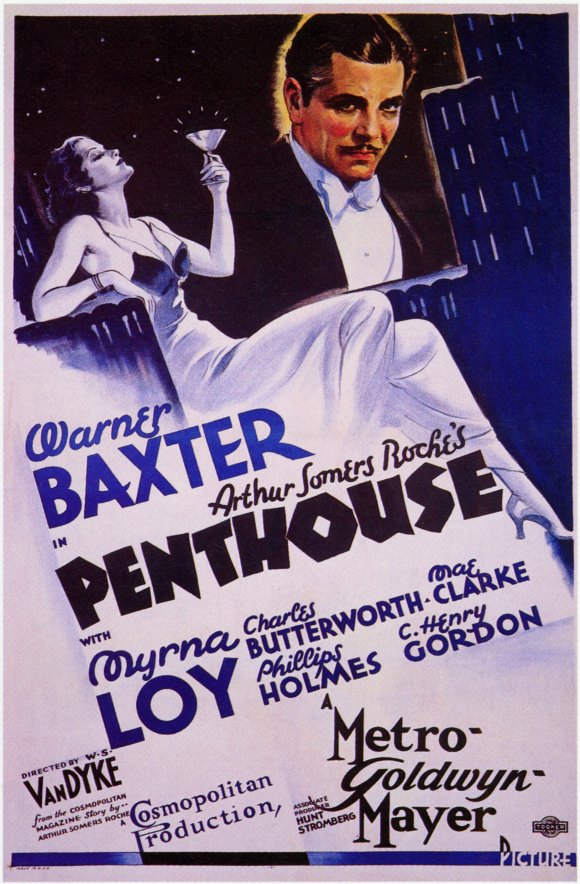
Penthouse 1933 - The gangster lawyer and his gang


IMDB Link
IMDB rating: 7,0


Director: W. S. Van Dyke
Main Cast: Warner Baxter, Myrna Loy, Charles Butterworth, Mae Clarke, Phillips Holmes


"The leads, plus some very frank dialogue and W. S. Van Dyke's breezy direction, are the main selling points for Penthouse - but also in the plus column are some great art-deco settings and a truly suspenseful denouement with a genuinely surprising (and bitter-sweet) twist, followed by a sorting out of the romantic complications that is refreshingly carnal, twist-laden, and honest.
Warner Baxter plays a lawyer who has a reputation of getting guilty men off with murders but in reality he takes those who look guilty and proves their innocents. After getting a gangster off for murder, he gets involved with a new case where a friend of his is accused of murder and the only way to break through the case is by taking up with a gangster moll (Myrna Loy).
This film was made a year before Myrna Loy catapulted to super-stardom with the Thin Man movies. At this point in her career, she was still a relatively unknown actress with a long but generally undistinguished track record. Warner Baxter, on the other hand, was the bigger star - with starring roles in 42nd Street, The Cisco Kid (and its sequel) and The Squaw Man.
Stylistically, the film is actually a lot like Baxter's B-movie series, The Crime Doctor, though in this case he plays a defense attorney who investigates crimes instead of a criminal psychiatrist who investigates crimes. Additionally, Penthouse has a bit more style, polish and better acting than the Columbia Pictures series."

DVD links:


Sunday, April 15, 2012

Blessed event 1932 - Lee Tracy as a lost joy of the pre-code era


IMDB Link
IMDB rating: 7,2


Director: Roy Del Ruth
Main Cast: Lee Tracy, Mary Brian, Dick Powell, Allen Jenkins, Ruth Donnelly


"Blessed Event is one of several early-1930s films inspired by the meteoric rise to fame of gossip columnist Walter Winchell - and like most such films, its title is based on a Winchell tag line.
Lee Tracy plays a glib-tongued reporter who is conducting a feud with popular singer Dick Powell (making his film debut). Along the way, Tracy offends a powerful gangster, and in so doing becomes entangled with chorus girl Mary Brian.
The original Broadway stage version of Blessed Event was written by Manuel Seff and Forrest Wilson--and reportedly inspired by the career of Ruby Keeler, who rose to stardom thanks in part to the patronage of a New York mobster.
There never was anyone quite like Lee Tracy, the machine gun-mouthed character actor who managed a brief starring career in pre-Code movies, of which Blessed Event arguably gives Tracy the chance to shine in all his diamond hard glory. Tracy was an odd choice for stardom, a guy who wasn't blessed with male model looks and who had a persona that was perfect for self-centered egoists who don't mind a little love but only if it doesn't get in the way of old number one. It's the kind of character that can be repulsive, but Tracy's total self-absorption and, equally important, his incredible timing and precise delivery of a one-liner make him somehow appealing. He's a force of nature, and one that won't be denied; moreover, he's a peculiarly American one, taking the concept of individualism to an extreme. Tracy also is someone who requires an amoral atmosphere in which to thrive. After the Production Code really came in, the kind of stories, situations and characters that could best contain him lost their power. But Blessed has none of these worries, blithely dealing with unwanted pregnancies, homosexuality and other subjects soon to be forbidden, and allowing the audience to cheer on a go-getter who tramples anyone in the way of getting what he wants. Tracy is perfectly complemented by Roy Del Ruth's rapid-fire direction and by a script that gives him plenty to get his mouth around; his electric chair monologue is really astounding." - www.allmovie.com

DVD links:


Tuesday, March 27, 2012

The secret six 1931 - A terrific cast makes this early gangster flick


IMDB Link
IMDB rating: 6,4


Director: George W. Hill
Main Cast: Wallace Beery, Lewis Stone, Johnny Mack Brown, Jean Harlow, Marjorie Rambeau, Clark Gable, Ralph Bellamy, John Miljan


"George W. Hill's The Secret Six was an unlikely subject for an MGM feature - its story of bootleggers battling the law and each other is closer to what Warner Bros. was doing at the start of the 1930s. (One can also see some unique MGM touches in the production - the apartment in which Jean Harlow's character is set up by her mobster/lover Wallace Beery is more elegant, in the best Art Deco design, than anything that would have turned up in a Warner Bros. drama of this sort). And the presence of Clark Gable in a leading role here, and the modest similarities in the plot to Warner Bros.' Little Caesar (released three months earlier) have a certain irony - Gable had been up for the role of Edward G. Robinson's best friend (who eventually helps bring him down) when that earlier film was in pre-production in 1930. He gave such a strong performance in this movie, however, and showed he could dominate the screen so successfully, that he landed a long-term contract with MGM on the strength of his performance here. And Gable is the sparkplug that drives the movie - Wallace Beery is okay, doing what he did best as a sometimes comically uncouth but vicious villain; Jean Harlow is good to look at and acquits herself well as an actress; and Lewis Stone is surprisingly effective as a lawyer whose contact with his criminal clients goes far beyond representing them in court. There are also some tense and well-staged scenes, such as an execution in a subway car, but the movie also creaks in spots where it should roll along smoothly, as was a risk with any talkie in 1931; and the director wasn't quite up to carrying it over those patches - except when Gable is on the screen. There is also some fairly snappy dialogue, courtesy of Hill's wife Frances Marion, and it helps; but the whole notion of a group of masked citizens organizing a secret war against the mob will seem even sillier today than it probably did to anyone who stopped to think about it in 1931. Oddly enough, despite the plot holes and a certain unreality to the briskness of some of the events depicted, this movie was very topical for its time - the exploits of Chicago mobster Al Capone were the obvious basis for some of the misdeeds attributed to Beery's Louis Scorpio, and Capone was indicted for tax evasion (one of the charges leveled at Scorpio) in 1931. As a multi-layered curio, in the career of Clark Gable, as an MGM crime film, and a piece of topical filmmaking, The Secret Six is worth a look - and at its best, it's also an old-style thrill ride." - www.allmovie.com

DVD links:


The finger points 1931 - Depression era gangster story with a dominating Gable


IMDB Link
IMDB rating: 6,1


Director: John Francis Dillon
Main Cast: Richard Barthelmess, Fay Wray, Regis Toomey, Robert Elliott, Clark Gable, Oscar Apfel


"The names have all been changed, but this hard-hitting gangster tale is based on an actual newspaper headline story involving the brutal slaying of corrupt crime reporter Alfred 'Jake' Lingle, who had been suspected of betraying his boss Al Capone. Naive Southern boy Breckinridge Lee comes to the big city for fame and fortune. He starts out honest, but is unable to the resist hefty payoffs offered by crime lord Louis Blanco to suppress certain stories. Time passes and Lee does a great job for Blanco. Lee's girl friend tries to get him to go straight, but he has become too accustomed to the money and besides is too deeply mired in corruption to ever escape. In the end, he loses his life when a story about Blanco's latest shenanigans escapes his watchful eye and gets printed. Believing Lee was behind the double-cross, Blanco orders him executed and tragedy ensues.
After talkies came in, Warner Brothers didn't really seem to know what to do with Richard Barthelmess, but he hung around in starring roles quite a bit longer than most of his silent counterparts - from 1929 to 1934. Of course, most notable here is Clark Gable, sitting in the palm of Jack Warner's hand, and not being recognized by him as a star in the making. Gable is impressive here as a spats-wearing charming sinner, the gangster who sees Lee as a useful idiot - for awhile anyways." - www.allmovie.com

Download links:


The Finger Points 1931 Mp4

Saturday, March 3, 2012

The doorway to hell 1930 - Early crime melodrama with memorable gangster cliches


IMDB link: http://www.imdb.com/title/tt0020836/?ref_=fn_al_tt_1
IMDB rating: 6,5


Director: Archie Mayo
Main Cast: Lew Ayres, James Cagney, Dorothy Mathews


"In this early talkie, a vicious crime lord (played by Lew Ayres in a rare villainous role) decides that he has had enough and much to the shock of his colleagues decides to give the business to his second in command (James Cagney in his second film role) and retire to Florida after marrying his moll. Unfortunately, he has no idea that she and Cagney are lovers. Part of the reason the don wants to leave is to keep his young brother, who idolizes him, from learning the awful truth about his avocation. Soon after moving down to Florida, former rivals kidnap the brother and kill him, causing the reformed gangster to come back for deadly revenge. This was an innovative film and featured a lot of elements that would become standards in the gangster genre including tommy guns carried in violin cases, terrible shoot-outs, and lots of rum-running rivalry." - http://www.allmovie.com/movie/the-doorway-to-hell-v89811

DVD links:


Wednesday, February 29, 2012

Framed 1930 - A rare gangster B-movie


IMDB link: http://www.imdb.com/title/tt0020900/?ref_=fn_tt_tt_25
IMDB rating: 6,5


Director: George Archainbaud
Main Cast: Evelyn Brent, Regis Toomey


"Framed represented the return of Evelyn Brent to her old home studio of FBO, which by 1930 had been rechristened RKO Radio. Brent plays Rose Manning, a sexy nightclub hostess who hopes to avenge the murder of her father. Holding the local police chief responsible (the chief is played by William Holden - but not that William Holden), Rose sets about to seduce and compromise the chief's patrolman son Jimmy McArthur (Regis Toomey), only to fall in love with the boy. To save Jimmy from being put 'on the spot', Rose double-crosses her crooked cohort, bootlegger Chuck Gaines (Ralf Harolde). Both contemporary critics and later film historians noted that Framed borrowed freely from such earlier 'slice of life' crime mellers as Broadway (which also starred Evelyn Brent) and The Racket." - http://www.allmovie.com/movie/framed-v92276

Download links:


Monday, February 13, 2012

A slight case of murder 1938 - A well-written comic gem


IMDB link: http://www.imdb.com/title/tt0030764/?ref_=fn_al_tt_1
IMDB rating: 7,2


Director: Lloyd Bacon
Main Cast: Edward G. Robinson, Jane Bryan, Allen Jenkins, Ruth Donnelly


"A Slight Case of Murder is a non-stop laugh riot and a brilliant parody of the classic Hollywood gangster film. Blessed with a screenplay that is not only flawlessly constructed but also drop-dead funny, Murder also benefits from a peculiar, quirky and, at times, surreal sensibility that makes it stand out from many other studio comedies of the period. The hand of Damon Runyon is clearly evident in much of the dialogue, but the trio of writers who collaborated with him on the screenplay have kept many of Runyon's bad habits - such as an occasional willingness to go for cheap sentiment - in check. Director Lloyd Bacon is operating in top form, almost as if he were competing with Howard Hawks to keep things moving in the most crackling manner possible. In the demanding lead role, Edward G. Robinson is delightful, a presumed tough guy who can't help but be a cuddly softie; no one handles the fish-out-of-water routines in quite the same way, and his offhanded way with a punch line is delicious. Ruth Donnelly is a stitch as his wife and Bert Hanlon has an amusing turn as Sad Sam the bookie. Unlike Robinson's cheap, bootleg booze, Murder just gets better with age." - http://www.allmovie.com/movie/a-slight-case-of-murder-v110601/

DVD links:


Sunday, November 6, 2011

The beast of the city 1932 - A riveting look into the gangster life


IMDB link: http://www.imdb.com/title/tt0022660/
IMDB rating: 7,0


Director: Charles J. Brabin
Main Cast: Walter Huston, Jean Harlow, Wallace Ford, Jean Hersholt


"A reluctantly appointed police chief in a crime-riddled city takes his job seriously and works hard to clean the streets of gangsters and to shape up his own corrupt department in this brutal, gritty film noir. Jean Harlow plays a luminescent but ill-fated gun moll.  Adapted by John Lee Mahin from a W.R. Burnett story, and directed by Charles Brabin (The Mask of Fu Manchu), this 1932 talkie is said to be better than average, as a police chief (Walter Huston) sets out to battle organized crime.
This is a very elaborate production for an early 30's film. The camera was surprisingly fluid with some strong cinematography. The Beast of the City was the precursor to many modern crime drama films that pit the gangsters vs. the diligent cops - eventually in a courtroom setting. It was also certainly racy for it's time - made a couple of years before enforcement of the Motion Picture Production Code (also known as the Hays Code), with an exceptional cast."

DVD links: