Have a good time learning about and watching these classic movies and if you can, buy the DVD! (You can keep movies alive and support this blog this way!)
DVD links will be added movie by movie - from where you can pick your own favorite one. (Isn't it wonderful to have your own?)
And please take a look at my other blogs too! (My Blog List below)

Search this blog

Showing posts with label DVD. Show all posts

Sunday, December 14, 2014

Old Yeller 1957 - An influential tear-jerker family movie


IMDB Link
IMDB Rating: 7,3


Director: Robert Stevenson
Main Cast: Dorothy McGuire, Fess Parker, Tommy Kirk, Beverly Washburn


"Old Yeller is one of the best-loved live-action features ever made by the Walt Disney Company. Unabashedly weepy, the film is genuine enough to have become a family classic. Director Robert Stevenson coaxes some fine performances from his cast and does an admirable job recreating farm life in the mid-1800s. The film inspired a number of copycats, and its influence can still be felt in almost any movie that prominently features an animal. Disney began to move away from animation after the success of 1950's Treasure Island; Yeller was one of many live-action hits directed by Stevenson, including Kidnapped, The Absent-Minded Professor, and, most notably, Mary Poppins. Yeller spawned an inferior sequel, Savage Sam, featuring much of the same cast but a different director." - www.allmovie.com


DVD links:


Night of the demon/Curse of the demon 1957 - The significant horror classic


IMDB Link
IMDB Rating: 7,6


Director: Jacques Tourneur
Main Cast: Dana Andrews, Peggy Cummins, Niall MacGinnis, Maurice Denham


"One of the finest horror films ever made, Curse of the Demon is a frightening, fast-paced, and unrelenting chiller that only gets better with passing years and repeated viewings. Directed by Jacques Tourneur from the M.R. James story Casting the Runes, Curse stars Dana Andrews as a psychologist out to disprove the black magic of co-star Niall MacGinnis. Peggy Cummings also stars as the daughter of a scientist killed by the title creature during the shocking opening. Tourneur was a master at scaring an audience by the power of suggestion, and Curse accomplished this with one exception: the producer insisted the 'demon' had to make its appearance at the beginning and ending of the film. That aside, the film is a masterful collage of fine filmmaking from its sharply written story, characters, and dialogue to Clifton Parker's spine-tingling score and the spectacular special effects, highlighted by production designer Ken Adams' terrifying demon. The performances are excellent across the board, with Andrews solid as the boorish non-believer who refuses to become convinced of the curse placed on him. MacGinnis' character is the real gem, a devilish trickster whose devious delight in the black arts hides a surprisingly bratty and less-than-sinister bad guy. This character was loosely based on the famed occultist, Aleister Crowley." - www.allmovie.com


DVD links:


The incredible shrinking man 1957 - A strange adventure into the unknown


IMDB Link
IMDB Rating: 7,7


Director: Jack Arnold
Main Cast: Grant Williams, Randy Stuart, April Kent, Paul Langton, Raymond Bailey


"The notion of a man who shrinks to the size of a ChapStick and finds himself hunted by his own pet cat would seem to be the height of comic absurdity, but screenwriter Richard Matheson and director Jack Arnold had the good sense not to play it as a traditional horror/sci-fi story. Instead, The Incredible Shrinking Man emphasizes the psychological side of the character's dilemma alongside his obvious physical problems; Scott Carey (Grant Williams, in the best and best-known performance of a sadly misbegotten career) finds his view of himself and the world radically challenged by his extreme reaction to a radioactive cloud. As Scott slowly begins to shrink, he first loses touch with his masculinity as he begins to look more like his wife's son than her husband, and then begins to question his humanity, as his home turns into a horrific netherworld and he's eventually reduced to the size of a molecule. Director Arnold and his special effects crew do fine work, making Scott's situation look as realistic as possible given the circumstances, and they turn his struggle to emerge from the basement into an adventure to reckon with. But it's Matheson's perceptive script that sets the film apart; plenty of monster movies had an ordinary guy turn into an unrecognizable creature, but few faced the psychological and even theological implications of a man transformed into something unknowable. The result was the most intelligent movie of the 1950s 'atomic mutation' cycle, and, along with Them!, the one that has best stood the test of time." - www.allmovie.com


DVD links:


Sweet smell of success 1957 - A sharp and bitter urban masterpiece


IMDB Link
IMDB Rating: 8,2


Director: Alexander Mackendrick
Main Cast: Burt Lancaster, Tony Curtis, Susan Harrison, Martin Milner, Barbara Nichols


"Ernest Lehman drew upon his experiences as a Broadway press agent to write the devastating a clef short story 'Tell Me About Tomorrow'. This in turn was adapted by Lehman and Clifford Odets into the sharp-edged, penetrating feature film Sweet Smell of Success. Burt Lancaster stars as J. J. Hunsecker, a Walter Winchell-style columnist who wields his power like a club, steamrolling friends and enemies alike. Tony Curtis co-stars as Sidney Falco, a sycophantic press agent who'd sell his grandmother to get an item into Hunsecker's popular newspaper column. Hunsecker enlists Falco's aid in ruining the reputation of jazz guitarist Steve Dallas (Martin Milner), who has had the temerity to court Hunsecker's sister Susan (Susan Harrison). Falco contrives to plant marijuana on Dallas, then summons corrupt, sadistic NYPD officer Harry Kello (Emile Meyer), who owes Hunsecker several favors, to arrest the innocent singer.
The real Walter Winchell, no longer as powerful as he'd been in the 1940s but still a man to be reckoned with, went after Ernest Lehman with both barrels upon the release of Sweet Smell of Success. Winchell was not so much offended by the unflattering portrait of himself as by the dredging up of an unpleasant domestic incident from his past.
While Success was not a success at the box office, it is now regarded as a model of street-smart cinematic cynicism. The electric performances of the stars are matched by the taut direction of Alex MacKendrick, the driving jazz score of Elmer Bernstein, and the evocative nocturnal camerawork of James Wong Howe, setting the nocturnal mood of New York's lost theaters and nightclubs.
Though a de facto N.Y.C. companion to Billy Wilder's equally superb and mordant West Coast showbiz exposé Sunset Boulevard (1950), Sweet Smell suffered an ignominious contemporary fate more akin to Wilder's acid press satire Ace in the Hole (1951). Since then, Sweet Smell of Success has aged gracefully into a masterwork; it was adapted not so gracefully as a Broadway musical in 2002." - www.allmovie.com


DVD links:


The bridge on the River Kwai 1957 - One of the greatest war films ever made


IMDB Link
IMDB Rating: 8,3


Director: David Lean
Main Cast: William Holden, Alec Guinness, Jack Hawkins, Sessue Hayakawa, James Donald


"The Bridge on the River Kwai ranks as one of the greatest films of all time and arguably director David Lean's best film. At the heart of the film is the performance of Alec Guinness as the obsessively principled Colonel Nicholson. In a lesser film, his character might be simplified into a heroic martyr, but The Bridge on the River Kwai revels in its moral ambiguity: no significant character is either purely a hero or purely a villain. Filmed in Ceylon (now Sri Lanka), the film features brutal prisoner-of-war work camps that are nonetheless considerably nicer than their historical counterparts, a good decision since it frees the audience to focus on the battle of wills, at first between Nicholson and Saito (Sessue Hayakawa), later between Shears (William Holden) and Warden (Jack Hawkins). The film's closing line ('Madness... Madness') is among the best-known and most enigmatic closings in screen history.
Bridge on the River Kwai won seven Academy Awards, including Best Picture, Best Director for the legendary British filmmaker David Lean, and Best Actor for Guinness. It also won Best Screenplay for Pierre Boulle, the author of the novel on which the film was based, even though the actual writers were blacklisted writers Carl Foreman and Michael Wilson, who were given their Oscars under the table." - www.allmovie.com


DVD links:


Witness for the prosecution 1957 - A courtroom drama with suprise twists and shocking climax


IMDB Link
IMDB Rating: 8,5


Director: Billy Wilder
Main Cast: Tyrone Power, Marlene Dietrich, Charles Laughton, Elsa Lanchester


"Witness for the Prosecution is multi-faceted director Billy Wilder's stab at the courtroom genre, and he handles it with aplomb. Reworking Agatha Christie's stage play, based on Christie's own short story, Wilder retools the play in order to develop a humorous subtext in the interplay between the physically fragile defense attorney (Charles Laughton) and his overbearing but well-meaning nurse (real-life wife Elsa Lanchester). Laughton and Lanchaster have great chemistry and give fully realized performances that transcend the limitations of the genre. Wilder also jiggers Marlene Dietrich's role, wife of the accused, to make use of moments from her personal life, particularly the wonderful "Berlin cabaret" flashback sequence. The twists and turns of the plot are allowed to emerge unobtrusively in this methodically paced drama, and while the finale stretches credulity in order to circumvent the inevitable Production Code restrictions, Wilder's film is a completely satisfying experience anchored by a handful of memorable performances, including the last in Tyrone Power's illustrious career.
A delicious Billy Wilder mixture of humor, intrigue and melodrama, Witness for the Prosecution is distinguished by its hand-picked supporting cast: John Williams as the police inspector, Henry Daniell as Robards' law partner, Una O'Connor as the murder victim's stone-deaf maid, Torin Thatcher as the prosecutor, Ruta Lee as a sobbing courtroom spectator, and Elsa Lanchester as Robards' ever-chipper nurse (a role especially written for the film, so that Lanchester could look after Laughton on the set).
The movie was nominated for six Academy Awards, but ran up against David Lean's The Bridge on the River Kwai juggernaut, and was shut out." - www.allmovie.com


DVD links:


Paths of glory 1957 - Kubrick's breakthrough war masterpiece


IMDB Link
IMDB Rating: 8,5


Director: Stanley Kubrick
Main Cast: Kirk Douglas, Ralph Meeker, Adolphe Menjou


"Paths of Glory is a remarkable anti-war film that retains its impact decades after its release. The story's horrifying, tragic inevitability combines with Stanley Kubrick's forthright documentary style to create a film of rare power, a stinging, pre-Vietnam indictment of the inflexibility of war-time decision-making. Kirk Douglas, who produced the film, seems an odd choice to play a French colonel in World War I, yet he fills the screen with his righteous indignation. Kubrick's indictment of a military elite out of touch with - even openly antagonistic towards - its own men is brilliantly vicious. Filmed in pristine black-and-white that mirrors the thematic emphasis on the battle between good (enlisted men) and evil (the officers), with Kubrick's keen eye toward detail, Paths of Glory is both an intellectual and a visual treat. The film touched many raw nerves, and it was banned in several European countries, with France the last to lift the ban in the late 1970s. The conclusion features the soon-to-be Mrs. Kubrick in a sentimental and melodramatic scene that has been criticized as out-of-step with the rest of the somber and gritty film." - www.allmovie.com


DVD links:


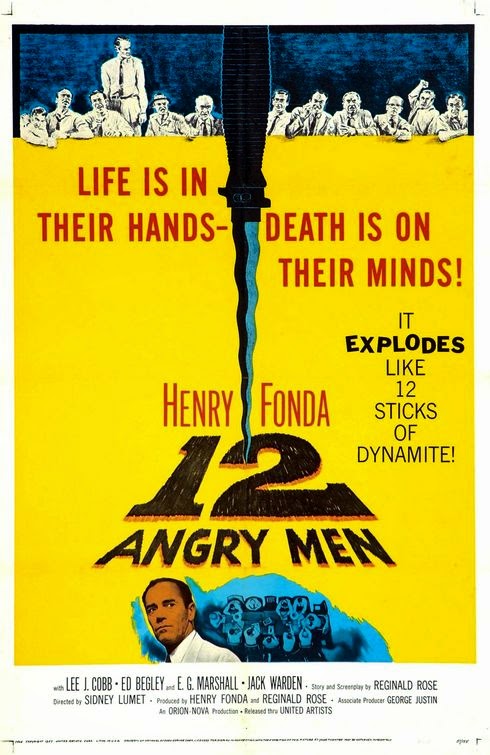
12 angry men 1957 - The finest courtroom drama


IMDB Link
IMDB rating: 8,9


Director: Sidney Lumet
Main Cast: Henry Fonda, Martin Balsam, John Fiedler, Lee J. Cobb, E. G. Marshall, Jack Klugman, Edward Binns, Jack Warden, Joseph Sweeney, Ed Begley, George Voskovec, Robert Webber


"Twelve Angry Men is a tightly wound top of a movie. Each scene ratchets up the tension another notch as Henry Fonda's character tries desperately to open the minds of his fellow jurors. The setting - a claustrophobic jury room in the dog days of summer - superbly augments the suspense. Operating within the constraints of a small budget, first-time director Sidney Lumet tightens the noose by accentuating the throbbing pulse of the ceiling fan and slowly narrowing his shots on his characters as the film approaches its climax. Based on Reginald Rose's well-known play, which had been adapted to the television screen three years earlier, Twelve Angry Men boasts a series of excellent performances by young actors who would soon become household names, including Jack Klugman, Jack Warden, and Martin Balsam. However, it is the film's established stars - Lee J. Cobb, E. G. Marshall and most importantly Fonda - who play the leads, delivering the goods like seasoned pros. The film has instructional value as a study of the inherent strengths and weaknesses of the jury system, but its real value is how it allows each member of the cultural mosaic of a jury to develop into distinct, damaged, and interesting characters. In a well-crafted metaphor for the broader outline of society, the jury members must confront their prejudices in order to see that justice prevails.
A pet project of Henry Fonda's, Twelve Angry Men was his only foray into film production; the actor's partner in this venture was Reginald Rose. A flop when it first came out (surprisingly, since it cost almost nothing to make), Twelve Angry Men holds up beautifully when seen today.
Nominated for three Oscars, Twelve Angry Men ran into the juggernaut of Bridge on the River Kwai and came up empty handed.
It was remade for television in 1997 by director William Friedkin with Jack Lemmon and George C. Scott." - www.allmovie.com


DVD links:


Saturday, November 8, 2014

The King and I 1956 - The much-loved family classic


IMDB Link
IMDB Rating: 7,5


Director: Walter Lang
Main Cast: Yul Brynner, Deborah Kerr, Rita Moreno, Martin Benson, Terry Saunders, Rex Thompson


"The King and I, Richard Rodgers and Oscar Hammerstein's 1951 Broadway musical hit, was based on Margaret Landon's book Anna and the King of Siam. Since 20th-Century-Fox had made a film version of the Landon book in 1946, that studio had first dibs on the movie adaptation of The King and I. It typifies the elaborate Broadway musical adaptations with which Hollywood studios often tried to fight the advance of television of 1950s. In general, The King and I tends to be somewhat stagey, with the notable exception of the matchless 'Small House of Uncle Thomas' ballet, which utilizes the Cinemascope 55 format to best advantage (the process also does a nice job of 'handling' Deborah Kerr's voluminous hoopskirts) to counter the smallness of the TV screen, offering equally grand set design, costumes, and cinematography. Most of the Broadway version's best songs ('Getting to Know You', 'Whistle a Happy Tune', 'A Puzzlement', 'Shall We Dance' etc.) are retained. None of the omissions are particularly regrettable, save for Anna's solo 'Shall I Tell You What I Think of You?' This feisty attack on the King's chauvinism was specially written to suit the talents of Gertrude Lawrence, who played Anna in the original production; the song was cut from the film because it made Deborah Kerr seem 'too bitchy' (Kerr's singing, incidentally, is dubbed for the most part by the ubiquitous Marni Nixon - who had been responsible for Natalie Wood's singing voice in West Side Story and Audrey Hepburn's in My Fair Lady). So the songs and performances are equally impressive: Yul Brynner - being the main attraction of the movie - won an Oscar for his career-best performance as the King of Siam, the role that made him a star and with which he will forever be identified." - www.allmovie.com

DVD links:


Friendly persuasion 1956 - Pacifism put to the test during the Civil War


IMDB Link
IMDB Rating: 7,5


Director: William Wyler
Main Cast: Gary Cooper, Dorothy McGuire, Anthony Perkins, Richard Eyer, Robert Middleton, Phyllis Love


"Friendly Persuasion is a charming, sensitive tale of a family of Quakers that attempts to maintain their pacifist ideals amid the turmoil of the U.S. Civil War. Best-known for playing quiet, understated characters who use violence when pushed too far, Gary Cooper gets the opportunity to explore a more peaceful resolution - though the film occasionally suggests that no person can be completely pacifistic. The tech credits are solid, as should be expected for a film directed by William Wyler; of particular note are Dimitri Tiomkin's score and Dorothy Jeakins's costume design. Though the film tends to exaggerate Quaker speech, the performances are convincing, and the screenplay (by blacklisted Michael Wilson) does a good job of transferring Jessamyn West's story to the screen. The film received six Oscar nominations, including Best Picture, though it did not win in any category." - www.allmovie.com

DVD links:


Giant 1956 - From rigid conservatism to mindless materialism


IMDB Link
IMDB Rating: 7,7


Director: George Stevens
Main Cast: Elizabeth Taylor, Rock Hudson, James Dean, Carroll Baker, Mercedes McCambridge, Dennis Hopper, Sal Mineo, Rod Taylor


"George Stevens' sprawling adaptation of Edna Ferber's best-selling novel successfully walks a fine line between potboiler and serious drama for its 210-minute running time, making it one of the few epics of its era that continues to hold up as engrossing entertainment across the decades. Even if it hadn't starred three of the most iconic screen figures of the 1950s, George Stevens's Giant would still be an emotionally powerful and visually striking film; adding Rock Hudson, Elizabeth Taylor, and James Dean (in his final performance) to the mix was just the icing on the cake. Dean contributes the highest-caliber fireworks, though his Method style sometimes blends uncomfortably with the more traditional performances of the other actors, but Stevens also drew atypically strong performances from Taylor and Hudson, who delivers perhaps his best performance on screen next to Seconds (1966). The story is a glorified soap opera, but Stevens's epic production strengthens the narrative rather than drowning it, providing a visual metaphor for the intimidating vastness of the Texas landscape. The image of the vast Benedict mansion slowly appearing as a tiny dot on the horizon is only the most memorable of the film's many indelible images. Giant is as big and sprawling as Texas itself; it's the tininess of the larger-than-life characters in the oilfields of the Southwest that keeps them human, and makes them all the more fascinating.
The talented supporting cast includes Mercedes McCambridge as Bick’s frustrated sister, put out by the new woman of the house, and with Carroll Baker and Dennis Hopper as the Benedict’s rebellious children.
Giant was nominated for 10 Academy Awards with director George Stevens winning his second Oscar for this ambitious, grandly realized epic of the changing socio-economic (and physical) landscape of modern Texas." - www.allmovie.com

DVD links:


Forbidden planet 1956 - The ultimate predecessor of cinematic space voyages


IMDB Link
IMDB Rating: 7,7


Director: Fred M. Wilcox
Main Cast: Walter Pidgeon, Anne Francis, Leslie Nielsen, Warren Stevens, Jack Kelly, Richard Anderson, Earl Holliman, Robby the Robot


"At the time Forbidden Planet came along, science fiction hadn't existed for all that long as a movie genre, having really only established itself after World War II as distinct from horror films and movie serials. And there had been some serious science fiction films made up to that time - most notably, Robert Wise's The Day the Earth Stood Still (1951). But science fiction was still considered primarily a genre that appealed to children, centered on action and adventure, without undue plot complexities or character relationships. Forbidden Planet changed all that, without sacrificing a genuine sense of wonder and other elements that juvenile audiences could enjoy. At the time, people mostly noticed the special effects, perhaps the best ever done up to that time and for many years beyond; it was the first movie that could convince viewers, moment to moment, that they were out in space or on some alien planet. Forbidden Planet's real importance, however, lay in respecting its audience, including the kids, enough to steep its plot in psychology and to make some statements about human nature that were pretty strong stuff in the midst of the Cold War, with both sides detonating H-bomb tests on a regular basis. The movie walks an even more precarious tightrope with its subplot about nubile Anne Francis' relationship with her father and the officers of the starship that has just landed in their two-person paradise. The plot was adapted from William Shakespeare's The Tempest, which flabbergasted (and distressed) some critics but helped draw a new, more serious viewer to this kind of movie. Forbidden Planet was so good, in fact, that it proved an impossible act to follow, and no one tried for almost a decade. But its influence trails out for a half-century beyond: Gene Roddenberry drew most of his ideas about the crew, officers (and their personal relationships), and setting of Star Trek from Forbidden Planet's script and set designs, and George Lucas' funny androids (not to mention Lost in Space's helpful robot servant) have their origins in Forbidden Planet's Robby the Robot. And one can only guess at what luck Stanley Kubrick might've had getting financing for 2001: A Space Odyssey, especially out of MGM, had it not been for the precedent of Forbidden Planet." - www.allmovie.com

DVD links:


The Ten Commandments 1956 - The epic masterpiece of the 50s


IMDB Link
IMDB Rating: 7,9


Director: Cecil B. DeMille
Main Cast: Charlton Heston, Yul Brynner, Anne Baxter, Edward G. Robinson, Yvonne De Carlo, Debra Paget, John Derek, Cedric Hardwicke, Nina Foch, Martha Scott, Judith Anderson, Vincent Price, John Carradine


"The Ten Commandments was the final film in the five-decade career of legendary producer/director Cecil B. DeMille and, despite its flaws, it remains a primary example of combining high production values and epic scope for a box-office blockbuster. Expanded from one of the segments in DeMille's 1923 silent film of the same name (though not exactly a remake of that film as is often claimed - the earlier version took place mostly in modern times), it benefits greatly from Charlton Heston's star-making performance as Moses, and from a veteran supporting cast that includes Yul Brynner, Anne Baxter, Edward G. Robinson, and Vincent Price. The acting, though, is secondary to DeMille's visually expansive storytelling. The production design has an appropriate sense of grandeur, and the parting of the Red Sea is among the most famous scenes in any film from the 1950s. DeMille's directing style is straightforward, maintaining a clean, brisk pace throughout the film's 220 minutes. The Ten Commandments was nominated for seven Academy Awards, including Best Picture, winning for John Fulton's special effects." - www.allmovie.com

DVD links:


Invasion of the body snatchers 1956 - A cautionary fable about the blacklisting hysteria of the McCarthy era


IMDB Link
IMDB Rating: 7,8


Director: Don Siegel
Main Cast: Kevin McCarthy, Dana Wynter, Larry Gates, King Donovan, Carolyn Jones


"Though it was an inexpensive production for B-movie studio Allied Artists, Don Siegel's Invasion of the Body Snatchers (1956) is a class-A 1950s science fiction allegory about the fragility of inner passion. With Siegel's matter-of-fact approach and 'ordinary' small town setting and characters, the story about human possession by unexplained alien pods becomes all the more frightening; though the pods are from elsewhere, the 'monsters' assume human faces. While the pods have often been seen as a Cold War sci-fi metaphor for Communist infiltration of American society, they are an equally compelling symbol of soul-deadening 1950s suburban conformity. Invasion of the Body Snatchers builds tension slowly and steadily, dealing not in the shock of bug-eyed monsters common to other 1950s science-fiction movies but in the unnerving possibility that the enemy is among us - and impossible to tell from our allies. Siegel himself liked to assert that the Hollywood studios were filled with pods; and when Allied Artists saw Siegel's bleak ending, they demanded a prologue and epilogue that added an element of hope. The 'Siegel version' of Invasion of the Body Snatchers, however, was seen in Europe and 'underground' American screenings, before the 1979 reissue officially deleted the studio-mandated additions.
Keep an eye peeled for a bit part by soon-to-be-legendary Western director Sam Peckinpah, who plays a meter reader and also (uncredited) helped write the screenplay. Based on a novel by Jack Finney, Invasion of the Body Snatchers was remade in 1978 by Philip Kaufman and in 1993 by Abel Ferrara (as Body Snatchers); and its influence can be felt from The Stepford Wives (1975) to The X-Files." - www.allmovie.com


DVD links:


Monday, November 3, 2014

The searchers 1956 - Ford's masterpiece, Wayne's definitive role


IMDB Link
IMDB Rating: 8,0


Director: John Ford
Main Cast: John Wayne, Jeffrey Hunter, Vera Miles, Ward Bond, Natalie Wood, John Qualen


"If John Ford is the greatest Western director, The Searchers is arguably his greatest film, at once a grand outdoor spectacle like such Ford classics as She Wore a Yellow Ribbon (1949) and Rio Grande (1950) and a film about one man's troubling moral codes, a big-screen adventure of the 1950s that anticipated the complex themes and characters that would dominate the 1970s.
Described by the director as a 'psychological epic', The Searchers (1956) is John Ford's most revered Western, for its visual richness and profoundly ambiguous critique of the genre's (and America's) racism. Ford pushed John Wayne's archetypal Westerner into the realm of antiheroism, as Ethan's five-year quest to rescue his niece from Comanche chief Scar mutates into killing her when he discovers her living placidly as Scar's bride. While Ethan's lethal racism signals his insanity, Wayne's charismatic presence and Ethan's desire to salvage the family unit of 'civilized' settlers carries its own sheen of Western heroism. Still, the famous final image of Ethan's departure into the desert reveals that 'civilization' has no place for such an uncompromising figure.
Shot on location in Colorado and Monument Valley, Ford's vividly arid Technicolor vistas render Ethan a man of the magnificent and punishing landscape, unable to reconcile his inner savagery with domestic constraints. Greeted in America as just another quality Ford oater, the film was first reclaimed by French critics for the unresolved tensions and evocative style of Ford's narrative, elevating it to the status of cinematic art.
John Wayne gives perhaps his finest performance in a role that predated screen antiheroes of the 1970s; by the film's conclusion, his single-minded obsession seems less like heroism and more like madness. Wayne bravely refuses to soft-pedal Ethan's ugly side, and the result is a remarkable portrait of a man incapable of answering to anyone but himself, who ultimately has more in common with his despised Indians than with his more 'civilized' brethren. Natalie Wood is striking in her brief role as the 16-year-old Debbie, lost between two worlds, and Winton C. Hoch's Technicolor photography captures Monument Valley's savage beauty with subtle grace.
The Searchers paved the way for such revisionist Westerns as The Wild Bunch (1969) and McCabe & Mrs. Miller (1971), and its influence on movies from Taxi Driver (1976) to Close Encounters of the Third Kind (1977) and Star Wars (1977) testifies to its lasting importance." - www.allmovie.com

DVD links:


The killing 1956 - A lastingly influential early Kubrick movie


IMDB Link
IMDB Rating: 8,1


Director: Stanley Kubrick
Main Cast: Sterling Hayden, Coleen Gray, Vince Edwards, Jay C. Flippen, Ted de Corsia, Marie Windsor, Elisha Cook Jr.


"Stanley Kubrick's third feature showed that he was no ordinary director, as he dispensed with traditional time structure to detail the planning and execution of a racetrack heist gone wrong. Combining a non-linear story with a unifying, matter-of-fact voice-over narration, Kubrick constructed an intricate yet lucid cinematic puzzle that shifted back and forth both in time and among the central characters, revealing the personal stakes for each participant by following their individual actions leading up to the fateful seventh race. Johnny the leader thinks he has it all under control, but, in true Kubrick fashion, his plan is not immune to human failure. While the fractured time frame and use of long takes and tracking shots signaled Kubrick's stylistic break from classical form, the sharp black-and-white photography, Marie Windsor's insidious femme fatale, and Sterling Hayden's doomed Johnny place The Killing in the mode of 1940s/1950s film noir. His first film made on a reasonable budget and with an established cast of pros, The Killing caught critics' attention and established Kubrick as a director to watch, especially for such future cinematic time-tricksters as Quentin Tarantino.  The Killing is based on the novel Clean Break by Lionel White." - www.allmovie.com

DVD links:


Saturday, November 1, 2014

Du rififi chez les hommes (Rififi) 1955 - An instant commercial success in Paris and worldwide


IMDB Link
IMDB Rating: 8,2


Director: Jules Dassin
Main Cast: Jean Servais, Carl Möhner, Robert Manuel, Janine Darcey


"Jules Dassin - in his second European film after being driven out of the United States during the years of the house Un-American Activities Committee hearings - directed this landmark caper film about the planning and execution of a nighttime robbery at a swanky English jewelry shop in the Rue de Rivoli. The pinnacle of heist movies, Dassin's Du Rififi Chez Les Hommes (1955) is not only one of the best French noirs, but one of the top movies in the genre. Crafting an archetypal noir story about how human weakness can sabotage the best-laid plans, Dassin masterfully emphasizes the skill and nerve-shredding delicacy that it takes for the central band of thieves to execute those intricate plans (without making a sound) in the classic half-hour heist sequence. The air of seediness and inevitable doom that lingers over the proceedings - shot on location in Paris - adds an existential weight to the suspense, turning Rififi into more than just a caper. Though Rififi's all-too-clear primer on how to rob a jewelry store and its then-excessive violence and decadence got the film in trouble in some countries, Rififi became an oft-imitated international hit and Cannes prizewinner for Dassin's direction. Barely seen in the U.S. since its original release, Rififi was restored to its full 35 mm visual glory in 2000, complete with new, more explicit subtitles (done in collaboration with Dassin) and a translation of the title song." - www.allmovie.com

DVD links:


Les diaboliques 1955 - The greatest film that Alfred Hitchcock never made


IMDB Link
IMDB Rating: 8,2


Director: Henri-Georges Clouzot
Main Cast: Simone Signoret, Vera Clouzot, Paul Meurisse, Charles Vanel, Jean Brochard


"French filmmaker Henri-Georges Clouzot created enough pulse-racing suspense in just two movies to take his place in history next to Alfred Hitchcock as one of the finest thriller directors ever. Clouzot followed up his remarkable 1953 action film The Wages of Fear with the dark and mysterious Diabolique (Les Diaboliques). Wages has moments of almost preternatural tension and is arguably the more interesting film, but Diabolique most captured the popular imagination. That's probably due to the film's familiar yet strikingly fresh combination of chilling atmospherics, sexual intrigue, macabre pacing, and influential 'horror' plot construction. Typical of many French films of the 1950s, Clouzot's style was influenced by American film noir; unlike the French New Wave films which followed it, Diabolique also revealed the German expressionist roots of noir. The film has been remade three times, as Reflections of Murder, House of Secrets and the pitiful 1996 Diabolique, and many of its plot twists have been recycled in countless other thrillers." - www.allmovie.com

DVD links:


Friday, October 31, 2014

Kiss me deadly 1955 - A terrific film noir with the famously enigmatic ending


IMDB Link
IMDB Rating: 7,7


Director: Robert Aldrich
Main Cast: Ralph Meeker, Albert Dekker, Paul Stewart, Juano Hernandez, Wesley Addy, Marian Carr


"Regarded by many critics as the ultimate film noir, and by many more as the finest movie adaptation of a book by Mickey Spillane, Kiss Me Deadly stars Ralph Meeker as Spillane's anti-social private eye Mike Hammer in the ultimate Cold War paranoia investigation. With macho 'bedroom dick' Hammer using any violence necessary, this darkest of 1950s films noirs sends him on a search for the 'Great Whatsit', an ominously incandescent box encompassing America's nuclear nightmares, as well as man's deepest fears about unpredictably explosive female potency. Starring Ralph Meeker as the brutal Hammer, Kiss Me Deadly is shot through with Aldrich's anarchic sensibility, from Cloris Leachman's desperate opening run along a pitch-black road to the final apocalyptic conflagration. While the film was dismissed by U.S. reviewers, the French Cahiers du cinéma critics praised Kiss Me Deadly's hysterically expressionist style and singular power, as then-critic François Truffaut declared Aldrich the revelation of 1955. Later rediscovered by American film buffs, Kiss Me Deadly has since assumed its rightful place in the film noir pantheon, and films from Alex Cox's Repo Man (1984) to Quentin Tarantino's Pulp Fiction (1994) have paid homage to that evocatively glowing container. The apocalyptic climax is doubly devastating because we're never quite certain if Hammer survives (he doesn't narrate the story, as was the case in most Mike Hammer films and TV shows). Director Robert Aldrich and scriptwriter Jack Moffit transcend Kiss Me Deadly's basic genre trappings to produce a one-of-a-kind melodrama for the nuclear age. The 1998 restoration returned the final minute-and-a-half of footage to 35mm prints, dramatically altering the film's conclusion." - www.allmovie.com

DVD links:


Marty 1955 - The basic needs for love and companionship


IMDB Link
IMDB Rating: 7,8


Director: Delbert Mann
Main Cast: Ernest Borgnine, Betsy Blair, Esther Minciotti, Joe Mantell, Karen Steele


"Paddy Chayefsky's Oscar-winning slice-of-life drama originated as a live 1953 broadcast directed by Delbert Mann on The Philco-Goodyear Television Playhouse starring Rod Steiger and Nancy Marchand. The Hecht-Lancaster movie version, also directed by Mann, replaces the two leads with Ernest Borgnine and Betsy Blair (as well as featuring several soon-to-be-familiar faces, including Jerry Paris, Frank Sutton, and Karen Steele, plus Joe Mantell, Nehemiah Persoff, and Betsy Palmer from the TV version). But it remains otherwise intact, telling of 24 very important hours in the lives of two lonely people. Marty is a bittersweet, sometimes funny, sometimes poignant, and always realistic comedy-drama about Marty Pilletti (Ernest Borgnine), a 34-year-old Bronx butcher.
Marty derives its greatness from Paddy Chayefsky's superb screenplay, which examines the reasons why people needlessly consign themselves to lives of sterile loneliness. The film makes the audience feel the ennui that surrounds Marty (Ernest Borgnine), from his mother's smothering love to the banality of his friends and his job. In one of the screen's great moments of heroism, Marty breaks free of his self-chosen prison and accepts the emotional risk of seeking happiness. There are few closing words more frightening and more hopeful than in the climactic moment when Marty picks up the phone, dials the number of the woman he has met, and says, 'Hello, Clara'." - www.allmovie.com

DVD links: