Have a good time learning about and watching these classic movies and if you can, buy the DVD! (You can keep movies alive and support this blog this way!)
DVD links will be added movie by movie - from where you can pick your own favorite one. (Isn't it wonderful to have your own?)
And please take a look at my other blogs too! (My Blog List below)

Search this blog

Showing posts with label Alfred Hitchcock. Show all posts

Saturday, November 1, 2014

Les diaboliques 1955 - The greatest film that Alfred Hitchcock never made


IMDB Link
IMDB Rating: 8,2


Director: Henri-Georges Clouzot
Main Cast: Simone Signoret, Vera Clouzot, Paul Meurisse, Charles Vanel, Jean Brochard


"French filmmaker Henri-Georges Clouzot created enough pulse-racing suspense in just two movies to take his place in history next to Alfred Hitchcock as one of the finest thriller directors ever. Clouzot followed up his remarkable 1953 action film The Wages of Fear with the dark and mysterious Diabolique (Les Diaboliques). Wages has moments of almost preternatural tension and is arguably the more interesting film, but Diabolique most captured the popular imagination. That's probably due to the film's familiar yet strikingly fresh combination of chilling atmospherics, sexual intrigue, macabre pacing, and influential 'horror' plot construction. Typical of many French films of the 1950s, Clouzot's style was influenced by American film noir; unlike the French New Wave films which followed it, Diabolique also revealed the German expressionist roots of noir. The film has been remade three times, as Reflections of Murder, House of Secrets and the pitiful 1996 Diabolique, and many of its plot twists have been recycled in countless other thrillers." - www.allmovie.com

DVD links:


Tuesday, October 28, 2014

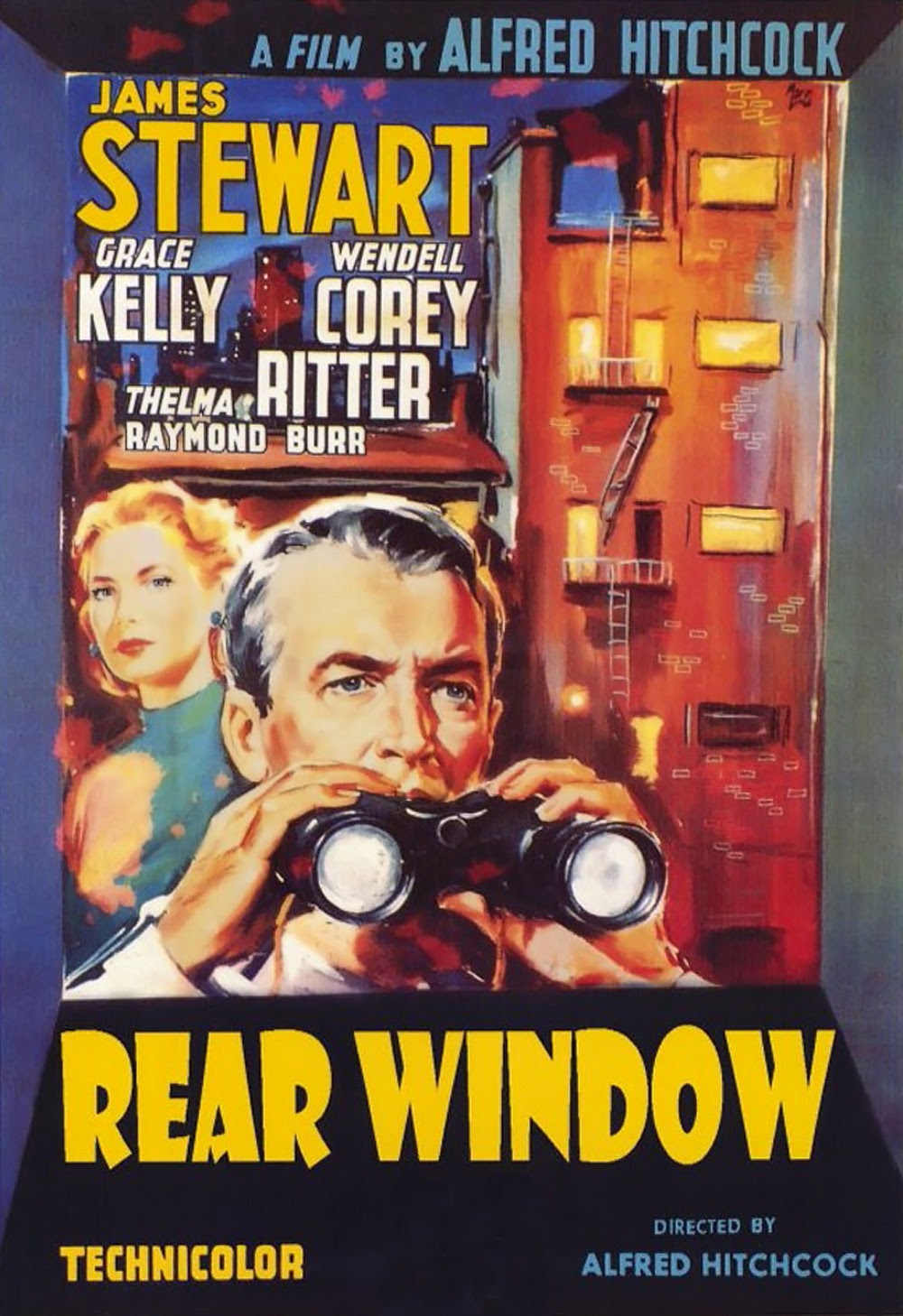
Rear window 1954 - Hitchcock's masterpiece in voyeurism


IMDB Link
IMDB Rating: 8,6


Director: Alfred Hitchcock
Main Cast: James Stewart, Grace Kelly, Wendell Corey, Thelma Ritter, Raymond Burr


"One of Alfred Hitchcock's very best efforts, Rear Window is a crackling suspense film that also ranks with Michael Powell's Peeping Tom (1960) as one of the movies' most trenchant dissections of voyeurism.
On the surface a comic thriller about a photographer and the crime he thinks took place across the courtyard, Alfred Hitchcock's Rear Window (1954) turns into an interrogation of voyeurism and movie-viewing. Keeping the camera in Jeff's apartment (except for a couple of shots near the climax), Hitchcock limits the audience's view to what Jeff can see and hear from his immobilized perch. He is free to take in the spectacle of the events in the apartments that he sees, but he is powerless to intervene. Why he looks, however, is the larger question; Hitchcock suggests not just that Jeff is channel-surfing among apartments for idle entertainment but also that the urge to peep is a more universal trait than we might care to acknowledge. What Jeff finds, moreover, becomes a fantasy projection of his own fears about his own relationship with Lisa. Jeff becomes a voyeur to escape, but his gaze is literally - and violently - turned back on him by the suspected wife-killer in his thriller narrative. Wryly entertaining as well as skillfully executed and thematically complex, the popular Rear Window earned Hitchcock an Oscar nomination for Best Director and inspired such later films as Francis Ford Coppola's The Conversation (1974) and Brian De Palma's Sisters (1973). It was remade in 1998 as a TV movie with Christopher Reeve in the James Stewart role." - www.allmovie.com

DVD links:


Saturday, May 31, 2014

Strangers on a train 1951 - Compelling and stunning thriller masterpiece


IMDB Link
IMDB rating: 8,1


Director: Alfred Hitchcock
Main Cast: Farley Granger, Ruth Roman, Robert Walker, Leo G. Carroll, Patricia Hitchcock


"From the opening shots of two pairs of shoes walking, two train tracks crisscrossing, and those shoes accidentally bumping toes, Alfred Hitchcock's Strangers on a Train explores one of his signature concerns: the coexistence of good and evil in one person. In a story adapted from Patricia Highsmith's novel and structured through a series of doublings, Robert Walker's Bruno becomes the flamboyant homicidal id to Farley Granger's stiff arriviste Guy, obliging Guy's desire to eliminate his wife and expecting Guy to return the favor with Bruno's father. After the murder, dreamily reflected in a pair of eyeglasses, Bruno haunts Guy, menacingly popping into Guy's life in Washington and on the tennis court. Yet, with Walker's charisma and Granger's weakness, Bruno is the more charming figure, revealing the appeal of moral chaos even as that chaos must be punished. Hitchcock's persistent pairs - shoes, train tracks, crossed tennis racquets on Guy's lighter, two fateful carnival trips, two bespectacled women - point to the ineffable connection between Bruno and Guy, and the (literally) dark psychosis that lurks beneath everyone's bright, well-ordered surface. A popular success, Strangers on a Train was Hitchcock's return to form after several failures." - www.allmovie.com

DVD links:


Friday, May 9, 2014

Notorious 1946 - Hitchcock's visual masterpiece


IMDB Link
IMDB rating: 8,1


Director: Alfred Hitchcock
Main Cast: Cary Grant, Ingrid Bergman, Claude Rains, Louis Calhern


"One of Alfred Hitchcock's greatest films, Notorious features the director at his devilishly elegant, self-assured best. The film's smooth veneer largely creates its visceral impact; lurking beneath the gloss are dealings of the most grotesque sort, their execution made all the more insidious by their sophisticated guise. Aside from containing one of Hitchcock's most famous MacGuffins, the uranium ore, Notorious boasts some of his most famous camerawork, most notably the gorgeous tracking shot during Sebastian's party that takes the viewer from the top of a staircase to Alicia's hand, clenched around the key that will lead her to the uranium ore. The camera moves with the quiet intimacy of an unobserved party guest, almost serpentine in its journey. Similarly ingenious is Hitchcock's use of point-of-view shots, particularly that of Alicia's waking up with a hangover and watching Devlin walk toward her as the camera spins 180 degrees. Seeing through Alicia's eyes, the audience sympathizes with her, making the character one of Hitchcock's most full-blooded and enduring heroines. It goes without saying that the success of Alicia's characterization is in no small part due to Ingrid Bergman's performance; tragic, lovelorn, and marked by logical cynicism, her portrayal of Alicia was one of the best of Bergman's career. She was ably supported by Cary Grant and Claude Rains, the former going against his likeable, effortlessly charismatic persona to play an initially charmless man with morals as questionable as the heroine's are supposed to be. Rains, paired with Bergman again after Casablanca, makes Sebastian into one of the film's more sympathetic characters; it is a mark of Rains' ability that when Sebastian turns to climb the stairs in the film's closing scene, we feel real terror for him. That Sebastian's fate is the result of both his own manipulations of others and his heart's manipulations of himself is at the center of the film's true MacGuffin: masquerading as a Cold War thriller, Notorious is one of the screen's classic black romances." - www.allmovie.com

DVD links:


Monday, April 28, 2014

Shadow of a doubt 1943 - Hitchcock's personal favorite


IMDB Link
IMDB rating: 8,0


Director: Alfred Hitchcock
Main Cast: Teresa Wright, Joseph Cotten, Macdonald Carey, Henry Travers, Patricia Collinge, Hume Cronyn


"One of Hitchcock's best films of the 1940s, Shadow of a Doubt is both a fascinating psychological case study and a scathing portrait of the American middle-class family. The film is often considered one of Hitchcock's darkest, and the director himself reportedly claimed it as his favorite. Cynicism underlies all the proceedings, from young Charlie's 'miraculous' summoning of her Uncle Charlie (tantamount to calling up the Angel of Death) to Uncle Charlie's chilling exposition of his view on life, relayed to his niece: 'You live in a dream. Do you know the world is a foul sty? Do you know if you ripped the fronts off houses you'd find swine? The world's a hell. What does it matter what happens in it?' This is one of Hitchcock's most unsettling films, preoccupied like many other Hitchcock works with good vs. evil, and the capacity for evil that lurks within us all; and it is also one of his most stylized, gorgeously shot by Joseph Valentine. Featuring stellar performances from Teresa Wright and Joseph Cotten (as well as Hume Cronyn's comical debut as a dim-witted, self-appointed murder 'expert'), Shadow of a Doubt is a memorable experience as both a major Hitchcock film and an enduringly creepy commentary on human nature." - www.allmovie.com

DVD links:


Wednesday, April 23, 2014

Rebecca 1940 - Hitchcock's hauntingly atmospheric masterpiece


IMDB Link
IMDB rating: 8,3


Director: Alfred Hitchcock
Main Cast: Laurence Olivier, Joan Fontaine, George Sanders, Judith Anderson, Nigel Bruce, Reginald Denny, C. Aubrey Smith, Gladys Cooper


"Producer David O. Selznick's 's second consecutive Best Picture (after the previous year's Gone With the Wind) and another enormously popular adaptation of a bestseller, this adaptation of Daphne du Maurier's novel was also the first American film directed by Alfred Hitchcock. Screenwriters Robert E. Sherwood and Joan Harrison recreated du Maurier's novel precisely, complete with the ideal casting of new star Laurence Olivier as brooding Maxim de Winter and insecure neophyte Joan Fontaine as his timid new bride. Rebecca displayed Hitchcock's unparalleled talent for ominous atmosphere, as he derived suspense from the clash between Fontaine and Judith Anderson's coldly sadistic, Rebecca-obsessed Mrs. Danvers. The elaborately appointed Manderley mansion became a character in itself, with Rebecca's expressively lit, diaphanously curtained bedroom, overlooking a suitably wild ocean, evoking her all-consuming absent presence.
Selznick's and Hitchcock's attention to detail paid off with eleven Oscar nominations, including Best Director, Best Actor, Best Actress, and Best Supporting Actress, and it won the top prize as well as an award for George Barnes's cinematography. David O. Selznick had the final cut of the picture, which was drastically altered from Hitchcock's original vision." - www.allmovie.com

DVD links:


Monday, April 2, 2012

Rich and strange 1931 - One of Hitchcock's best early talkies

Joan Barry in Rich and Strange (1931)


IMDB Link
IMDB rating: 6,0


Director: Alfred Hitchcock
Main Cast: Henry Kendall, Joan Barry, Percy Marmont, Betty Amann, Elsie Randolph


"Rich and Strange is an off-beat and interesting, if not totally successful, film. Clearly, devotees of Alfred Hitchcock will take to it more than average filmgoers; the latter will probably be disappointed to discover that it is not a thriller, as they might expect from the 'Master'. But if they can get over this disappointment, they will find much to appreciate, including a story that doesn't go exactly where one expects and an odd mixture of the comic and the melodramatic. True, Hitchcock doesn't blend these two styles seamlessly, but that helps to give the film its unique impact. The film is schizophrenic in other ways, especially in its attempt to be both a silent film and a talkie, and this can be disconcerting; but it does allow the director to take advantage of the fluidity of the silent camera. (He also has a delightful time experimenting with a few new effects, such as making the words on a dinner menu fly off the page.) And the opening commuter sequence is a gem. Henry Kendall and Joan Barry are a bit wan as the leads; she in particular has a peculiar delivery, and he has several moments that grate, but they overall are adequate. Much better are Betty Amann as the gold digging princess and the wonderful Elsie Randolph, whose old lady is both annoying and strangely endearing. If the various components of Rich and Strange never really coalesce, the film is still intriguing and enjoyable.
Partly a sophisticated sex comedy, partly a grim seafaring melodrama, Rich and Strange had the negative effect of confusing the public in general and Hitchcock's fans in particular, and as a result the film, which remains one of Hitch's best early talkies, died at the box office." - www.allmovie.com

DVD links:


Thursday, February 9, 2012

The lady vanishes 1938 - The culmination of Hitchcock's British period


IMDB link: http://www.imdb.com/title/tt0030341/?ref_=fn_al_tt_1
IMDB rating: 8,0


Director: Alfred Hitchcock
Main Cast: Margaret Lockwood, Michael Redgrave, Paul Lukas, Dame May Whitty, Cecil Parker


"It's easy to forget, with all his successes, that Alfred Hitchcock's career suffered quite a few periods of commercial decline. Following his two international breakthroughs, The Man Who Knew Too Much (1934) and The 39 Steps (1935), the director produced three films with relatively disappointing box-office returns. In 1938, he broke out of this slump with the popular and entertaining The Lady Vanishes. The director's penultimate movie before leaving England, it's a very light picture, more dependent on comedy than almost any of his previous films. A good deal of the humor comes from the interplay between the definitively British tourists Charters and Caldicott, played indelibly by Basil Radford and Naunton Wayne, that the actors would reprise in several other films. Despite (or perhaps because of) its 'Englishness', The Lady Vanishes made quite a splash in America, securing Hitchcock a place in Hollywood. The charming script by Frank Launder and Sidney Gilliat was based on the popular Ethel Lina White novel, The Wheel Spins." - http://www.allmovie.com/movie/the-lady-vanishes-v28077/

DVD links:


Sunday, January 22, 2012

The 39 steps 1935 - The thriller that firmly established Hitchcock's reputation


IMDB link: http://www.imdb.com/title/tt0026029/
IMDB rating: 7,9


Director: Alfred Hitchcock
Main Cast: Robert Donat, Madeleine Carroll, Lucie Mannheim, Godfrey Tearle, Peggy Ashcroft, John Laurie


"This classic British thriller was one of Alfred Hitchcock's first major international successes, and it introduced a number of the stylistic and thematic elements that became hallmarks of his later work.
He'd already made three excellent thrillers - The lodger (1926), Blackmail (1929), and The man who knew too much (1934) - that had attracted considerable attention in America, but The 39 steps, as a piece of screencraft, assembled all the best elements in those widely scattered successes (spread across eight years of his career) between two covers in a way that riveted audiences and industry observers. It played exactly the way that British movies weren't supposed to: lively and piercingly funny, rather than stodgy and dignified; it was almost as much a comedy as a thriller, which was something new in any country's cinema; and it was almost as much a battle of the sexes in the jousting of its two leads (Robert Donat, Madeleine Carroll) as it was a quest by the hero to prove his innocence of a murder charge; by the end of the movie, we want to see not only how Richard Hanney proves his innocence but also how he and Pamela manage to stay together. Not coincidentally, The 39 steps was also the first of his major films in which Hitchcock ripped up and threw away most of the contents of the underlying source (a novel by John Buchan that had been a best-seller then and which has remained a perennially popular read ever since) - he later followed this practice in his subsequent treatments of Josephine Tey's A Shilling For Candles (as Young and innocent), Ethel Lina White's The Wheel Spins (as The lady vanishes), and Francis Beeding's The House of Dr. Edwardes (as Spellbound), among other literary properties. In the process, he struck a blow for the director as a creative voice in his own right, independent of and superior to the novelist (at least where actual screen adaptations were concerned), who might take one or two good ideas, a name or two, and perhaps a setting and a scene from a chapter and junk everything else, making it his own. In a time when producers and studios still occupied a place of cultural inferiority (even in their own minds) to the authors and publishers of the printed word, this was no small achievement, especially considering that it was done well and, thus, justified itself. So, in his own way, working within the thriller genre in The 39 steps, Hitchcock helped open the way for virtually every major director who came after him." - http://www.allmovie.com/movie/the-39-steps-v73696

DVD links:


Saturday, January 21, 2012

The man who knew too much 1934 - The international breakthrough for Hitchcock


IMDB link: http://www.imdb.com/title/tt0025452/?ref_=nv_sr_3
IMDB ratings: 6,9


Director: Alfred Hitchcock
Main Cast: Leslie Banks, Edna Best, Peter Lorre


"Though Alfred Hitchcock would remake the movie himself in 1956 with a bigger budget, the original 1934 version of The Man Who Knew Too Much is arguably a more historically significant and aesthetically interesting film. It was Hitchcock's first true international hit. Though he wouldn't have a major success in America until The Lady Vanishes, Man and the subsequent The 39 Steps helped establish the director's distinctive style and lay the groundwork for his popularity. Along with Hitchcock's trademark blend of suspense and humor and blurring of the normal and abnormal, the film also features his characteristically grand showpieces, most memorably the recreation of the true-life 'Sidney Street Siege' and the famous Albert Hall scene. The film was also significant as German actor Peter Lorre's first English-language part. Having fled Nazi Germany in 1933, Lorre had to learn his lines phonetically, but he steals the film as the cruel but melancholic bad guy, and his difficulties with English barely show. The actor would go on to give memorable turns in such notable Hollywood productions as Casablanca and The Maltese Falcon." - http://www.allmovie.com/movie/the-man-who-knew-too-much-v31107/

DVD links: