Have a good time learning about and watching these classic movies and if you can, buy the DVD! (You can keep movies alive and support this blog this way!)
DVD links will be added movie by movie - from where you can pick your own favorite one. (Isn't it wonderful to have your own?)
And please take a look at my other blogs too! (My Blog List below)

Search this blog

Showing posts with label 1954. Show all posts

Wednesday, October 29, 2014

Chikamatsu monogatari (The crucified lovers) 1954 - An essential tale of tragic romance


IMDB Link
IMDB Rating: 8,2


Director: Kenji Mizoguchi
Main Cast: Kazuo Hasegawa, Kyoko Kagawa, Eitaro Shindo, Eitaro Ozawa


"In the 1950s, Kenji Mizoguchi was on a roll. He won two successive Golden Lions at the Venice Film Festival - an unprecedented feat - and produced three unqualified masterpieces: Life of Oharu, Ugetsu, and Sansho Dayu. The Crucified Lovers, made the same year as Sansho, stands as Mizoguchi's last great film. For this film - about star-crossed lovers, based on a puppet play by Monzaemon Chikamatsu - he returns to familiar themes: avaricious, duplicitous men; pious, long-suffering women; and the cruel vagaries of fate. Unlike his previous postwar films, the lead male character, Mohei, does not seem consumed by greed, vengeance, or vanity. Yet compared to the purity and devotion of lead female - a near constant in Mizoguchi's oeuvre - Mohei still seems weak in comparison. The film unfolds with marvelous fluidity, gathering momentum until the lovers' gruesome end. The blissful smiles on the faces of Osan and Mohei as they are led to crucifixion is one of the most striking images in Mizoguchi's long catalogue. Technically, Mizoguchi fills this film with striking photography and elegant camera movement. Though perhaps lacking the lyricism of Ugetsu and the grandeur of Sansho Dayu, The Crucified Lovers is a breathtaking work." - www.allmovie.com

Download links:


La strada 1954 - Being among the most studied films of late Italian Neo-Realism and a classic of the first rank.


IMDB Link
IMDB Rating: 8,1


Director: Federico Fellini
Main Cast: Anthony Quinn, Giulietta Masina, Richard Basehart


"La Strada is often considered one of the masterpieces of 20th century filmmaking, a sad and poignant remembrance of innocence lost and of the roads that each of us must choose. As with much of the work of director Federico Fellini, man is viewed as suspended between the heavens and the earth, adroitly symbolized here by Il Matto/The Fool (Richard Baseheart), a high-wire circus performer. Fellini's motifs are among the most influential of all post-WWII filmmakers. Giulietta Masina's Chaplin-like Gelsomina is among the screen's most poignant and tragic performances, and she, like the entire film, is aided by Nino Rota's evocative score. The bubbly, waiflike Gelsomina is a simpleton sold to the gruff, bullying circus strongman Zampanò (Anthony Quinn) as a servant and assistant. Treated no better than an animal, Gelsomina nonetheless falls in love with the brute Zampano. When they join a small circus they meet Il Matto (Richard Basehart), a clown who enchants Gelsomina and relentlessly taunts Zampanograve;, whose inability to control his hatred of Il Matto (literally, "the Fool") leads to their expulsion from the circus and eventually to the film's fateful conclusion. Masina is heartbreaking as the wide-eyed innocent, whose generous spirit and love of life leads her to try to "save" Quinn's unfeeling, brutal Zampanò. Though the film resonates with mythic and biblical dimensions, Fellini never loses sight of his characters, lovingly painted in all their frailties and failings. Fellini's lyrical style reaches back to the simple beauty of his neorealist films and looks ahead to the impressionistic fantasies of later films, but at this unique period in Fellini's career, they combine to create a poetic, tragic masterpiece.
The movie was the winner of the first official Academy Award for Best Foreign-Language Film, awarded in 1956."

DVD links:


Sansho dayu (Sansho the bailiff) 1954 - An unforgettably sad story of social injustice, family love, and personal sacrifice


IMDB Link
IMDB Rating: 8,3


Director: Kenji Mizoguchi
Main Cast: Kinuyo Tanaka, Yoshiaki Hanayagi, Kyoko Kagawa, Eitaro Shindo


"On its French release in 1960, Sansho the Bailiff was ranked by Cahiers du cinéma as the best film of the year, topping such classics as Breathless, L'avventura, and Psycho. Critics were struck by the film's gorgeous photography, elegant camerawork, and exotic settings and by Kenji Mizoguchi's signature use of imagery that quietly evokes a spiritual transcendence above the suffering of the material world. Unlike Akira Kurosawa's frequent use of close-ups and fast-paced editing, Mizoguchi, here as elsewhere, keeps his camera distant and his takes long, resulting in a contemplative style in which the characters' suffering and pain seem vivid, yet small compared with the immutability of the landscape. The result is a film that is thoroughly engaging up to its devastating finale. Though it was initially more popular in the West than in Japan, this masterpiece has since been widely recognized as one of Mizoguchi's most beautiful works.
The subjugated plight of women in Japanese society was always a subject close to Mizoguchi's heart--never more so than in Sansho Dayu, one of the towering late masterpieces of his final years. Its intensity, compassion, dramatic sweep and breathtaking formal beauty place it among his greatest films. The story is set in the harsh feudal world of 11th-century Japan. A provincial governor is demoted and exiled for showing too much clemency to those he rules; travelling to join him, his wife is kidnapped and forced to become a courtesan and her children are sold into slavery. They grow up under the harsh regime of the bailiff Sansho while their mother (the great actress Kinuyo Tanaka, in a performance of heartbreaking desolation) yearns hopelessly for them. Working with his favourite cameraman, Kazuo Miyagawa, Mizoguchi films this tragic story in long, intricate takes, rarely resorting to close-ups. The visual elegance and formal restraint of his style make the film all the more emotionally harrowing, and the final scene, on a desolate and windswept island, must be one of the most unbearably moving endings in all cinema."

Download links:


Shichinin no samurai (Seven Samurai) 1954 - Unanimously hailed as one of cinema's greatest masterpieces


IMDB Link
IMDB Rating: 8,7


Director: Akira Kurosawa
Main Cast: Toshiro Mifune, Takashi Shimura, Keiko Tsushima, Yukiko Shimazaki, Daisuke Kato


"Widely considered one of the greatest films ever made, Seven Samurai was both the apex of Akira Kurosawa's long career and the high-water mark of the Japanese period drama. The film's action rivets the viewer in spite of the three-hour-plus running time: the battle sequences, among the best ever filmed, are immediate and visceral; and the characters are complex and so well-rendered that the viewer grieves when one dies. Like few other historical films, it captures not only the physical look of the time but also its essence. Like Jean Renoir's masterpieces Grand Illusion (1937) and The Rules of the Game (1939), Seven Samurai illustrates the collapse of social distinctions and the growing irrelevance of old traditions in dangerous and chaotic times. Kurosawa questions the division between samurai and bandit, between good and evil. In one scene, peasant-born Kikuchiyo heatedly argues that the samurai have been abusing and exploiting the peasants for centuries. In this framework, the samurais' acts of bravery, selflessness, and honor seem absurd, if not pointless. The peasants' choice of the samurai over the bandits is merely one of a lesser evil. Once the bandits are gone, the samurai will no longer be needed. This is underscored in the film's poignant end, when the surviving three samurai leave the village, receiving neither acclaim nor reward, as the villagers plant rice. American audiences were so impressed with Kurosawa's epic masterpiece that it was remade into John Sturges' Magnificent Seven (1960)." - www.allmovie.com

DVD links:


Tuesday, October 28, 2014

Johnny Guitar 1954 - An unusual Western with much sexual symbolism


IMDB Link
IMDB Rating: 7,7


Director: Nicholas Ray
Main Cast: Joan Crawford, Sterling Hayden, Mercedes McCambridge, Scott Brady, Ward Bond, Ben Cooper, Ernest Borgnine, John Carradine


"Few Westerns more obviously begged the question 'What was the studio thinking?' than Nicholas Ray's brilliantly perverse Johnny Guitar. Ray had a knack for finding subversive subtexts in standard material, and on the surface Johnny Guitar's outlaws on the run, factions battling over a town's future, and love and betrayal among the tumbleweeds seem like the stuff of a typical Western. But in Johnny Guitar, nearly all the men are unwilling or afraid to fight, the action is dominated by two aggressive women who hate each other (but are also oddly drawn to each other), the title character is at once the lover and the employee of the female lead, and her arch-rival is driven to near-psychotic hatred and violence by unrequited affection for a handsome outlaw. Lust rules nearly everyone in this film, and in ways that generally fall outside the boundaries of mainstream Hollywood's sexual economy; one look at Joan Crawford's butch Western outfit, complete with string tie, should be enough to signal that this isn't an ordinary sagebrush shoot-'em-up. Ray plays this saga of unusual appetites in a hyper-emotional style against a broad and colorful backdrop, and the result feels more like an opera than a Western, as Martin Scorsese has pointed out. Throw in an allegory of 1950s anti-Communist blacklisting, the bold visual style, Victor Young's moody score, and the con brio performances of Crawford, Mercedes McCambridge, and Sterling Hayden and you have a unique movie that's fascinating and entertaining throughout.
According to most sources, the animosity between Joan Crawford and Mercedes McCambridge was quite real, added several extra dimensions to their scenes together. Director Nicholas Ray and screenwriter Philip Yordan stuff the film with so much sexual symbolism that one wonders why they left out a train going into a tunnel. Ms. Crawford's vivid red-and-blue wardrobe scheme was later appropriated by Ray for James Dean in Rebel Without a Cause - with equally stunning results. In addition to the stars, Johnny Guitar is well stocked with reliable supporting players, including Ernest Borgnine, Ben Cooper, Royal Dano (superb as a consumptive, book-reading hired gun) and Paul Fix." - www.allmovie.com

DVD links:


Sabrina 1954 - Charming modern-day Cinderella story


IMDB Link
IMDB Rating: 7,8


Director: Billy Wilder
Main Cast: Humphrey Bogart, Audrey Hepburn, William Holden, Martha Hyer


"Billy Wilder's Sabrina has an explicit fairy-tale quality (it begins with the words 'once upon a time') that betrays its Cinderella roots. Based on Samuel Taylor's stage play, the movie suffers occasionally from feelings of staginess and windiness. It is, at times, obviously formulaic and predictable, but such is the nature of most romantic comedies. Audrey Hepburn's naïf-like vulnerability and angelic beauty make her the perfect fit for the part; her natural elegance, playfulness, and intelligence have the audience cheerfully manipulated into applauding her elevation from rags to riches. Humphrey Bogart (in a part originally intended for Cary Grant) plays against type as the romantic lead who knows the price of everything, but has no concept of the value of love. His character, Linus Larrabee, not Sabrina, is the real protagonist of the piece, as it is his big decisions and personal growth that key the movie's action and resolution. William Holden is well cast as the debonair and wanton playboy. While Bogie and Hepburn don't rank up there with Bogie and Bacall on the chemistry meter, both are incessantly charming. Sabrina is not as insightful or cutting as Wilder's best work, but the snappy and witty banter, which is marked by droll double entendres, help to elevate the film above standard entrants in this genre. The film was nominated for six Academy Awards, but ended up winning only one, for Edith Head's costume design." - www.allmovie.com

DVD links:


A star is born 1954 - Judy's triumph from beginning to end


IMDB Link
IMDB Rating: 7,8


Director: George Cukor
Main Cast: Judy Garland, James Mason, Jack Carson, Charles Bickford, Tommy Noonan, Amanda Blake


"The 1954 musical remake of A Star is Born could have been titled A Star is Reborn, in that it represented the triumphal return to the screen of Judy Garland after a four-year absence. The remake adheres closely to the plotline of the 1937 original: An alcoholic film star, on his last professional legs, gives a career boost to a unknown aspiring actress. The two marry, whereupon her fame and fortune rises while his spirals sharply downward. Unable to accept this, the male star crawls deeper into the bottle. The wife tearfully decides to give up her own career to care for her husband. To spare her this fate, the husband chivalrously commits suicide. His wife is inconsolable at first, but is urged to go 'on with the show' in memory of her late husband.
To make room for the songs, several supporting characters from the 1937 version were eliminated. The result is a film that, despite the increased length, has less story-telling richness, though the deficiency is compensated by Garland's superb performance.
What truly sets the 1954 A Star is Born apart from other films of its ilk is its magnificent musical score by Harold Arlen and Ira Gershwin. The songs include The Man Who Got Away (brilliantly performed by Garland in one long take, sans dubbing), It's a New World, Somewhere There's a Someone, I Was Born in a Trunk, Lose That Long Face and Gotta Have Me Go With You. When originally previewed in 1954, the film ran well over three hours, thanks to the lengthy-and thoroughly disposable-Born in a Trunk number, added to the film as an afterthought without the approval or participation of director George Cukor. The Warner Bros. executives trimmed the film to 154 minutes, eliminating three top-rank musical numbers and several crucial expository sequences (including Norman's proposal to Vicki). At the instigation of the late film historian Ronald Haver, the full version was painstakingly restored in 1983, with outtakes and still photos bridging the 'lost' footage. Despite the efforts of restoration experts, there are today no complete prints of the original release version. Judy Garland benefits from the increased emphasis on her character, and the film is far more of a star vehicle for her than was the original for Janet Gaynor. Though nominated in several categories, A Star is Born was left empty-handed at Academy Award time, an oversight that caused outrage then and still rankles Judy Garland fans to this day. (Hedda Hopper later reported that her loss to Grace Kelly for The Country Girl (1954) was the result of the closest Oscar vote up till that time that didn't end in a tie, with just six votes separating the two.)" - www.allmovie.com

DVD links:


On the waterfront 1954 - "I coulda been a contender. I coulda been somebody"


IMDB Link
IMDB Rating: 8,3


Director: Elia Kazan
Main Cast: Marlon Brando, Karl Malden, Lee J. Cobb, Rod Steiger, Eva Marie Saint


"Arguably the best movie ever released by Columbia Pictures and among the finest movies ever made in America, On the Waterfront's reputation has only grown across the decades since its release. Based on a series of articles about corruption on the New York/New Jersey docks, with a story and screenplay by Budd Schulberg (who also wrote a novel, Waterfront, to tell the story without the compromises necessary for the screenplay), the movie - directed by Elia Kazan - retains the feel of truth from the first frame to the last, down to the smallest nuances of the supporting players.
The acting in On the Waterfront has the aura of truth, and the decision to shoot on location in northern New Jersey gave the film the immediacy and realism of a documentary. Into that mix goes Leonard Bernstein's music (his only film score), which anticipates elements of West Side Story and, in its editing and mixing into the audio track, imparts a very subtle operatic quality to the otherwise hyper-realistic film. Just check out the interaction of the visuals and the music in the scene depicting the fight at the morning shape-up, especially the build up to the horn flourish at the moment when Terry's friend points out that he's fighting with Joey Doyle's sister. The film is an extraordinary mix of elements both coarse and refined - harsh realism and art at its most quietly elegant - in a coherent and compelling whole that still holds up more than a half century later.
Featuring Brando's famous 'I coulda been a contendah' speech, On the Waterfront has often been seen as an allegory of 'naming names' against suspected Communists during the anti-Communist investigations of the 1950s. Director Elia Kazan famously informed on suspected Communists before a government committee - unlike many of his colleagues, some of whom went to prison for refusing to 'name names' and many more of whom were blacklisted from working in the film industry for many years to come - and Budd Schulberg's screenplay has often been read as an elaborate defense of the informer's position.
On the Waterfront won Oscars for Best Picture, Best Director, Best Adapted Screenplay, Best Actor for Brando, Best Supporting Actress for Saint, Best Cinematography, Best Art Direction, and Best Editing." - www.allmovie.com

DVD links:


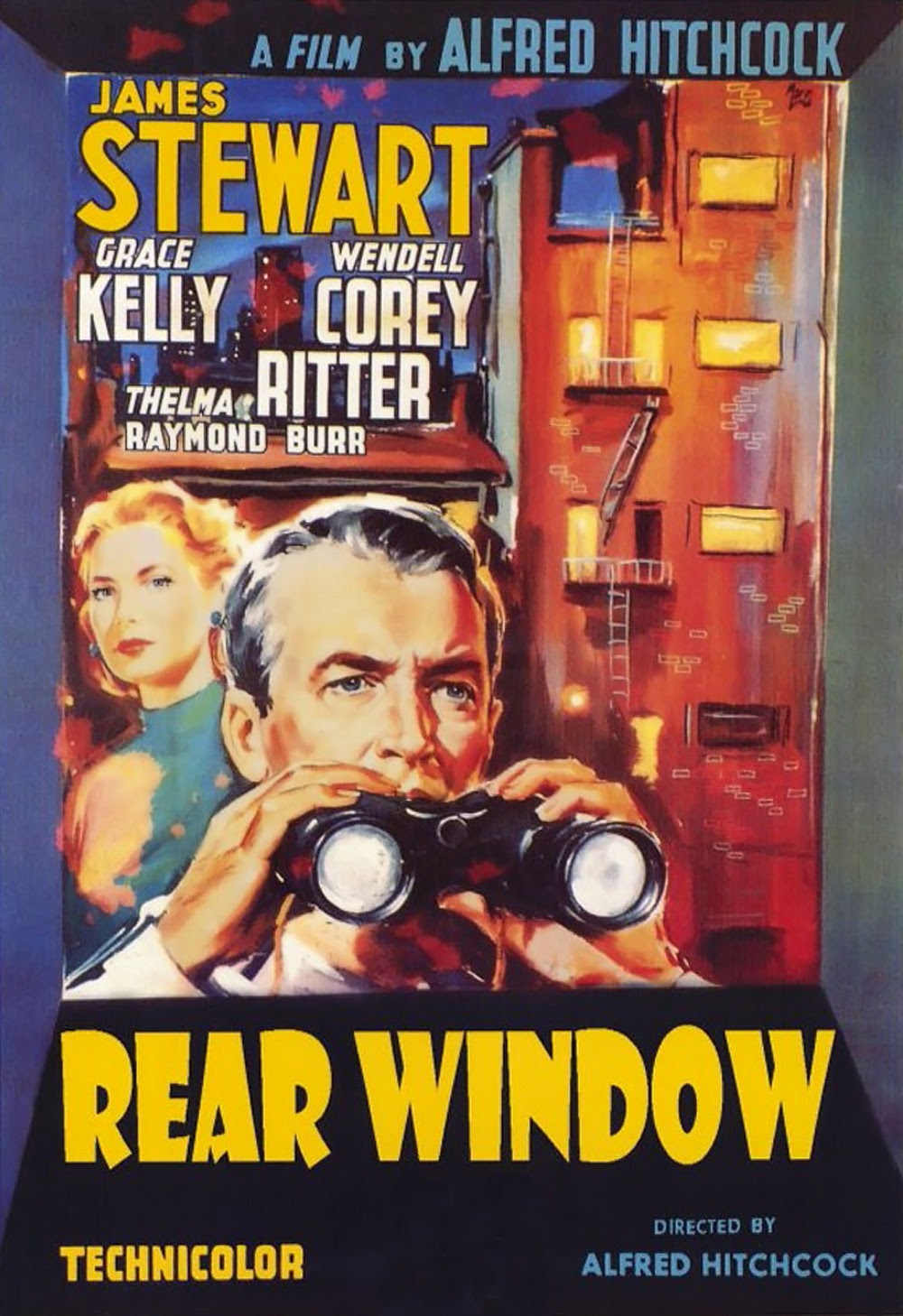
Rear window 1954 - Hitchcock's masterpiece in voyeurism


IMDB Link
IMDB Rating: 8,6


Director: Alfred Hitchcock
Main Cast: James Stewart, Grace Kelly, Wendell Corey, Thelma Ritter, Raymond Burr


"One of Alfred Hitchcock's very best efforts, Rear Window is a crackling suspense film that also ranks with Michael Powell's Peeping Tom (1960) as one of the movies' most trenchant dissections of voyeurism.
On the surface a comic thriller about a photographer and the crime he thinks took place across the courtyard, Alfred Hitchcock's Rear Window (1954) turns into an interrogation of voyeurism and movie-viewing. Keeping the camera in Jeff's apartment (except for a couple of shots near the climax), Hitchcock limits the audience's view to what Jeff can see and hear from his immobilized perch. He is free to take in the spectacle of the events in the apartments that he sees, but he is powerless to intervene. Why he looks, however, is the larger question; Hitchcock suggests not just that Jeff is channel-surfing among apartments for idle entertainment but also that the urge to peep is a more universal trait than we might care to acknowledge. What Jeff finds, moreover, becomes a fantasy projection of his own fears about his own relationship with Lisa. Jeff becomes a voyeur to escape, but his gaze is literally - and violently - turned back on him by the suspected wife-killer in his thriller narrative. Wryly entertaining as well as skillfully executed and thematically complex, the popular Rear Window earned Hitchcock an Oscar nomination for Best Director and inspired such later films as Francis Ford Coppola's The Conversation (1974) and Brian De Palma's Sisters (1973). It was remade in 1998 as a TV movie with Christopher Reeve in the James Stewart role." - www.allmovie.com

DVD links: