Have a good time learning about and watching these classic movies and if you can, buy the DVD! (You can keep movies alive and support this blog this way!)
DVD links will be added movie by movie - from where you can pick your own favorite one. (Isn't it wonderful to have your own?)
And please take a look at my other blogs too! (My Blog List below)

Search this blog

Showing posts with label john ford. Show all posts

Monday, November 3, 2014

The searchers 1956 - Ford's masterpiece, Wayne's definitive role


IMDB Link
IMDB Rating: 8,0


Director: John Ford
Main Cast: John Wayne, Jeffrey Hunter, Vera Miles, Ward Bond, Natalie Wood, John Qualen


"If John Ford is the greatest Western director, The Searchers is arguably his greatest film, at once a grand outdoor spectacle like such Ford classics as She Wore a Yellow Ribbon (1949) and Rio Grande (1950) and a film about one man's troubling moral codes, a big-screen adventure of the 1950s that anticipated the complex themes and characters that would dominate the 1970s.
Described by the director as a 'psychological epic', The Searchers (1956) is John Ford's most revered Western, for its visual richness and profoundly ambiguous critique of the genre's (and America's) racism. Ford pushed John Wayne's archetypal Westerner into the realm of antiheroism, as Ethan's five-year quest to rescue his niece from Comanche chief Scar mutates into killing her when he discovers her living placidly as Scar's bride. While Ethan's lethal racism signals his insanity, Wayne's charismatic presence and Ethan's desire to salvage the family unit of 'civilized' settlers carries its own sheen of Western heroism. Still, the famous final image of Ethan's departure into the desert reveals that 'civilization' has no place for such an uncompromising figure.
Shot on location in Colorado and Monument Valley, Ford's vividly arid Technicolor vistas render Ethan a man of the magnificent and punishing landscape, unable to reconcile his inner savagery with domestic constraints. Greeted in America as just another quality Ford oater, the film was first reclaimed by French critics for the unresolved tensions and evocative style of Ford's narrative, elevating it to the status of cinematic art.
John Wayne gives perhaps his finest performance in a role that predated screen antiheroes of the 1970s; by the film's conclusion, his single-minded obsession seems less like heroism and more like madness. Wayne bravely refuses to soft-pedal Ethan's ugly side, and the result is a remarkable portrait of a man incapable of answering to anyone but himself, who ultimately has more in common with his despised Indians than with his more 'civilized' brethren. Natalie Wood is striking in her brief role as the 16-year-old Debbie, lost between two worlds, and Winton C. Hoch's Technicolor photography captures Monument Valley's savage beauty with subtle grace.
The Searchers paved the way for such revisionist Westerns as The Wild Bunch (1969) and McCabe & Mrs. Miller (1971), and its influence on movies from Taxi Driver (1976) to Close Encounters of the Third Kind (1977) and Star Wars (1977) testifies to its lasting importance." - www.allmovie.com

DVD links:


Friday, October 31, 2014

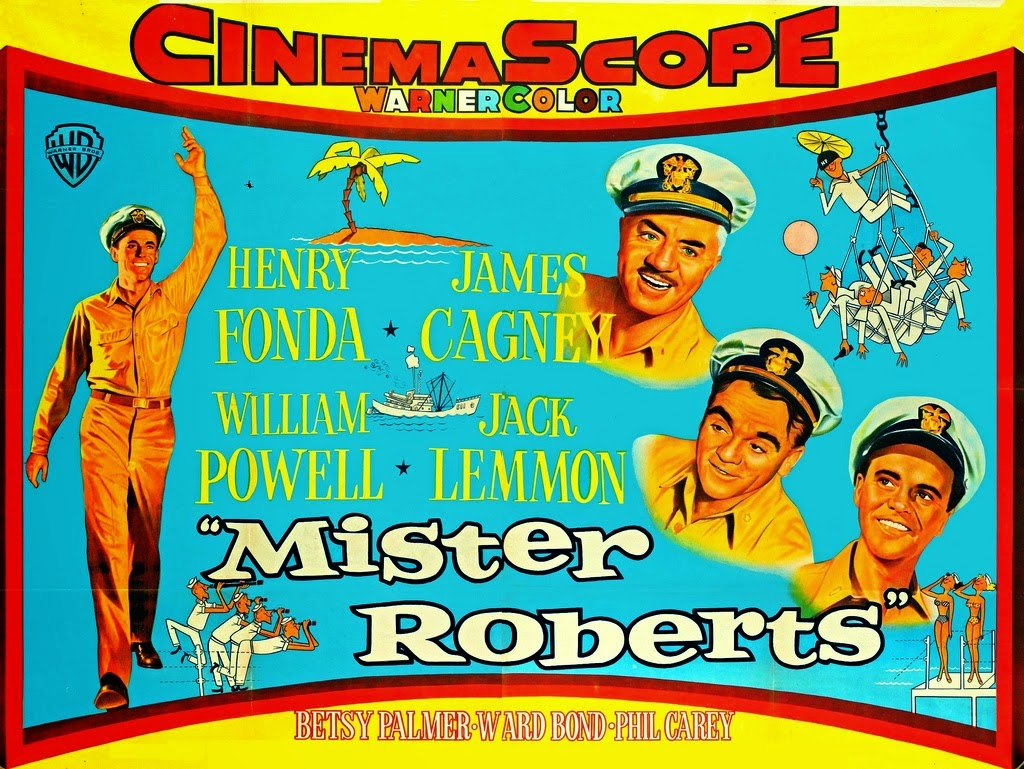
Mister Roberts 1955 - Petty tyranny and the man who fights it


IMDB Link
IMDB Rating: 7,9


Directors: John Ford, Mervyn LeRoy
Main Cast: Henry Fonda, James Cagney, William Powell, Jack Lemmon, Betsy Palmer, Ward Bond, Philip Carey


"Mister Roberts was one of the more thoughtful, reflective films from the 1950s to deal with World War II. It was a reflection of the distance filmmakers as well as the public had come from the war, a distance which allowed for a more sophisticated dramatic treatment of the conflict and the people involved. Other films during this era also reflected the new maturity, among them, The Caine Mutiny, Between Heaven and Hell, and The Naked and the Dead. Mister Roberts was the most successful of them all, and for good reason - though getting it made properly took real work. It stood to figure that John Ford was ideal for the project, since he loved the United States Navy more than almost anything else in his life (he retired from the reserves as a rear admiral). With Mister Roberts, however, Ford may have been too close to his subject to do justice to the script, and he butted up against the competing personality of star Henry Fonda. Fonda had scored a huge hit on Broadway in the stage version of Mister Roberts, but he'd given up hope of ever doing the movie, since he hadn't been on-screen in eight years and major studios weren't convinced that he was still a box office draw. As a condition of directing the film, Ford insisted on Fonda to star - but the two were at loggerheads from the beginning of the production, mainly over the director's tendency to inject rough-house comedy into his movies. Such an approach breathed life into Ford's somber cavalry movies, such as Fort Apache, but Mister Roberts was a character-driven story with very little real action, and Fonda thought the director's emphasis on laughs would destroy the integrity of the material. Ford's demanding, dictatorial directing style - exacerbated by his excessive drinking - created tension between the two, which erupted into a fistfight after only a few weeks' work. Ford left the production and was replaced by Mervyn LeRoy, who essentially asked the cast to use their best judgement and make the kind of movie Ford would've made. The end result is a finely textured character study that captured the best dramatic moments of the play as it interspersed an effective, new comic element. Fonda, who'd previously performed in four films for the director, would never work with Ford again; the director would only make one more navy film after Mister Roberts, the successful Donovan's Reef.
One of the finest service comedies ever made, Mister Roberts spawned a less amusing sequel, Ensign Pulver (1964), as well as a 1965 TV sitcom." - www.allmovie.com

DVD links:


Wednesday, June 4, 2014

The quiet man 1952 - A delightful romantic comedy made with love


IMDB Link
IMDB rating: 8,0


Director: John Ford
Main Cast: John Wayne, Maureen O'Hara, Barry Fitzgerald, Ward Bond, Victor McLaglen, Mildred Natwick


"The last of four films for which John Ford would win Best Director, The Quiet Man is a charming romantic comedy from a man best known for his somber Westerns. Many consider it his best-loved film; it was certainly one of Ford's favorites, and he considered it some of his most personal work. The director had trouble funding the production, and the notoriously cheap Republic Pictures eventually financed the film. Even with a relatively small budget, however, Ford was able to shoot on location in Ireland and produce a fabulous-looking color film. John Wayne turns in an amiable performance, exhibiting a diversity often overlooked in considerations of the actor's work. The supporting cast, including Maureen O'Hara, Victor McLaglen, and Barry Fitzgerald, is equally good. Quiet Man was the first high-profile film made in Ireland, and some viewers today may consider the portrayal of the Irish stereotypical. In addition to Ford's win, the cinematography by Winton Hoch and Archie J. Stout was recognized with an Academy Award." - www.allmovie.com

DVD links:


Friday, May 9, 2014

My darling Clementine 1946 - One of the greatest classic Westerns, but an idealized version of the shootout at OK Corral


IMDB Link
IMDB rating: 7,8


Director: John Ford
Main Cast: Henry Fonda, Linda Darnell, Victor Mature, Cathy Downs, Walter Brennan, Tim Holt


"One of the greatest movie Westerns, John Ford's My Darling Clementine is hardly the most accurate film version of the Wyatt Earp legend, but it is still one of the most entertaining. Shot on location in Monument Valley in crisp, deep-focus black-and-white, the film opens as Henry Fonda's upstanding yet slightly (and humorously) awkward Wyatt Earp arrives in Tombstone to settle a family score with the murderous Clantons, staying long enough to make the untamed town safe for the new church and schoolmarm-to-be Clementine and enable corrupt, tubercular Easterner Doc Holliday to find a bit of redemption. Yet even as Ford celebrates the possibilities of the new West, he also engages the post-war tendency for Westerns to examine their own myths: for instance, in the expressionistic photography and in Earp's contradictory place between civilization and the wilderness. He knows the way Tombstone ought to be, but he can't settle there himself; the final shootout begins as an orderly ritual but becomes a chaotic montage of death. The 'director's cut' discovered in 1994 contains several minutes of excised footage; the ending was reportedly changed due to the reaction of a 1946 preview audience." - www.allmovie.com

DVD links:


Friday, April 25, 2014

How green was my valley 1941 - The classic masterpiece of John Ford


IMDB Link
IMDB rating: 7,9


Director: John Ford
Main Cast: Walter Pidgeon, Maureen O'Hara, Anna Lee, Donald Crisp, Roddy McDowall, John Loder, Sarah Allgood, Barry Fitzgerald


"How Green Was My Valley is fondly remembered by fans of director John Ford for its loving recreation of a Welsh coal mining village. Spanning some fifty years in the life of its protagonist, the film presents an often poignant portrait of the good and bad of small town life. At the center of the story is the dehumanization brought by increasing technology; the scenes in which more efficient machinery makes some of the mines' best workers unneeded and unemployed remain relevant to today's audiences and our environment of shifting corporations and uncertain security. Ford scholars differ on where to rank How Green Was My Valley - indeed there is no clear consensus on what film critics and historians consider to be Ford's greatest - but it was a popular choice as the best film of 1941. Based on the novel of the same name by Richard Llewellyn, How Green Was My Valley won five Academy Awards in 1941, including Best Director, Best Supporting Actor (Crisp), Best Art Director, Best Cinematography, and Best Picture (beating Citizen Kane). The book was later adapted into a 1975 BBC miniseries." - www.allmovie.com

DVD links:


Wednesday, April 23, 2014

The grapes of wrath 1940 - A heartbreaking, compelling American classic


IMDB Link
IMDB rating: 8,2


Director: John Ford
Main Cast: Henry Fonda, Jane Darwell, John Carradine, Charley Grapewin, Dorris Bowdon


"John Ford's The Grapes of Wrath is arguably the director's greatest movie, and the rare Hollywood film superior to its literary source (a view shared by the novel's author, John Steinbeck). Indeed, it is the movie that sums up the impact of the Great Depression, at least on rural America, better than any other film of its time (and there were hundreds that tried, by everyone from Frank Capra to Preston Sturges). From the opening shot of Tom Joad's return to the ruined land where he grew up, the movie is a study of people whose dreams and hopes wither away like the drought-stricken crops. Yet Ford managed to make a movie that wasn't utterly pessimistic, despite its story and setting: the performers and script availed him of indomitable characters, convincingly portrayed, with the result that even the most cynical viewers were persuaded of Ford's artistic vision. Henry Fonda, who'd been an up-and-coming leading man, solidified his image as an upright hero with an almost mystical bent in his portrayal of Tom Joad; Jane Darwell became the archetypal rural matriarch; and even the bit players, such as Ward Bond and Grant Mitchell, got relatively rare opportunities to play against their usual types as beneficent characters. The movie became a strange case of fiction transcending fact, as Ford's images (photographed by the great cinematographer Gregg Toland) became more representative of the period than most documentary photography. Countless filmmakers have quoted from The Grapes of Wrath (there's a very funny audio-visual reference in Close Encounters of the Third Kind), and Ford himself never made a more compelling social statement despite several attempts (The Sun Shines Bright, Sergeant Rutledge, and others) over the next 20 years." - www.allmovie.com

DVD links:


Young Mr. Lincoln 1939 - Great Ford, great Fonda, authentic American film-making


IMDB Link
IMDB rating: 7,7


Director: John Ford
Main Cast: Henry Fonda, Alice Brady, Marjorie Weaver, Arleen Whelan, Eddie Collins, Pauline Moore


"More hagiography than biography, Young Mr. Lincoln took such outrageous liberties with historical fact that its value as a portrait of the nation's sixteenth president remains questionable. Nevertheless, the performance of Henry Fonda and the assured, fully engaged direction of John Ford placed Young Mr. Lincoln among both men's best work. Indeed, 1939 came to be regarded as Ford's annus mirabilis, the year in which he began his ascent to legend status, directing not only Young Mr. Lincoln but also Drums Along the Mohawk and Stagecoach. It is ironic that Young Mr. Lincoln came to be so well regarded, since neither Ford nor Fonda initially wanted to do the picture. A pair of plays about Lincoln's younger years had just enjoyed success on Broadway, so a reluctant Ford was pressured by Fox producer Darryl F. Zanuck to tackle what was essentially a studio assignment. On reading the script by Lamar Trotti, however, the zealously patriotic Ford became more enthusiastic about the film's all-American subject matter, even persuading a reluctant Fonda to take the lead role. Intimidated by playing such an august historical figure, Fonda at first rejected the part, but he changed his mind during a meeting in which Ford reportedly told the skittish star that he would be playing not 'the Great Emancipator' but 'a jack-legged lawyer from Springfield, Illinois - a gawky kid still wet behind the ears who rides a mule because he can't afford a horse'. When Ford clashed with Zanuck over the film's slow pace and grew fearful that the studio would ruin his film in post-production, he destroyed the negatives of every take he disliked and did in-camera editing. The studio disappointed Ford anyway, excising a scene in which Lincoln and a young John Wilkes Booth have a friendly encounter. Like that scene, most of Young Mr. Lincoln is pure Hollywood balderdash, resting on only the slimmest tissue of truth. For instance, the real murder trial depicted in the film was based not on one tried by Lincoln but on a real-life courtroom drama witnessed by Trotti, who had covered it as a reporter. Though it was not in any way an authoritative view of its subject, Young Mr. Lincoln was a masterpiece of cinema, showcasing a writer, director, and star at the top of their games. In a supreme irony, Young Mr. Lincoln was a major inspiration for master Soviet filmmaker Sergei Eisenstein in the creation of his propagandistic classic, Ivan the Terrible (1944)." - www.allmovie.com

DVD links:


Stagecoach 1939 - Lifting the Western genre and John Wayne up to A-movie status


IMDB Link
IMDB rating: 7,9


Director: John Ford
Main Cast: John Wayne, Claire Trevor, Andy Devine, John Carradine, Thomas Mitchell


"Although there were Westerns before it, Stagecoach quickly became a template for all movie Westerns to come. Director John Ford combined action, drama, humor, and a set of well-drawn characters in the story of a stagecoach set to leave Tonto, New Mexico for a distant settlement in Lordsburg, with a diverse set of passengers on board.
Relegated to B-movie status by the mid-1930s, the western was regenerated most prominently by John Ford's Stagecoach in 1939. Ford and screenwriter Dudley Nichols artfully balanced the genre's standard action with the character studies and quality production values of prestigious 1930s films. In the microcosm of the stagecoach, the confrontation between 'civilization' and 'savagery', Western future and Eastern past, is played out among characters journeying through hostile Apache territory, with honor-bound outlaw Ringo fighting valiantly for a society that shuns him. Though not the top-billed player, and then a B-movie actor, John Wayne as Ringo became the star hero from the moment that Ford introduces him with a rare kinetic flourish. Ford here introduced his signature Western setting of Monument Valley, lending Stagecoach a realism that set it apart from studio-bound films; and his deep focus interiors preceded Citizen Kane by two years. When he made Citizen Kane, Orson Welles claimed that he learned everything about directing movies from watching Stagecoach more than 40 times.
A critical and commercial success, Stagecoach offers plenty of cowboys, Indians, shootouts, and chases, aided by Yakima Canutt's remarkable stunt work and Bert Glennon's majestic photography of Ford's beloved Monument Valley. It also offers a strong screenplay by Dudley Nichols with plenty of room for the cast to show its stuff. John Wayne's performance made him a star after years as a B-Western leading man, and Thomas Mitchell won an Oscar for what could have been just another comic relief role. Thousands of films have followed Stagecoach's path, but no has ever improved on its formula." - www.allmovie.com

DVD links:


Saturday, April 12, 2014

Flesh 1932 - A lesson in love


IMDB Link
IMDB rating: 6,5


Director: John Ford
Main Cast: Wallace Beery, Ricardo Cortez, Karen Morley, Jean Hersholt


"Flesh was one of the few big-studio films to deal with the subject of professional wrestling - at least until Hulk Hogan came along in the 1980s. Wallace Beery stars as a thickheaded waiter in a German beer garden who uses his muscles to clear out rowdy patrons. Beery channels his strength into a wrestling career, grappling his way up to the championship. His wife Karen Morley enjoys the creature comforts of Beery's success, but her heart belongs to her ex-lover Ricardo Cortez, and soon Karen is stepping out on her husband. Beery finds out and exacts a terrible revenge on Cortez - just minutes after Karen wises up and realizes she loves Beery after all. John Ford directed Flesh in a heavy Germanic fashion reminiscent of the Emil Jannings 'cuckolded husband' melodramas of the 1920s." - www.allmovie.com

DVD links:


Thursday, April 12, 2012

Seas beneath 1931 - Visually interesting sea adventure


IMDB Link
IMDB rating: 5,7


Director: John Ford
Main Cast: George O'Brien, Marion Lessing, Mona Maris


"Seas Beneath is a rousing sea adventure from John Ford that takes place in the closing months of World War I. Largely unavailable for decades, Seas Beneath remains a solid and gritty war picture that is also guilty - like much of Ford's work - of idealizing history. About half of the film takes place in a Spanish port town, where German spies abound. These scenes suffer from a stasis probably dictated by the technical restrictions of the early sound era, but Ford injects them with a seediness and mysteriousness that makes them compelling nonetheless. When Seas Beneath really comes alive, however, is when Captain Kingsley and company leave port and embark on their cat-and-mouse game with the German U-boat. With the invaluable aid of some remarkable location camerawork (as well as the assistance of the U.S. Navy), Ford places the viewer into the center of the action, creating a sense of authenticity that makes these scenes all the more dramatic, and leading up to a stunning climactic sea battle. The battle scenes are the highlight of the picture, and some credit must go to the sound crew for capturing the intensity of the action as the U-boat bombards the schooner over and again while Kingsley waits for his chance to strike. Another valuable element to the film is Ford's wise decision to actually have the Germans speak German, with only a minimal use of intertitles to translate the more important dialogue. The cast is solid, especially Mona Maris as the seductive spy Lolita. Seas Beneath is not a classic, but it deserves to be far better known and more widely seen." - www.allmovie.com

Download links:


Tuesday, March 27, 2012

Arrowsmith 1931 - An early sound version of a Pulitzer Prize winning novel


IMDB Link
IMDB rating: 6,2


Director: John Ford
Main Cast: Ronald Colman, Helen Hayes, Richard Bennett, Myrna Loy


"One of the more prestigious films of its time, John Ford's film adaptation of Sinclair Lewis' Pulitzer Prize-winning novel has a sleek Art Deco look strangely out of tune with its tale of moral struggle. One of the director's most uncharacteristic projects, it was an enormous critical and commercial success, and although it remains an interesting film it's marred by an absence of clarity. In taking on the most complex protagonist he had attempted to date, Ford's film tries to balance a critique of the scientist's Faustian ambitions and hunger for glory with an awareness that the research he's doing is absolutely necessary. The film alternates uncertainly between condoning its protagonist's idealism and castigating his indifference to his wife, and the possible side effects of his work. Colman is also somewhat miscast, his characteristic suavity unable to accommodate the complexity of the driven, tormented physician. Helen Hayes easily handles the character of the long-suffering, possibly abused wife, and legendary stage actor Richard Bennett does the best work as the emphatic Sondelius. Particularly in the island sequence, Ford's stylized depth of focus work betrays the influence of Murnau, and his evocation of an undercurrent of paranoia in the face of the burgeoning disease is the film's most powerful effect." - www.allmovie.com

DVD links:


Sunday, March 4, 2012

Men without women 1930 - Sailors trapped in a sinking submarine

Men without women - shooting a sequence

Director: John Ford
Main Cast: Kenneth MacKenna, Frank Albertson, J. Farrell MacDonald, Stuart Erwin


"John Ford directed this undersea adventure from the early days of the sound era; it features talking sequences along silent passages with intertitles. After a brief shore leave in Singapore, where sailors have the opportunity to slake their thirsts for both liquor and women, the crew of a U.S. Navy S-13 submarine is ordered back to duty (with many still drunk) in hopes of getting into safer waters before rough weather hits. In the midst of a storm, the sub collides with a ship and starts to sink; the S-13 begins taking on water, which knocks out their radio equipment not long after they begin sending out distress signals. The sub has a limited amount of oxygen on board, and tempers begin to flare as the men begin to wonder who (if anyone) can survive if they are not rescued soon. Adding to this tension is the presence of torpedo launcher Burke (Kenneth MacKenna). The ship's commander, Weymouth (Charles Gerrard), thinks that Burke may actually be Quartermain, a British officer who was the enemy of Weymouth's best friend and was widely presumed to be dead after going missing in action. A young Frank Albertson plays the sub's ensign, and John Wayne has a small part as a radio operator." - http://www.allmovie.com/movie/men-without-women-v102131

Download links:


(695 MB, rar):

http://depositfiles.com/files/bpoypsswz 

Saturday, March 3, 2012

Born reckless 1930 - An early John Ford talkie with its flaws


IMDB link: http://www.imdb.com/title/tt0020702/?ref_=fn_al_tt_1
IMDB rating: 5,6


Directors: Andrew Bennison, John Ford
Main Cast: Edmund Lowe, Catherine Dale Owen, Frank Albertson, Marguerite Churchill, William Harrigan, Lee Tracy, Ilka Chase


"Born Reckless is a comic look, at a man who is at the fringes of gangdom. The film dances around the edges of the 'gangster picture' as a genre, without ever becoming a full-fledged gangster movie. The film is almost as much of a burlesque of the gangster genre, as Ford's next film Up the River will be of the prison movie.
Based on a true story, this drama profiles the experiences of a young gangster. After getting caught during a robbery, the gangster is given a choice: he can either go to prison or join the military. He chooses the military. However, when he returns home, he returns to gangster life. So the hero starts out as a crook: a member of a gang that commits burglaries. While technically thus a 'gangster', he never becomes a big time criminal, and never becomes involved in bootlegging or other typical activities of Al Capone era gangdom. And he keeps trying to get out of this world, during most of the picture.
Neither Born Reckless nor Ford approve of gangsters. Unlike most 'real' gangster movies, Born Reckless does not idolize or glorify gangsters. Instead, it views them in a negative and satirical light. Born Reckless is based on the novel Louis Beretti (1929) by Donald Henderson Clarke. By 1929, gang tales were popular in stage and prose fiction, as well as movies.
In his long career John Ford shared directorial credit in two other films, Mister Roberts and Young Cassidy. Both were considerably better than Born reckless. Andrew Bennison who was mostly a screenwriter was the co-director, presumably to help Ford over the bumps of the new sound media."

DVD links:


Sunday, February 19, 2012

Drums along the Mohawk 1939 - Three-strip Technicolor in all its glory!


IMDB link: http://www.imdb.com/title/tt0031252/?ref_=nv_sr_1
IMDB rating: 7,2


Director: John Ford
Main Cast: Henry Fonda, Claudette Colbert, Edna May Oliver, Eddie Collins, John Carradine


"The first of many collaborations between director John Ford and Henry Fonda, this fine, typically Fordian vision of community life also features the director's first use of the then recently developed Technicolor process. A visually appealing slice of Americana, the film places a youthful, yet stoic Fonda in a series of iconic poses as he and his new wife, an incongruously soigné Claudette Colbert struggle to maintain their farm during the outbreak of the Revolutionary War in the Indian-infested Mohawk Valley. As the farmers fight off Indian attacks, with the well-born Colbert learning to adapt to a difficult new environment, the director links self-sacrifice with heroism. As with much of Ford, the characters' behavior is concerned with the enactment of rituals and the display of pageantry, and the main characters, essentially types. He's more willing to allow the character actors, like Oscar-nominated Edna May Oliver, who plays a feisty widow, to indulge in some theatrics. Despite the hardships the farmers must endure, the film's bright look signals an optimism characteristic of the director during this period, perhaps addressing his Depression-era audience about the grit and cohesiveness required to survive in difficult times. 1939 was a stellar year for John Ford; along with this highly successful adventure tale, which was nominated for three Academy Awards, Ford also released the ground-breaking western Stagecoach." - http://www.allmovie.com/movie/drums-along-the-mohawk-v14871/

DVD links:


Monday, February 6, 2012

The hurricane 1937 - Classic South Sea adventure with terrific special effects


IMDB link: http://www.imdb.com/title/tt0029030/?ref_=nv_sr_2
IMDB rating: 7,3


Directors: John Ford, Stuart Heisler
Main Cast: Dorothy Lamour, John Hall, Mary Astor, C. Aubrey Smith, Thomas Mitchell, Raymond Massey


"Though dated and in places a bit silly, The Hurricane still gets high marks and comes out on top. Truth to tell, Hurricane would rate highly if for no other reason than because its climactic title sequence is one of the most stunning put on film. While listed as a John Ford film, this sequence was actually directed by Stuart Heisler (with the undeniable and invaluable help of special effects wizards James Basevi and R.O. Binger). Make no mistake about it: this sequence is a real humdinger. Even many decades later, it packs a real, thrilling punch. Now, things are not always so enthralling leading up to the hurricane; this is a film with definite ups and downs, and the melodramatic story is not always as engaging as you might wish. Too, the male lad, Jon Hall, though physically impressive, doesn't really convince as an island native. But the rest of the cast is solid, filled with notable players such as Thomas Mitchell, C. Aubrey Smith, Mary Astor, Raymond Massey and the eternally-saronged Dorothy Lamour. They keep your interest when the story sags here and there." - http://www.allmovie.com/movie/the-hurricane-v23941/

Download links:


Saturday, January 28, 2012

The prisoner of Shark Island 1936 - "Your name is mud!"


IMDB link: http://www.imdb.com/title/tt0028141/?ref_=fn_al_tt_1
IMDB rating: 7,4


Director: John Ford
Main Cast: Warner Baxter, Gloria Stuart


"The team of director John Ford, screenwriter Nunnally Johnson, and producer Darryl F. Zanuck was best remembered for its work on the classic The Grapes of Wrath (1940). Four years earlier, the same three men crafted the excellent The Prisoner of Shark Island (1936), memorable as Ford's only foray into docudrama. While much of the depiction of Dr. Samuel Mudd (Warner Baxter)'s relationship with his crusading wife (Gloria Stuart) was probably invention, the adherence to a mostly accurate historical viewpoint was unusual for Ford. The director's most successful forays into historical storytelling, such as Young Mr. Lincoln (1939) and My Darling Clementine (1946), liberally blended fact with fiction in films that bore little resemblance to reality. The Prisoner of Shark Island was the first of three Hollywood efforts to exonerate Mudd, the Maryland physician who was probably falsely accused of participating in the conspiracy to assassinate Abraham Lincoln in 1865; the other films were Hellgate (1952) and, for television, The Ordeal of Dr. Mudd (1980). In real life, Mudd earned an 1869 pardon from his valiant efforts to save fellow prisoners and captors during a yellow fever epidemic at the remote island fort in the Dry Tortugas where he was in captivity. However, Mudd, whose name gave birth to the insulting expression, 'your name is mud', was not pardoned for the crime he allegedly committed until nearly a hundred years after his death. That pardon owed no small debt to the trio of popular films that uniformly depicted him as an innocent victim of justice gone wrong." - http://www.allmovie.com/movie/the-prisoner-of-shark-island-v106712/


Download links:


The Prisoner of Shark Island by crazedigitalmovies

Monday, January 23, 2012

The informer 1935 - John Ford's labor of love


IMDB link: http://www.imdb.com/title/tt0026529/
IMDB rating: 7,6


Director: John Ford
Main Cast: Victor McLaglen, Heather Angel, Preston Foster, Margot Grahame, Wallace Ford, Una O'Connor


"The informer, Liam O'Flaherty's novel of the the Irish 'troubles' of the early 1920s, was first filmed in England in 1929, with Cyril McLaglen in the lead. When director John Ford remade The informer in 1935, the role of the tragic Irish roisterer Gypo Nolan went to Cyril's brother Victor McLaglen.
The informer was a box-office dud for John Ford, but it brought him his first Best Director Oscar and remains one of the most studied films of its era. The pathos created by the convincing performance of Victor McLaglen is made all the more intense by Ford's sensitive direction and Max Steiner's emotional score. Filmed in black-and-white and taking place mostly at night, The informer creates an effective atmosphere of desperation, as the sadness of the story takes hold on the audience, especially since the Irish struggle for independence remains a powerful current-day theme.
The informer earned Victor McLaglen an Oscar, as well as several other nominations; the film did poorly at the box office, but John Ford had anticipated this reaction, reportedly waiving his considerable salary just to make certain that picture - a labor of love for the director, who was himself a native of Ireland - would be completed." - http://www.allmovie.com/movie/the-informer-v24847

DVD links:


Saturday, January 21, 2012

Judge Priest 1934 - John Ford's immortal classic


IMDB link: http://www.imdb.com/title/tt0025335/?ref_=fn_al_tt_1
IMDB rating: 6,6


Director: John Ford
Main Cast: Will Rogers, Tom Brown, Anita Louise, David Landau, Rochelle Hudson, Hattie McDaniel


"Will Rogers stars as Judge William 'Billy' Priest, the common-sense Kentucky jurist created by humorist Irvin S. Cobb. The Judge's easygoing manner bothers many of the self-righteous good citizens of his small 19th-century hometown, imperiling his chances for re-election. The anecdotal plot boils down to a single storyline involving orphaned Anita Louise, reclusive David Landau (secretly Louise's father), and young attorney Tom Brown.The testimony that saves Landau from a murder charge is delivered by Civil War veteran H.B. Walthall, whose stirring loyalty to the Confederacy inspires everyone in town to organize an impromptu parade! Some of the best scenes are highlighted by Will Rogers' affectionate rapport with stereotyped black-actors Stepin Fetchit and Hattie McDaniel, though these scenes are frequently removed from TV showings of Judge Priest due to their undeniably racist overtones. If you haven't guessed by the first frame of the film that John Ford was the director, you'll recognize Ford's personal stamp the moment Will Rogers kneels by his wife's grave and carries on a warm conversation with his long-departed bride. Ford would remake (and improve upon) Judge Priest in 1953 as The Sun Shines Bright, with Charles Winninger as the judge." - http://www.allmovie.com/movie/judge-priest-v26670

DVD links:


Friday, December 16, 2011

The lost patrol 1934 - Ford's epic story of boiling passions


IMDB link: http://www.imdb.com/title/tt0025423/?ref_=fn_al_tt_2
IMDB ratings: 7,0


Director: John Ford
Main Cast: Victor McLaglen, Boris Karloff, Wallace Ford, Reginald Denny


"Previously filmed in 1929, Philip MacDonald's novel Patrol was lensed by director John Ford as The Lost Patrol in 1934. This is a minor entry in the pantheon of John Ford classics, though it had a substantial influence on subsequent films. The film has a dated look and feel, even if Ford's stylistic touches are still occasionally evident. What works is Ford's ability to develop a sense of helplessness among the characters. The scene with the rescue pilot is exceptional, and Max Steiner's score is among the best of his prolific career. The film also features one of the few bad performances by Boris Karloff, whose overwritten fanatical character is too blatantly symbolic. The film's best parts convey the bleak futility of warfare. At other times, the story tries too hard to create an anti-religious counterpoint. Nonetheless, its good parts are very good, and the story of survival in combat against overwhelming odds has been imitiated to the point of becoming an action-film sub-genre.
Max Steiner's relentless musical theme for The Lost Patrol would later be adapted into his score for Warner Bros' Casablanca. Lost Patrol would itself be adapted as the 1939 western Bad Lands." - http://www.allmovie.com/movie/the-lost-patrol-v30160

DVD links: