Have a good time learning about and watching these classic movies and if you can, buy the DVD! (You can keep movies alive and support this blog this way!)
DVD links will be added movie by movie - from where you can pick your own favorite one. (Isn't it wonderful to have your own?)
And please take a look at my other blogs too! (My Blog List below)

Search this blog

Showing posts with label play. Show all posts

Sunday, December 14, 2014

Witness for the prosecution 1957 - A courtroom drama with suprise twists and shocking climax


IMDB Link
IMDB Rating: 8,5


Director: Billy Wilder
Main Cast: Tyrone Power, Marlene Dietrich, Charles Laughton, Elsa Lanchester


"Witness for the Prosecution is multi-faceted director Billy Wilder's stab at the courtroom genre, and he handles it with aplomb. Reworking Agatha Christie's stage play, based on Christie's own short story, Wilder retools the play in order to develop a humorous subtext in the interplay between the physically fragile defense attorney (Charles Laughton) and his overbearing but well-meaning nurse (real-life wife Elsa Lanchester). Laughton and Lanchaster have great chemistry and give fully realized performances that transcend the limitations of the genre. Wilder also jiggers Marlene Dietrich's role, wife of the accused, to make use of moments from her personal life, particularly the wonderful "Berlin cabaret" flashback sequence. The twists and turns of the plot are allowed to emerge unobtrusively in this methodically paced drama, and while the finale stretches credulity in order to circumvent the inevitable Production Code restrictions, Wilder's film is a completely satisfying experience anchored by a handful of memorable performances, including the last in Tyrone Power's illustrious career.
A delicious Billy Wilder mixture of humor, intrigue and melodrama, Witness for the Prosecution is distinguished by its hand-picked supporting cast: John Williams as the police inspector, Henry Daniell as Robards' law partner, Una O'Connor as the murder victim's stone-deaf maid, Torin Thatcher as the prosecutor, Ruta Lee as a sobbing courtroom spectator, and Elsa Lanchester as Robards' ever-chipper nurse (a role especially written for the film, so that Lanchester could look after Laughton on the set).
The movie was nominated for six Academy Awards, but ran up against David Lean's The Bridge on the River Kwai juggernaut, and was shut out." - www.allmovie.com


DVD links:


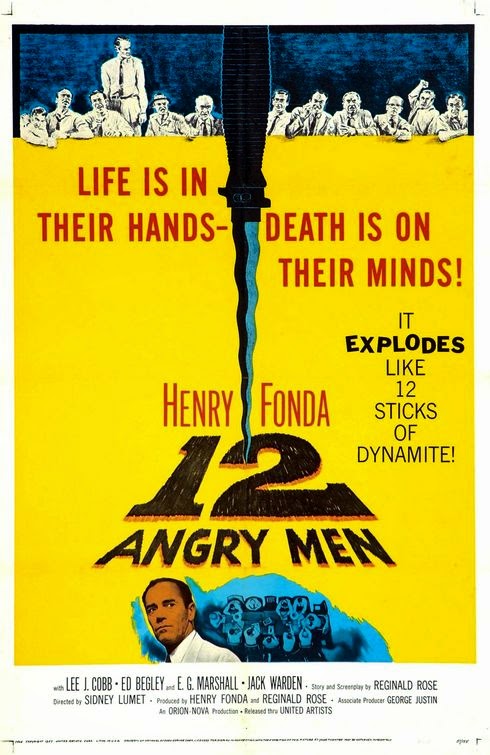
12 angry men 1957 - The finest courtroom drama


IMDB Link
IMDB rating: 8,9


Director: Sidney Lumet
Main Cast: Henry Fonda, Martin Balsam, John Fiedler, Lee J. Cobb, E. G. Marshall, Jack Klugman, Edward Binns, Jack Warden, Joseph Sweeney, Ed Begley, George Voskovec, Robert Webber


"Twelve Angry Men is a tightly wound top of a movie. Each scene ratchets up the tension another notch as Henry Fonda's character tries desperately to open the minds of his fellow jurors. The setting - a claustrophobic jury room in the dog days of summer - superbly augments the suspense. Operating within the constraints of a small budget, first-time director Sidney Lumet tightens the noose by accentuating the throbbing pulse of the ceiling fan and slowly narrowing his shots on his characters as the film approaches its climax. Based on Reginald Rose's well-known play, which had been adapted to the television screen three years earlier, Twelve Angry Men boasts a series of excellent performances by young actors who would soon become household names, including Jack Klugman, Jack Warden, and Martin Balsam. However, it is the film's established stars - Lee J. Cobb, E. G. Marshall and most importantly Fonda - who play the leads, delivering the goods like seasoned pros. The film has instructional value as a study of the inherent strengths and weaknesses of the jury system, but its real value is how it allows each member of the cultural mosaic of a jury to develop into distinct, damaged, and interesting characters. In a well-crafted metaphor for the broader outline of society, the jury members must confront their prejudices in order to see that justice prevails.
A pet project of Henry Fonda's, Twelve Angry Men was his only foray into film production; the actor's partner in this venture was Reginald Rose. A flop when it first came out (surprisingly, since it cost almost nothing to make), Twelve Angry Men holds up beautifully when seen today.
Nominated for three Oscars, Twelve Angry Men ran into the juggernaut of Bridge on the River Kwai and came up empty handed.
It was remade for television in 1997 by director William Friedkin with Jack Lemmon and George C. Scott." - www.allmovie.com


DVD links:


Saturday, May 31, 2014

A streetcar named Desire 1951 - A milestone Hollywood work with Brando's star-making performance


IMDB Link
IMDB rating: 8,1


Director: Elia Kazan
Main Cast: Vivien Leigh, Marlon Brando, Kim Hunter, Karl Malden


"With the same director (Elia Kazan), a screenplay co-adapted by the playwright (Tennessee Williams), and three-quarters of the Broadway production's stars, A Streetcar Named Desire transcended 'filmed theater' to become a groundbreaking Hollywood work. Battling the stringent Production Code, Kazan and Williams made concessions concerning the 'perverse' sexual elements of Blanche DuBois' past, but they retained the crucial rape of 'delicate', old-fashioned Blanche by brutal, 'modern' Stanley Kowalski, earning the Code's approval for a film definitively aimed toward adults. Marlon Brando's star-making performance as the 'Stella'-howling Stanley burned itself into popular consciousness with its combination of carnality and Method-acting 'naturalness', establishing Brando as the premier purveyor of the then-innovative Method acting style and a striking erotic presence. The more traditional Vivien Leigh, replacing Broadway's Jessica Tandy, similarly flourished as Blanche, while the Oscar-winning art direction, Harry Stradling's photography, and Alex North's moody, influential jazz score enhanced the hothouse atmosphere. The film was nominated for 12 Oscars, including Best Picture, and took home awards for Leigh, Karl Malden, and Kim Hunter, though Brando lost to Humphrey Bogart in The African Queen." - www.allmovie.com

DVD links:


Saturday, May 24, 2014

Born yesterday 1950 - Judy Holliday's pitch-perfect performance


IMDB Link
IMDB rating: 7,7


Director: George Cukor
Main Cast: Judy Holliday, Broderick Crawford, William Holden


"Garson Kanin's Broadway hit was transferred to the screen with only a few passing nods to the stricter censorship required by films. Judy Holliday won an Oscar for her portrayal of Billie Dawn, a strident, dim-bulbed ex-chorus girl who is the mistress of millionaire junk tycoon Harry Brock (Broderick Crawford). In Washington to put a few senators and congressmen in his pocket (the better to lay the groundwork for an illegal cartel), the rude-and-crude Brock realizes that the unrefined Billie will prove an embarrassment. Thus he hires idealistic but impoverished Paul Verrell (William Holden) to pump some intelligence and 'class' into Billie. Paul does his job too well; by awakening Billie's social and political consciousness, he turns the girl into Brock's most formidable foe in his efforts to buy influence in DC. Along the way Paul and Billie fall in love.
Crooked politicians were nothing new to motion pictures, but the film was released into an era of Anti-Communism when even the smallest criticism of the U.S. government was perceived as serving the Communist cause. So strong was this mood that Holliday was investigated by the FBI - and cleared via a personal message from FBI Director J. Edgar Hoover to studio chief Harry Cohn." - www.allmovie.com

DVD links:


Wednesday, May 14, 2014

Hamlet 1948 - Legendary adaptation, melancholic hero


IMDB Link
IMDB rating: 7,9


Director: Laurence Olivier
Main Cast: Laurence Olivier, Jean Simmons, Eileen Herlie, Norman Wooland, Stanley Holloway, Esmond Knight, Anthony Quayle, Peter Cushing


"Although criticized by Shakespeare devotees upon its release because of director, producer, and star Laurence Olivier's decision to excise large portions of the text, his cinematic version of Hamlet is widely considered the best out of several dozens (and counting). Hamlet (Olivier) is a medieval Danish prince who's still melancholy over the sudden death of his father and the quick, subsequent remarriage of his mother, Queen Gertrude (Eileen Herlie) to his uncle, Claudius (Basil Sydney). Informed by the ghost of his father that Claudius murdered him, Hamlet schemes to take revenge. Unsure how best to proceed, his delays and the horrible secret burdening him eventually lead to the violent snuffing out of several lives in both his family and that of courtier Polonius (Felix Aylmer), whose daughter Ophelia (Jean Simmons) is in love with Hamlet. Greatly influenced by the inventive camera work in Citizen Kane (1941) and by modern, psychological reinterpretations of Shakespeare's play, Olivier's masterpiece was the winner of four Academy Awards, for Best Picture, Best Actor (Olivier), Best Black and White Art Direction/Set Direction and Best Black and White Costume Design." - www.allmovie.com

DVD links:


Tuesday, May 13, 2014

Key Largo 1948 - Gangster melodrama in the guise of film noir


IMDB Link
IMDB rating: 7,9


Director: John Huston
Main Cast: Humphrey Bogart, Edward G. Robinson, Lauren Bacall, Lionel Barrymore, Claire Trevor


"John Huston's Key Largo - based on Maxwell Anderson's play - shares crucial similarities and differences with Archie Mayo's The Petrified Forest, also starring Humphrey Bogart but made 12 years earlier. The two plots are similar - a group of people held hostage in a remote locale by a gangster on the run - but the differences between the two movies, and Bogart's roles in them, reflect changes in the world and in perceptions of evil and how to deal with it. Where The Petrified Forest was steeped in romantic notions of self-sacrifice, rationalizing the loss of life in World War I, Key Largo implicitly questioned the right of any moral person to withdraw from the responsibility of taking moral action - and it even questioned the wisdom of self-sacrifice. The Petrified Forest's dreamy poet (Leslie Howard) nobly sacrifices himself to see the capture of the deadly sociopath played by Bogart. In Key Largo, Bogart plays embittered, disillusioned war veteran Frank McCloud, who starts the film with nothing to live for and discovers, in the course of fighting and killing old-time gangster Johnny Rocco (Edward G. Robinson), that there is a reason to remain engaged with the world and with his fellow human beings. The difference between the two movies was the intercession of World War II, in which society encountered the most monumental evil on as large a scale as was imaginable. Made in the wake of the war, with the Cold War and the Red Scare just getting rolling, Key Largo was almost a call to arms to any decent people watching that they were too important to withdraw from battlefields old or new, and that there were still battles to be fought that were worth fighting, as well as winning.
Claire Trevor's virtuoso performance as a besotted ex-nightclub singer won her an Academy Award - as predicted by her admiring fellow actors, who watched her go through several very difficult scenes in long, uninterrupted takes. While Key Largo sags a bit during its more verbose passages, on a visual level the film is one of the best and most evocative examples of the 'film noir' school." - www.allmovie.com

DVD links:


Saturday, May 3, 2014

Brief encounter 1945 - The classic poignant love story


IMDB Link
IMDB rating: 8,1


Director: David Lean
Main Cast: Celia Johnson, Trevor Howard, Stanley Holloway, Cyril Raymond


"Based on Noel Coward's play 'Still Life', Brief Encounter is a romantic, bittersweet drama about two married people who meet by chance in a London railway station and carry on an intense love affair. A model of narrative restraint and emotional power, the movie won over post-war audiences with its fidelity to the ordinariness of its story and ambiance. Through subtle details of character, manner, expression (and a Rachmaninoff score), Lean reveals the profound impact of unexpected passion on the lives of his middle-class, middle-aged couple, despite the final restoration of routine. Praised for its feeling and its realism, including the lack of Hollywood-ized glamour of its stars Celia Johnson and Trevor Howard, Brief Encounter became a rare foreign import hit. Johnson won the New York Film Critics' Circle award for Best Actress, while the film garnered Oscar nominations for Best Actress, Best Director, and Best Screenplay. It was Lean's first great film, and its intimate romanticism reveals the skill at portraying human relationships that would distinguish his later, spectacular epics, such as Lawrence of Arabia (1962), Doctor Zhivago (1965), Ryan's Daughter (1970), and A Passage to India (1984)." - www.allmovie.com

DVD links:


Friday, May 2, 2014

Henry V. 1944 - An inspiring classic for later Shakespeare adaptations


IMDB Link
IMDB rating: 7,4


Director: Laurence Olivier
Main Cast: Lairence Olivier, Robert Newton, Leslie Banks, Robert Helpmann


"Laurence Olivier's adaptation of Henry V is one of the finest Shakespeare films ever made, full of rousing action, beautiful colors, and passionate performances. In contrast to previous Shakespeare adaptations, it was fresh and lively - even challenging and daring - in its presentation and structure; it had fun with its subject, while other versions had been reverent and respectful; and it delighted audiences, scholars, and critics alike, becoming the first screen adaptation of a Shakespeare play to receive mostly enthusiastic reviews and turn a profit. Olivier made his movie in the middle of World War II, convincing the British government of the morale-boosting potential and propaganda uses of a good adaptation of the original play, about an English invasion of France in the 15th century; he then took off for the neutral wide-open spaces of Ireland with the best cast he could assemble from actors too old to be in uniform, a handful of actors borrowed from the armed services, highly sought-after Technicolor cameras, and a script that kept intact the core of Shakespeare's play. The movie earned him a special Academy Award. Equally important in broader historical terms, Henry V paved the way for all other Shakespeare films, from Olivier's versions of Hamlet, Richard III, and Othello through to Kenneth Branagh's more contemporary adaptations." - www.allmovie.com

DVD links:


Wednesday, April 23, 2014

The shop around the corner 1940 - Charming Hungarian story wrapped up with an American ribbon


IMDB Link
IMDB rating: 8,1


Director: Ernst Lubitsch
Main Cast: Margaret Sullavan, James Stewart, Frank Morgan, Joseph Schildkraut


"The Shop Around the Corner is adapted from the Hungarian play by Nikolaus (Miklos) Laszlo. The movie is one of the screen's best romantic comedies, and an excellent example of the subtle humor and wry character interplay that marked the films of director Ernst Lubitsch. The plot - likeable people (James Stewart and Margaret Sullavan) who are antagonists in real life but also anonymous pen pals are infatuated with each other - is ripe with comic potential, but Lubitsch takes the material further, including several bittersweet subplots that give the film richness and texture. The supporting performances are first-rate, particularly Frank Morgan and Joseph Schildkraut, and the film has the classy look that was a hallmark of MGM films of this era. Directed with comic delicacy by Lubitsch, this was later remade in 1949 as In the Good Old Summertime, and in 1998 as You've Got Mail. It was also musicalized as the 1963 Broadway production She Loves Me." - www.allmovie.com

DVD links:


The Philadelphia story 1940 - Hepburn's spectacular comeback, Stewart's Academy Award


IMDB Link
IMDB rating: 8,1


Director: George Cukor
Main Cast: Cary Grant, Katharine Hepburn, James Stewart, Ruth Hussey, John Howard, Roland Young


"Playwright Philip Barry reportedly based the central character of The Philadelphia Story on Katharine Hepburn's brittle public persona, so it should be little surprise that she plays the part so well. The film is a quick-witted translation of the play, essentially a parlor drama with witty, Oscar Wilde-like banter and glib repartee from nearly every actor. There are moments of rare beauty in the dialogue, even if director George Cukor rarely uses them to give the film more visual flair or energy. The story both spoofs and plays sly homage to Clifford Odets' earnest socialist dramas, in which kind-hearted socialites learn to love and admire the working poor - except that, in The Philadelphia Story, Hepburn turns her back on the working-class hero and returns to her own kind, the aristocratic, debonair, completely irresistible Cary Grant (who does a wonderful job of being... Cary Grant). The aristocrats are well-skewered by the delightful screenplay, and James Stewart is excellent as the cynical but smitten reporter, in a performance that won him his only Academy Award. Donald Ogden Stewart (no relation to Jimmy) also copped an Oscar for Best Adapted Screenplay. The Philadelphia Story was remade in 1956 with a Cole Porter musical score as High Society." - www.allmovie.com

DVD links:


His girl Friday 1940 - One of the fastest talking movies ever made


IMDB Link
IMDB rating: 8,1


Director: Howard Hawks
Main Cast: Cary Grant, Rosalind Russell, Ralph Bellamy, Gene Lockhart


"The second screen version of the Ben Hecht/Charles MacArthur play The Front Page, His Girl Friday changed hard-driving newspaper reporter Hildy Johnson from a man to a woman, transforming the story into a scintillating battle of the sexes. It's doubtful that one could find a movie as fast-paced as Howard Hawks' His Girl Friday, and next-to-impossible to find a film of the period more laced with sexual electricity. Decades after its release, the comedy-thriller adapted from Ben Hecht and Charles MacArthur's play The Front Page holds up as a masterpiece of pacing and performance, and even manages a few healthy swipes at some of officialdom's sacred cows. At the time, His Girl Friday was also a piece of groundbreaking cinema for the rules it broke: Hawks' version added an element of sexual tension that was about the only thing missing from the original play and the 1931 film version, in which main characters Walter Burns and Hildy Johnson are men engaged in a symbiotic/exploitative professional relationship. Hawks transmuted Hildy Johnson into the persona of Rosalind Russell, who was entering her prime as an archetype of the ambitious, energetic woman. Coupled with Cary Grant's cheerful nonchalance as the manipulative editor Walter Burns, the material - which was fairly scintillating on its own terms - took on a fierce sexual edge that made the resulting film a 92-minute exercise in eroticism masquerading as a comic thriller. Russell may never have had a better role than Hildy Johnson; she became a screen symbol for the intelligent, aggressive female reporter, decades before Candice Bergen's star turn as television's Murphy Brown. Amid all of the jockeying for superiority, and the sparring between Grant and Russell - which, in many ways, anticipates the jousting between Humphrey Bogart and Lauren Bacall in Hawks' own The Big Sleep, made four years later - His Girl Friday found room to enhance some of the issues from the original play, including cynicism about government, the justice system and freedom of the press.
His Girl Friday may well be the fastest comedy of the 1930s, with kaleidoscope action, instantaneous plot twists, and overlapping dialogue. And if you listen closely, you'll hear a couple of 'in' jokes, one concerning Cary Grant's real name (Archie Leach), and another poking fun at Ralph Bellamy's patented 'poor sap' screen image. Subsequent versions of The Front Page included Billy Wilder's 1974 adaptation, which restored Hildy Johnson's manhood in the form of Jack Lemmon, and 1988's Switching Channels, which cast Burt Reynolds in the Walter Burns role and Kathleen Turner as the Hildy Johnson counterpart." - www.allmovie.com


Download links:


The women 1939 - It's all about men!


IMDB Link
IMDB rating: 8,0


Director: George Cukor
Main Cast: Norma Shearer, Joan Crawford, Rosalind Russell, Mary Boland, Paulette Goddard, Joan Fontaine


"Based on the Clare Booth Luce play of the same name, this MGM comedy is famous for its all-female cast and deft direction by George Cukor. The themes explored in Clare Boothe Luce's play were so modern in 1939 that audiences found the film audaciously relevant, yet so timeless and universal that The Women could be successfully revived on Broadway in 2001, starring Jennifer Tilly, Kristen Johnston, and Cynthia Nixon. The film crackles with a sharp-toothed sarcasm even on a modern viewing. George Cukor's deft pacing and evident facility with actors (or, we should say, actresses) make The Women both a scathing and hilarious indictment of the institution of marriage. No less important, in fact probably more so, is the film's portrayal of the women's mercenary competitiveness. The ruthlessly casual deceptions they practice on each other are authenticated by the playwright's gender, as well as that of her adapters (Anita Loos and Jane Murfin). The Women recasts the discourse of high society as an exercise in the Darwinism of the animal kingdom, starting with an opening credits sequence that assigns an animal role to each character, from sly fox to gentle lamb. The opening shot says it all, as two dogs aggressively (and metaphorically) yap at each other as their pampered owners restrain them, all against a cacophony of background gossip. The women's ironic commentary on the regimen of exercise and beautification they must maintain to keep their men takes over from here, as does the rapid repartees and the almost incidental backstabbing. Casting the film entirely with women works beautifully, never straining the logic or staging, and the handful of leads each share the credit with Luce and Cukor for a fully realized farce on the warfare of feminine politics and societal advantage.
Snappy, witty dialogue, much of it courtesy of veteran screenwriter Anita Loos, helps send this film's humor over the top. So do the characterizations - Crawford is as venomous as they come, and this was Russell's first chance to show what she could do as a comedienne. And don't discount Shearer - her portrayal of good-girl Mary is never overpowered by these two far-flashier roles. Do keep an eye on the supporting players, though, especially Mary Boland as the Countess DeLage. The role was based on a cafe society dame of that era, the Countess DiFrasso, who had a wild affair with Gary Cooper; that romance is satirized here." - www.allmovie.com

DVD links:


Saturday, April 5, 2014

Animal crackers 1930 - One of the best Marx Brothers films


IMDB Link
IMDB rating: 7,7


Director: Victor Heerman
Main Cast: Marx Brotheers, Lillian Roth, Margaret Dumont


"Though many critics rank 1933's Duck Soup as the funniest Marx Brothers movie, others may prefer Animal Crackers, released in 1930. Based on the hit Broadway play by George S. Kaufman and Morris Ryskind, Animal Crackers features Groucho Marx as explorer Captain Spaulding, who is the guest of honor at a party hosted by wealthy matron Mrs. Rittenhouse (Groucho's favorite foil Margaret Dumont). The plot is a flimsy excuse for Groucho, Chico, and Harpo to run amok, with Zeppo playing his customary straight-man role. Director Victor Heerman is basically a bystander as the brothers take over, treating film as an extension of vaudeville. Animal Crackers was funnier and a bigger success than its predecessor, The Cocoanuts, and it marked the true beginning of the Marx Brothers' long and successful film careers, establishing their unique blend of physical and verbal mayhem." - www.allmovie.com

DVD links:


Holiday 1930 - The first film version of the classic Philip Barry comedy


IMDB Link
IMDB rating: 7,0


Director: Edward H. Griffith
Main Cast: Ann Harding, Mary Astor, Edward Everett Horton, Robert Ames, Hedda Hopper


"Ann Harding and Robert Ames starred in the first screen adaptation of Philip Barry's play -- remade eight years later in a much more famous version with Katharine Hepburn and Cary Grant, directed by George Cukor. This version is a little closer to the source, in terms of the nature of some of the characters, and has a charm all of its own, especially in the Oscar-nominated performance by Harding, an actress who deserves to be better remembered than she is. The supporting characters, especially Edward Everett Horton (who was also in the remake) as Nick Potter, are a little less 'housebroken' than they were in the 1938 version, and the result is some edges and sparks that didn't show up in the Cukor version, for all of its virtues. On the down side, the movie was done in 1930, early in the sound era, and at times displays the somewhat static visual nature of most talkies from that period." - www.allmovie.com

Download links:


Thursday, May 31, 2012

Morning glory 1933 - Hepburn's wonderful Oscar-winning performance


IMDB Link
IMDB rating: 6,6


Director: Lowell Sherman
Main Cast: Katharine Hepburn, Douglas Fairbanks Jr., Adolphe Menjou, Mary Duncan, C. Aubrey Smith


"Katharine Hepburn won her first Oscar for her portrayal of Eva Lovelace, a small-town community-theatre actress who comes to New York dreaming of theatrical stardom. She amuses producer Adolphe Menjou and playwright Douglas Fairbanks Jr. with her naively pretentious prattle, but neither man takes her too seriously. Both, however are attracted to Eva: Menjou has a brief affair with her, but she yearns for the more reserved Fairbanks. Partly out of sympathy, Fairbanks arranges for Eva to understudy the troublesome star (Mary Duncan) of Menjou's latest production. When the star walks out on opening night, Eva goes on in her stead, and is universally hailed as a brilliant new find. Backstage after her triumph, Eva is warned not to let her sudden success go to her head lest she become a 'morning glory': a briefly spectacular 'bloomer' that withers and dies within a very short time. Proof of this warning is Eva's maid, a middle-aged woman who had also been an instant star years earlier. But Eva is too intoxicated by the thrill of realizing her life's dream; embracing her weeping maid, Eva declares to the world that she doesn't care if she is a morning glory. The film fades as Eva shouts defiantly 'I'm not afraid! I'm not afraid!' Adapted from a stage play by Zoe Akins, Morning Glory was remade in 1957 as Stage Struck, with Susan Strasberg as Eva Lovelace." - www.allmovie.com

DVD links:


Sunday, April 29, 2012

Secrets 1933 - The last film of America's Sweetheart


IMDB Link
IMDB rating: 7,7


Director: Frank Borzage
Main Cast: Mary Pickford, Leslie Howard, C. Aubrey Smith, Blanche Friderici, Doris Lloyd, Ned Sparks


"Silent screen legend Mary Pickford makes her final movie appearance in Secrets, adapted from the play by Rudolph Besier and Mary Edgerton. Secrets is a curious misfire, meaning that it doesn't really work as a film but has more than enough interesting things about it to make it worth watching. For one thing, it's Mary Pickford's last film and one of the few talkies that the vibrant silent star made. Pickford never really made the transition from silent to sound, although a number of her talking pictures were popular. She was capable of being a fine talkie actress; the talent was clearly there, but she needed to put a great deal of effort into re-learning how to act in front of a camera with a microphone, and she apparently didn't want to do so. As a result, some of her scenes come across as stilted or disjointed; others, however, are magical and demonstrate what could have been. Indeed, her scene following the death of her child is pure gold. Leslie Howard was more at ease with dialogue, and his performance is a big help to Secrets, but there's also a problem here: Howard is very convincing as the lover, not quite as convincing as a rough Western hero type. Frank Borzage works some magic of his own in his direction; despite some credibility problems in the script, Borzage directs as if he believes in every wild moment, every truth-stretching bit turn of events." - www.allmovie.com

Download links:


Saturday, April 28, 2012

The animal kingdom 1932 - Good mistress vs. bad wife

Ann Harding, Leslie Howard & Myrna Loy in The Animal Kingdom (1932)


IMDB Link
IMDB rating: 6,6


Director: George Cukor, Edward H. Griffith
Main Cast: Ann Harding, Leslie Howard, Myrna Loy, William Gargan, Neil Hamilton, Ilka Chase


"The first film version of Philip Barry's Broadway play The Animal Kingdom stars Ann Harding, Leslie Howard and Myrna Loy. Howard plays a wealthy publisher who decides to marry the socially prominent Loy, leaving his mistress Harding in the lurch. In comically convoluted fashion, Loy behaves like a callous libertine, while Harding is the soul of love and fidelity. The frustrated Howard declares at the end that he is going back to his 'wife' - meaning, of course, the faithful Harding. Animal Kingdom was long withdrawn from public view due to the 1946 remake One More Tomorrow; a pristine 35-millimeter print was discovered in the Warner Bros. vaults in the mid-1980s.
Philip Barry as a playwright was able to find an audience in two distinct eras of American history, the carefree Roaring Twenties and the poorer socially significant Thirties. He did with a clever mixture of social commentary while writing about the privileged classes enjoying their privileges.
The Animal Kingdom had a 183 performance run on Broadway the previous year and its star Leslie Howard was a movie name already on two continents. So Howard, Bill Gargan, and Ilka Chase repeat their Broadway roles here.
Harding was an interesting leading woman - she was attractive but not beautiful and had a very low, distinctive speaking voice. She came from the Broadway stage, and her heyday in films was through the mid-thirties, though she worked consistently in films and television until the mid-60s. As was the case back then, at 31 years of age, her time as a leading lady was drawing to a close, and soon would be turned over to people like the younger Loy. Her performance in The Animal Kingdom is a very honest one. Loy is absolutely ravishing as she essays the part of the glamorous wife beautifully, reminiscent of Gene Tierney later on with the ultra-feminine facade hiding the steel underneath. Howard is handsome and thoughtful in the lead, and one can see it slowly occurring to him that he made a mistake."

Download links:


Doctor X 1932 - Beware the full moon!


IMDB Link
IMDB rating: 6,5


Director: Michael Curtiz
Main Cast: Lionel Atwill, Fay Wray, Lee Tracy, Preston Foster, John Wray


"Michael Curtis's Doctor X is a strange movie by any definition, both in its content and its execution. Based on a mystery/melodrama by Howard Warren Comstock and Allen C. Miller, which ran for 80 performances (a marginally respectable, if not profitable run, in those days) on Broadway in the winter/spring of 1931, the play was mostly set in the offices of a New York newspaper and in East Orange, New Jersey - screenwriter Earl W. Baldwin moved the action entirely to New York and Long Island, effectively creating an old dark house mystery; and Curtiz transposed it all into an eerily stylized mode, shot in two-color Technicolor that gives the whole movie a strangely mixed look of not-quite-verisimilitude and unearthly eeriness. Actually, the main element of New York verisimilitude resides in the presence and performance of Lee Tracy's fast-talking reporter, who propels a lot of the action forward in what is otherwise a surprisingly talkie script; Tracy makes an unconventional but likable hero, and is well matched to Fay Wray as the daughter of Dr. Xavier (Lionel Atwill), the pathologist called in on the case of the 'Moon Killer'. His casting, and the deliberately overstated performances by his colleagues at the Academy of Surgical Research, fill the movie with potential suspects (some of whom are obvious red herrings). The resolution, such as it is, and the logic of the story, coupled with the talkie nature of the picture, make Doctor X more of a curio than a truly great, or even very good movie. For decades the movie was only available in murky black-and-white prints, which further reduced its value, apart from the eeriness of the plot and resolution, but the renewed availability of Technicolor prints has restored much of its original value. (The movie was successful enough in its time to justify the creation of a low-budget (black-and-white) faux sequel, The Return of Dr. X, seven years later, with a pre-stardom Humphrey Bogart in the title role)." - www.allmovie.com

DVD links:


Friday, April 27, 2012

A bill of divorcement 1932 - Katharine Hepburn's auspicious film debut


IMDB Link
IMDB rating: 6,6


Director: George Cukor
Main Cast: John Barrymore, Katharine Hepburn, Billie Burke, David Manners


"Katharine Hepburn made her auspicious film debut in the otherwise undistinguished A Bill of Divorcement, based on a play by Clemence Dane. Even now, many decades later, there's still a raw freshness and energy to Hepburn's performance that is hard to resist. It's true that her work here is not particularly polished; there are moments when she clearly pushes too hard, and others when she sacrifices truth for effect. But there's a spirit and energy radiating from the actress that make the viewer forgive her these and other little sins, and she is so spot on in most of the sequences that there's no need to make excuses for this early performance. What's surprising is John Barrymore's performance, which was lauded at the time but has been overshadowed by Hepburn's through the years. The celebrated but uneven actor gives an exceptional performance, informed with telling detail and carefully nuanced, and there is a rare and essential rapport between him and Hepburn which goes a long way to smoothing over many of the rough patches of the dated and sometimes melodramatic screenplay. Also a surprise is Billie Burke, who gives her character an underlying melancholy and guilt, and who handles her dramatic scenes quite well. Divorcement doesn't stand up well as drama, and George Cukor's direction is often rudimentary, but it's a great showcase for its stars." - www.allmovie.com

Download links:


Saturday, April 14, 2012

Jewel robbery 1932 - A pre-code little comedy gem


IMDB Link
IMDB rating: 7,6


Director: William Dieterle
Main Cast: William Powell, Kay Francis, Helen Vinson


"A bored Baroness discovers love and excitement when she becomes caught up in a thrilling jewel robbery.
Scintillating, light as air and slightly naughty, this pre-Code charmer will delight discriminating viewers looking for a sophisticated comedy, a little trifle with which to while away an idle hour. Thievery, marijuana and infidelity - while very serious subjects - are here satirized almost to the point of insignificance. The whole purpose of this forgotten film - which compares nicely with the best of Lubitsch - is to provide the audience with a good time, and in that it succeeds quite admirably.
Beautiful Kay Francis is enchanting, her cool demeanor barely concealing the mischievous passions just below her elegant surface. Very bored with her wealthy but unattractive husband (Henry Kolker), she yearns for a more exciting life. Gentlemanly thief William Powell provides that opportunity. Suave and debonair, he instantly makes the viewer forgive his regrettable vocation. As a twosome, the stars bring just the right frisson of pleasure to their scenes to please all but the most jaded viewer.
The supporting cast further adds to the film's fine distillation. Hardie Albright as Francis' admirer and Helen Vinson as her friend both portray willing partakers of Old Vienna's hedonistic lifestyle. Spencer Charters is very humorous as a completely incompetent night watchman. Sour Clarence Wilson plays a police official, while Alan Mowbray shines in his few minutes as a no-nonsense detective.
 Jewel Robbery was based on a play by Ladislas Fodor, previously filmed in an Austrian version."

DVD links: