Have a good time learning about and watching these classic movies and if you can, buy the DVD! (You can keep movies alive and support this blog this way!)
DVD links will be added movie by movie - from where you can pick your own favorite one. (Isn't it wonderful to have your own?)
And please take a look at my other blogs too! (My Blog List below)

Search this blog

Showing posts with label 1948. Show all posts

Friday, May 23, 2014

Ladri di biciclette (The bicylce thief) 1948 - The signature work for the neorealist movement


IMDB Link
IMDB rating: 8,4


Director: Vittoria De Sica
Main Cast: Lamberto Maggiorani, Enzo Staiola, Lianella Carell


"This landmark Italian neorealist drama became one of the best-known and most widely acclaimed European movies, including a special Academy Award as 'most outstanding foreign film' seven years before that Oscar category existed. Written primarily by neorealist pioneer Cesare Zavattini and directed by Vittorio DeSica, also one of the movement's main forces, the movie featured all the hallmarks of the neorealist style: a simple story about the lives of ordinary people, outdoor shooting and lighting, non-actors mixed together with actors, and a focus on social problems in the aftermath of World War II. Lamberto Maggiorani plays Antonio, an unemployed man who finds a coveted job that requires a bicycle. When it is stolen on his first day of work, Antonio and his young son Bruno (Enzo Staiola) begin a frantic search, learning valuable lessons along the way. The movie focuses on both the relationship between the father and the son and the larger framework of poverty and unemployment in postwar Italy. As in such other classic films as Shoeshine (1946), Umberto D. (1952), and his late masterpiece The Garden of the Finzi-Continis (1971), DeSica focuses on the ordinary details of ordinary lives as a way to dramatize wider social issues. As a result, The Bicycle Thief works as a sentimental study of a father and son, a historical document, a social statement, and a record of one of the century's most influential film movements." - www.allmovie.com

DVD links:


Thursday, May 15, 2014

A foreign affair 1948 - A very funny post-war satire


IMDB Link
IMDB rating: 7,5


Director: Billy Wilder
Main Cast: Jean Arthur, Marlene Dietrich, John Lund


"A cutting-edge comedy in the post-World War II era, A Foreign Affair remains a very funny film, but much of its richness came from the historical context of its satire. At the heart of the film is the observant wit of writer/director Billy Wilder, a Jewish German émigré with a sardonic view of life in post-war Berlin. The interplay among Marlene Dietrich, Jean Arthur, and John Lund gives the film much of its comic texture; the dialogue is sharp and the story is knowing. Charles Lang's cinematography is first-rate, and Edith Head's costume designs give the film much of its glamour. While not as well-known as other Wilder films, A Foreign Affair was a clear example of Wilder's increasing willingness to push the limits of what Hollywood would allow. While a film like A Foreign Affair would be the crowning achievement for many directors, Wilder had still more great films ahead of him, with such classics as Sunset Boulevard (1950) and Some Like it Hot (1959)." - www.allmovie.com

DVD links:


Wednesday, May 14, 2014

Johnny Belinda 1948 - Jane Wyman's personal triumph


IMDB Link
IMDB rating: 7,9


Director: Jean Negulesco
Main Cast: Jane Wyman, Lew Ayres, Charles Bickford, Agnes Moorehead, Stephen McNally, Jan Sterling


"After years of dumb-blonde and best-friend roles, Jane Wyman proved her skills as a dramatic actress - and won an Academy Award in the bargain - in Johnny Belinda. Adapted from a stage play by Elmer Harris, the story takes place in Nova Scotia, where deaf-mute Belinda (Wyman) leads a lonely existence on the hardscrabble farm of her father Black Macdonald (Charles Bickford) and her aunt Aggie (Agnes Moorehead). Newly arrived doctor Robert Richardson (Lew Ayres) takes a special interest in Belinda, vowing to ease her road in life by teaching her sign language. Despite initial resistance from her father and aunt, Belinda quickly learns how to communicate with others, opening a whole, wonderful new world for her. But things take a sorry turn when local lout Locky (Stephan McNally) corners poor Belinda after a village dance and rapes her. If the ending seems a bit ambiguous, it is because director Jean Negulesco intended it that way, allowing the viewer to draw his or her own conclusion regarding Belinda's future relationship with her mentor Dr. Richardson. Ironically, Negulesco was fired late in the production of the film, when studio execs saw that he was avoiding the sort of tear-jerking sentimentality that they had expected. Because it would have been too expensive to re-shoot the entire picture, the studio reluctantly released it pretty much as Negulesco had wanted. The result was Warner Bros.' biggest hit of the year. This is another example of how films with strong, non-traditional women as the central character became more prominent in the post-WWII era. The film was nominated for a near-record twelve Academy Awards, though Wyman's Best Actress Oscar was the only category in which it won." - www.allmovie.com

DVD links:


Red river 1948 - Epic, emotional Western; a clash between the old and the new


IMDB Link
IMDB rating: 7,8


Director: Howard Hawks
Main Cast: John Wayne, Montgomery Clift, Joanne Dru, Walter Brennan, Coleen Gray, Harry Carey Sr., John Ireland, Noah Beery Jr., Harry Carey Jr.


"In his first collaboration with John Wayne, Howard Hawks examines capitalism and dueling masculinities in the rousing context of a Western cattle drive. A Mutiny on the Bounty for Big Sky country, Red River features a challenge between Montgomery Clift's Matthew Garth and Wayne's Tom Dunson that becomes a contest between new and old models of Western manhood - a clash enhanced by the different performance styles of ambiguous, Method-acting, proto-rebel Clift and stolidly imposing star Wayne. Young and adaptable, Garth sees the necessity of finding new markets and cooperating with a community, including such potential adversaries as John Ireland's gun-loving Cherry, while Dunson's Old West individualism becomes an inflexible, economically ruinous monomania. The unsympathetic Dunson challenged the traditional Wayne persona, presaging the disturbed Western heroes that proliferated in the 1950s and 1960s, including Wayne's later role as psychotic Ethan Edwards in John Ford's The Searchers (1956) and in the films that Red River writer Borden Chase wrote for director Anthony Mann. Powered by Russell Harlan's dynamic yet moody black-and-white cinematography and Dimitri Tiomkin's score, Red River became a substantial hit, confirming Clift's star quality in his film debut and earning Oscar nominations for Chase and action editor Christian Nyby; it still stands as one of Hawks's top Westerns." - www.allmovie.com

DVD links:


Oliver Twist 1948 - Dickens and Lean: Triumphant combination


IMDB Link
IMDB rating: 7,8


Director: David Lean
Main Cast: John Howard Davies, Robert Newton, Alec Guinness, Kay Walsh, Anthony Newley


"David Lean's ambitious interpretation of this Charles Dickens classic is a powerful but flawed film. Guy Green's hyaline cinematography dominates the picture from its opening shots of a terrified young woman stumbling around in a stormy heath to its closing scenes of mob violence. His camera is perched above the characters, implying moral superiority to the many flawed characters, while making the ever-vulnerable Oliver look cowed and beaten. The turbulent world of mid-19th century London, with its incessant hustle and bustle of human industry, is recreated so carefully that the vibrant set designs almost overshadow the memorable characters that roam these streets. A smorgasbord of urban decay, social disorder, and class conflict imbues the film with a potent sensuality, as both natural elements and human architecture conspire to consume the disadvantaged. An unrecognisable Alec Guinness, endowed with pounds of prosthetics to mask his youthful vigour, creates a sympathetic Fagin out of a potentially racist caricature. Robert Newton's Mephistophelean Bill Sikes is exemplary, particularly in the scene in which he brutally murders Nancy then sits in tortured and hysterical contemplation of the deed. Dickens' faith in the human spirit is well-depicted in Oliver's ability to survive despite the cruelty of this unjust world. Both Dickens when he wrote the novel and Lean when he filmed it were men near the beginning of their careers whose optimism shone through the darkness of the material. However, the film closes with scenes of mob vigilantism and sentimentality that carry messages betraying the social commentary that precedes them." - www.allmovie.com

DVD links:


Hamlet 1948 - Legendary adaptation, melancholic hero


IMDB Link
IMDB rating: 7,9


Director: Laurence Olivier
Main Cast: Laurence Olivier, Jean Simmons, Eileen Herlie, Norman Wooland, Stanley Holloway, Esmond Knight, Anthony Quayle, Peter Cushing


"Although criticized by Shakespeare devotees upon its release because of director, producer, and star Laurence Olivier's decision to excise large portions of the text, his cinematic version of Hamlet is widely considered the best out of several dozens (and counting). Hamlet (Olivier) is a medieval Danish prince who's still melancholy over the sudden death of his father and the quick, subsequent remarriage of his mother, Queen Gertrude (Eileen Herlie) to his uncle, Claudius (Basil Sydney). Informed by the ghost of his father that Claudius murdered him, Hamlet schemes to take revenge. Unsure how best to proceed, his delays and the horrible secret burdening him eventually lead to the violent snuffing out of several lives in both his family and that of courtier Polonius (Felix Aylmer), whose daughter Ophelia (Jean Simmons) is in love with Hamlet. Greatly influenced by the inventive camera work in Citizen Kane (1941) and by modern, psychological reinterpretations of Shakespeare's play, Olivier's masterpiece was the winner of four Academy Awards, for Best Picture, Best Actor (Olivier), Best Black and White Art Direction/Set Direction and Best Black and White Costume Design." - www.allmovie.com

DVD links:


Tuesday, May 13, 2014

Key Largo 1948 - Gangster melodrama in the guise of film noir


IMDB Link
IMDB rating: 7,9


Director: John Huston
Main Cast: Humphrey Bogart, Edward G. Robinson, Lauren Bacall, Lionel Barrymore, Claire Trevor


"John Huston's Key Largo - based on Maxwell Anderson's play - shares crucial similarities and differences with Archie Mayo's The Petrified Forest, also starring Humphrey Bogart but made 12 years earlier. The two plots are similar - a group of people held hostage in a remote locale by a gangster on the run - but the differences between the two movies, and Bogart's roles in them, reflect changes in the world and in perceptions of evil and how to deal with it. Where The Petrified Forest was steeped in romantic notions of self-sacrifice, rationalizing the loss of life in World War I, Key Largo implicitly questioned the right of any moral person to withdraw from the responsibility of taking moral action - and it even questioned the wisdom of self-sacrifice. The Petrified Forest's dreamy poet (Leslie Howard) nobly sacrifices himself to see the capture of the deadly sociopath played by Bogart. In Key Largo, Bogart plays embittered, disillusioned war veteran Frank McCloud, who starts the film with nothing to live for and discovers, in the course of fighting and killing old-time gangster Johnny Rocco (Edward G. Robinson), that there is a reason to remain engaged with the world and with his fellow human beings. The difference between the two movies was the intercession of World War II, in which society encountered the most monumental evil on as large a scale as was imaginable. Made in the wake of the war, with the Cold War and the Red Scare just getting rolling, Key Largo was almost a call to arms to any decent people watching that they were too important to withdraw from battlefields old or new, and that there were still battles to be fought that were worth fighting, as well as winning.
Claire Trevor's virtuoso performance as a besotted ex-nightclub singer won her an Academy Award - as predicted by her admiring fellow actors, who watched her go through several very difficult scenes in long, uninterrupted takes. While Key Largo sags a bit during its more verbose passages, on a visual level the film is one of the best and most evocative examples of the 'film noir' school." - www.allmovie.com

DVD links:


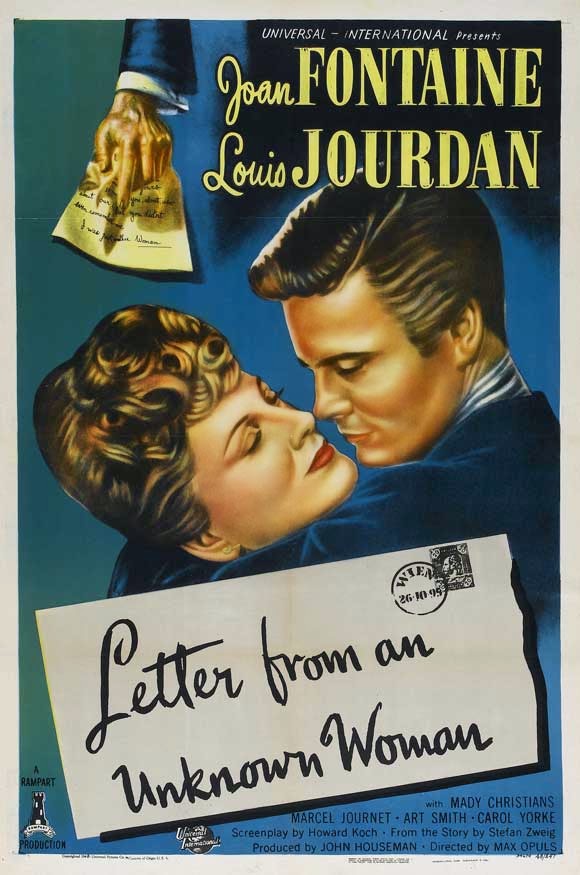
Letter from an unknown woman 1948 - A heart-breaking masterpiece from Ophüls


IMDB Link
IMDB rating: 8,0


Director: Max Ophüls
Main Cast: Joan Fontaine, Louis Jourdan


"A lush story of unrequited love in turn-of-the-century Vienna, Max Ophüls's Letter From an Unknown Woman sumptuously visualizes the emotional power of one woman's life-long fixation on a selfish man. The title missive from Joan Fontaine's 'unknown' Lisa to Louis Jourdan's flippant Stefan begins a series of flashbacks recounting her all-consuming love for him and his inability to remember her, even after he seduced her once and impregnated her. Ophüls's fluid shooting style communicates the passion that Lisa cannot articulate until it is too late, with lyrical camera movements that linger over Lisa's fascination with anything related to her one night with Stefan and evocative shots of the curved staircase leading to Stefan's apartment. The elegantly detailed period sets and costumes reveal the privileged life that Lisa abandons for Stefan, while subtly suggesting that she knows nothing about him beyond his entrancing surface. Though it was not initially a success, the gracefully romantic Letter From an Unknown Woman has since come to be considered Ophüls's best American film." - www.allmovie.com

DVD links:


I remember Mama 1948 - An affecting portrayal of family life


IMDB Link
IMDB rating: 8,4


Director: George Stevens
Main Cast: Irene Dunne, Barbara Bel Geddes, Oskar Homolka, Philip Dorn, Cedric Hardwicke, Rudy Vallee, Barbara O'Neil


"George Stevens's charming film version of Kathryn Forbes' collection of short stories entitled Mama's Bank Account features Irene Dunne as Mama in one of her finest and most ingratiating performances. The film is narrated by Mama's daughter Katrin (Barbara Bel Geddes), recalling the trials and tribulations of her family in turn-of-the-century San Francisco.
Stevens was occasionally taken to sentimentality in even his most dramatic films, and here, if no different, it is at least more appropriate. The movie is another excellent example of how films centered on women became increasingly important in the post-WWII era. Nicholas Musuraca's cinematography captures the feel of turn-of-the-century San Francisco, and the production values are adequate without being showy - somewhat better than average for an RKO picture from this era." - www.allmovie.com

DVD links:


The red shoes 1948 - Influential musical tragedy


IMDB Link
IMDB rating: 8,3


Directors: Michael Powell, Emeric Pressburger
Main Cast: Moira Shearer, Anton Walbrook, Marius Goring, Ludmilla Tcherina


"Michael Powell and Emeric Pressburger's 1948 film The Red Shoes was, for nearly four decades, the most successful British movie ever released in America. Movies had used ballet as a subject before but the public had mostly ignored them. The Red Shoes, by contrast, seemed to draw audiences into its spell, virtually one theater at a time. In New York, it played to sell-out crowds at a single theater in Manhattan for almost two years before going into wide release, by which time word of the film had spread sufficiently to make it a hit throughout the country.
The movie had started life as a proposed screenplay, written by Pressburger for Merle Oberon before World War II, which never saw production - the intervening war and its aftermath led to a major change in its focus, from romantic melodrama to art. Powell and Pressburger sincerely believed that having spent four years dying in the name of freedom and liberty, the world was ready to see a movie that suggested it was now alright to die in the name of art. The public (outside of England, where critics panned the movie and it closed very quickly) responded in kind, in what was the first huge 'art-house' success in postwar cinema." - www.allmovie.com

DVD links:


The treasure of the Sierra Madre 1948 - The tale of greed and its consequences


IMDB Link
IMDB rating: 8,4


Director: John Huston
Main Cast: Humphrey Bogart, Walter Huston, Tim Holt, Bruce Bennett, Barton MacLane


"Loosely based on the Biblical parable of the thieves and the 'Pardoner's Tale' in Chaucer's Canterbury Tales, John Huston's morality tale is one of the great cinematic proofs of the Biblical adage radix malorum est cupitidas, or, the root of evil is the love of money. The film is a clever study of the erosive effect that money can have on flawed men's characters. Shot entirely on location in Mexico, the film's dry and dusty atmosphere is clearly authentic. Humphrey Bogart's maniacal Fred Dobbs is one of moviedom's great characterizations, a conglomeration of cunning, greed and paranoia. As his wealth mounts, so does his distrust. While external threats abound, the real enemy lies within. The Treasure of the Sierre Madre examines the essential existential hopelessness and loneliness of the avaricious man, drawing an implicit parallel between the prospectors and man's contemporary pursuit of material wealth. A failure with audiences who apparently didn't want to see Bogie playing such a nefarious anti-hero, the movie is now recognized by most critics as an American classic. For the first time ever, a father and son - Walter Huston (for best supporting actor) and John (for directing and screenplay) - won Oscars for their stellar work." - www.allmovie.com

DVD links: