Have a good time learning about and watching these classic movies and if you can, buy the DVD! (You can keep movies alive and support this blog this way!)
DVD links will be added movie by movie - from where you can pick your own favorite one. (Isn't it wonderful to have your own?)
And please take a look at my other blogs too! (My Blog List below)

Search this blog

Sunday, December 14, 2014

Witness for the prosecution 1957 - A courtroom drama with suprise twists and shocking climax


IMDB Link
IMDB Rating: 8,5


Director: Billy Wilder
Main Cast: Tyrone Power, Marlene Dietrich, Charles Laughton, Elsa Lanchester


"Witness for the Prosecution is multi-faceted director Billy Wilder's stab at the courtroom genre, and he handles it with aplomb. Reworking Agatha Christie's stage play, based on Christie's own short story, Wilder retools the play in order to develop a humorous subtext in the interplay between the physically fragile defense attorney (Charles Laughton) and his overbearing but well-meaning nurse (real-life wife Elsa Lanchester). Laughton and Lanchaster have great chemistry and give fully realized performances that transcend the limitations of the genre. Wilder also jiggers Marlene Dietrich's role, wife of the accused, to make use of moments from her personal life, particularly the wonderful "Berlin cabaret" flashback sequence. The twists and turns of the plot are allowed to emerge unobtrusively in this methodically paced drama, and while the finale stretches credulity in order to circumvent the inevitable Production Code restrictions, Wilder's film is a completely satisfying experience anchored by a handful of memorable performances, including the last in Tyrone Power's illustrious career.
A delicious Billy Wilder mixture of humor, intrigue and melodrama, Witness for the Prosecution is distinguished by its hand-picked supporting cast: John Williams as the police inspector, Henry Daniell as Robards' law partner, Una O'Connor as the murder victim's stone-deaf maid, Torin Thatcher as the prosecutor, Ruta Lee as a sobbing courtroom spectator, and Elsa Lanchester as Robards' ever-chipper nurse (a role especially written for the film, so that Lanchester could look after Laughton on the set).
The movie was nominated for six Academy Awards, but ran up against David Lean's The Bridge on the River Kwai juggernaut, and was shut out." - www.allmovie.com


DVD links:


Paths of glory 1957 - Kubrick's breakthrough war masterpiece


IMDB Link
IMDB Rating: 8,5


Director: Stanley Kubrick
Main Cast: Kirk Douglas, Ralph Meeker, Adolphe Menjou


"Paths of Glory is a remarkable anti-war film that retains its impact decades after its release. The story's horrifying, tragic inevitability combines with Stanley Kubrick's forthright documentary style to create a film of rare power, a stinging, pre-Vietnam indictment of the inflexibility of war-time decision-making. Kirk Douglas, who produced the film, seems an odd choice to play a French colonel in World War I, yet he fills the screen with his righteous indignation. Kubrick's indictment of a military elite out of touch with - even openly antagonistic towards - its own men is brilliantly vicious. Filmed in pristine black-and-white that mirrors the thematic emphasis on the battle between good (enlisted men) and evil (the officers), with Kubrick's keen eye toward detail, Paths of Glory is both an intellectual and a visual treat. The film touched many raw nerves, and it was banned in several European countries, with France the last to lift the ban in the late 1970s. The conclusion features the soon-to-be Mrs. Kubrick in a sentimental and melodramatic scene that has been criticized as out-of-step with the rest of the somber and gritty film." - www.allmovie.com


DVD links:


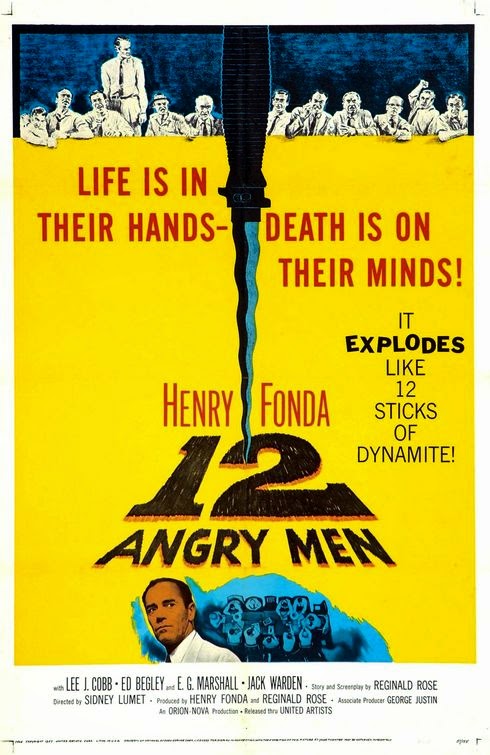
12 angry men 1957 - The finest courtroom drama


IMDB Link
IMDB rating: 8,9


Director: Sidney Lumet
Main Cast: Henry Fonda, Martin Balsam, John Fiedler, Lee J. Cobb, E. G. Marshall, Jack Klugman, Edward Binns, Jack Warden, Joseph Sweeney, Ed Begley, George Voskovec, Robert Webber


"Twelve Angry Men is a tightly wound top of a movie. Each scene ratchets up the tension another notch as Henry Fonda's character tries desperately to open the minds of his fellow jurors. The setting - a claustrophobic jury room in the dog days of summer - superbly augments the suspense. Operating within the constraints of a small budget, first-time director Sidney Lumet tightens the noose by accentuating the throbbing pulse of the ceiling fan and slowly narrowing his shots on his characters as the film approaches its climax. Based on Reginald Rose's well-known play, which had been adapted to the television screen three years earlier, Twelve Angry Men boasts a series of excellent performances by young actors who would soon become household names, including Jack Klugman, Jack Warden, and Martin Balsam. However, it is the film's established stars - Lee J. Cobb, E. G. Marshall and most importantly Fonda - who play the leads, delivering the goods like seasoned pros. The film has instructional value as a study of the inherent strengths and weaknesses of the jury system, but its real value is how it allows each member of the cultural mosaic of a jury to develop into distinct, damaged, and interesting characters. In a well-crafted metaphor for the broader outline of society, the jury members must confront their prejudices in order to see that justice prevails.
A pet project of Henry Fonda's, Twelve Angry Men was his only foray into film production; the actor's partner in this venture was Reginald Rose. A flop when it first came out (surprisingly, since it cost almost nothing to make), Twelve Angry Men holds up beautifully when seen today.
Nominated for three Oscars, Twelve Angry Men ran into the juggernaut of Bridge on the River Kwai and came up empty handed.
It was remade for television in 1997 by director William Friedkin with Jack Lemmon and George C. Scott." - www.allmovie.com


DVD links:


Saturday, November 8, 2014

The King and I 1956 - The much-loved family classic


IMDB Link
IMDB Rating: 7,5


Director: Walter Lang
Main Cast: Yul Brynner, Deborah Kerr, Rita Moreno, Martin Benson, Terry Saunders, Rex Thompson


"The King and I, Richard Rodgers and Oscar Hammerstein's 1951 Broadway musical hit, was based on Margaret Landon's book Anna and the King of Siam. Since 20th-Century-Fox had made a film version of the Landon book in 1946, that studio had first dibs on the movie adaptation of The King and I. It typifies the elaborate Broadway musical adaptations with which Hollywood studios often tried to fight the advance of television of 1950s. In general, The King and I tends to be somewhat stagey, with the notable exception of the matchless 'Small House of Uncle Thomas' ballet, which utilizes the Cinemascope 55 format to best advantage (the process also does a nice job of 'handling' Deborah Kerr's voluminous hoopskirts) to counter the smallness of the TV screen, offering equally grand set design, costumes, and cinematography. Most of the Broadway version's best songs ('Getting to Know You', 'Whistle a Happy Tune', 'A Puzzlement', 'Shall We Dance' etc.) are retained. None of the omissions are particularly regrettable, save for Anna's solo 'Shall I Tell You What I Think of You?' This feisty attack on the King's chauvinism was specially written to suit the talents of Gertrude Lawrence, who played Anna in the original production; the song was cut from the film because it made Deborah Kerr seem 'too bitchy' (Kerr's singing, incidentally, is dubbed for the most part by the ubiquitous Marni Nixon - who had been responsible for Natalie Wood's singing voice in West Side Story and Audrey Hepburn's in My Fair Lady). So the songs and performances are equally impressive: Yul Brynner - being the main attraction of the movie - won an Oscar for his career-best performance as the King of Siam, the role that made him a star and with which he will forever be identified." - www.allmovie.com

DVD links:


Friendly persuasion 1956 - Pacifism put to the test during the Civil War


IMDB Link
IMDB Rating: 7,5


Director: William Wyler
Main Cast: Gary Cooper, Dorothy McGuire, Anthony Perkins, Richard Eyer, Robert Middleton, Phyllis Love


"Friendly Persuasion is a charming, sensitive tale of a family of Quakers that attempts to maintain their pacifist ideals amid the turmoil of the U.S. Civil War. Best-known for playing quiet, understated characters who use violence when pushed too far, Gary Cooper gets the opportunity to explore a more peaceful resolution - though the film occasionally suggests that no person can be completely pacifistic. The tech credits are solid, as should be expected for a film directed by William Wyler; of particular note are Dimitri Tiomkin's score and Dorothy Jeakins's costume design. Though the film tends to exaggerate Quaker speech, the performances are convincing, and the screenplay (by blacklisted Michael Wilson) does a good job of transferring Jessamyn West's story to the screen. The film received six Oscar nominations, including Best Picture, though it did not win in any category." - www.allmovie.com

DVD links:


Giant 1956 - From rigid conservatism to mindless materialism


IMDB Link
IMDB Rating: 7,7


Director: George Stevens
Main Cast: Elizabeth Taylor, Rock Hudson, James Dean, Carroll Baker, Mercedes McCambridge, Dennis Hopper, Sal Mineo, Rod Taylor


"George Stevens' sprawling adaptation of Edna Ferber's best-selling novel successfully walks a fine line between potboiler and serious drama for its 210-minute running time, making it one of the few epics of its era that continues to hold up as engrossing entertainment across the decades. Even if it hadn't starred three of the most iconic screen figures of the 1950s, George Stevens's Giant would still be an emotionally powerful and visually striking film; adding Rock Hudson, Elizabeth Taylor, and James Dean (in his final performance) to the mix was just the icing on the cake. Dean contributes the highest-caliber fireworks, though his Method style sometimes blends uncomfortably with the more traditional performances of the other actors, but Stevens also drew atypically strong performances from Taylor and Hudson, who delivers perhaps his best performance on screen next to Seconds (1966). The story is a glorified soap opera, but Stevens's epic production strengthens the narrative rather than drowning it, providing a visual metaphor for the intimidating vastness of the Texas landscape. The image of the vast Benedict mansion slowly appearing as a tiny dot on the horizon is only the most memorable of the film's many indelible images. Giant is as big and sprawling as Texas itself; it's the tininess of the larger-than-life characters in the oilfields of the Southwest that keeps them human, and makes them all the more fascinating.
The talented supporting cast includes Mercedes McCambridge as Bick’s frustrated sister, put out by the new woman of the house, and with Carroll Baker and Dennis Hopper as the Benedict’s rebellious children.
Giant was nominated for 10 Academy Awards with director George Stevens winning his second Oscar for this ambitious, grandly realized epic of the changing socio-economic (and physical) landscape of modern Texas." - www.allmovie.com

DVD links:


Forbidden planet 1956 - The ultimate predecessor of cinematic space voyages


IMDB Link
IMDB Rating: 7,7


Director: Fred M. Wilcox
Main Cast: Walter Pidgeon, Anne Francis, Leslie Nielsen, Warren Stevens, Jack Kelly, Richard Anderson, Earl Holliman, Robby the Robot


"At the time Forbidden Planet came along, science fiction hadn't existed for all that long as a movie genre, having really only established itself after World War II as distinct from horror films and movie serials. And there had been some serious science fiction films made up to that time - most notably, Robert Wise's The Day the Earth Stood Still (1951). But science fiction was still considered primarily a genre that appealed to children, centered on action and adventure, without undue plot complexities or character relationships. Forbidden Planet changed all that, without sacrificing a genuine sense of wonder and other elements that juvenile audiences could enjoy. At the time, people mostly noticed the special effects, perhaps the best ever done up to that time and for many years beyond; it was the first movie that could convince viewers, moment to moment, that they were out in space or on some alien planet. Forbidden Planet's real importance, however, lay in respecting its audience, including the kids, enough to steep its plot in psychology and to make some statements about human nature that were pretty strong stuff in the midst of the Cold War, with both sides detonating H-bomb tests on a regular basis. The movie walks an even more precarious tightrope with its subplot about nubile Anne Francis' relationship with her father and the officers of the starship that has just landed in their two-person paradise. The plot was adapted from William Shakespeare's The Tempest, which flabbergasted (and distressed) some critics but helped draw a new, more serious viewer to this kind of movie. Forbidden Planet was so good, in fact, that it proved an impossible act to follow, and no one tried for almost a decade. But its influence trails out for a half-century beyond: Gene Roddenberry drew most of his ideas about the crew, officers (and their personal relationships), and setting of Star Trek from Forbidden Planet's script and set designs, and George Lucas' funny androids (not to mention Lost in Space's helpful robot servant) have their origins in Forbidden Planet's Robby the Robot. And one can only guess at what luck Stanley Kubrick might've had getting financing for 2001: A Space Odyssey, especially out of MGM, had it not been for the precedent of Forbidden Planet." - www.allmovie.com

DVD links: