Have a good time learning about and watching these classic movies and if you can, buy the DVD! (You can keep movies alive and support this blog this way!)
DVD links will be added movie by movie - from where you can pick your own favorite one. (Isn't it wonderful to have your own?)
And please take a look at my other blogs too! (My Blog List below)

Search this blog

Showing posts with label 1939. Show all posts

Wednesday, April 23, 2014

The roaring twenties 1939 - The torrid, blazing, wild, lush, lurid twenties


IMDB Link
IMDB rating: 7,9


Director: Raoul Walsh
Main Cast: James Cagney, Humphrey Bogart, Priscilla Lane, Gladys George, Jeffrey Lynn, Frank McHugh


"Raoul Walsh was one of cinema's greatest action directors in both silents and talkies, and The Roaring Twenties was a breakthrough film for him. Though he had directed standard comedies and melodramas before the film, Twenties would secure him a reputation as a bankable action director at Warner Bros. in the late 1930s. James Cagney, one of the great leads of the gangster-movie era, turns in an assured performance in the film: his demise on the snowy steps of a church is one of the most famous death scenes in movie history. Humphrey Bogart has a memorable supporting performance, though he would not become a big star until two years after the film, in Walsh's High Sierra and John Huston's The Maltese Falcon. Cagney and Bogart appeared together in two other movies, the gangster melodrama Angels with Dirty Faces and the Western The Oklahoma Kid." - www.allmovie.com

DVD links:


Wuthering heights 1939 - Torn with desire, tortured by hate!


IMDB Link
IMDB rating: 7,8


Director: William Wyler
Main Cast: Laurence Olivier, Merle Oberon, David Niven, Flora Robson, Donald Crisp, Geraldine Fitzgerald


"William Wyler's Wuthering Heights is one of the earliest screen adaptations of the classic Emily Brontë novel. Together with Gone With the Wind, Wuthering Heights represents the pinnacle of 1930s Hollywood romanticism. Laurence Olivier's contemptuous treatment of Merle Oberon in the film may have been partly heartfelt: He had wanted the great love of his life, Vivien Leigh, to play Cathy, but producer Samuel Goldwyn didn't see things that way, especially since Gone With the Wind had not yet established Leigh as a star of international magnitude. Though director William Wyler, cinematographer Gregg Toland, and art director James Basevi convincingly re-create the storm-tossed moors of Yorkshire, Wuthering Heights was filmed in California's Conejo Hills with extensive 'exterior' work within studio walls. The last image, of Heathcliffe and Cathy joyously walking hand in hand into the hereafter, is a bit of audience-pleasing idiocy which Wyler was dead set against: Neither he nor stars Olivier and Oberon participated in this scene (the actors were replaced by their stand-ins). Despite this artistic gaffe, Wuthering Heights is a well-nigh perfect example of studio-system moviemaking." - www.allmovie.com

DVD links:


Ninotchka 1939 - Garbo laughs!


IMDB Link
IMDB rating: 8,0


Director: Ernst Lubitsch
Main Cast: Greta Garbo, Melvyn Douglas, Ina Claire, Bela Lugosi


"Ninotchka connects the careers of 1930s directing great Ernst Lubitsch and future directing great Billy Wilder, who was among a quartet of writers who did credited work on this film. The film evidences the strength of both, Lubitsch's lighter style works together with Wilder's more cutting dialogue. The production values and tech credits are first-rate, with the glossy look and classy feel that were the hallmarks of MGM in this era. Greta Garbo, with more than a little self-parody, proves herself adept at comedy, and Melvyn Douglas shows why he was one of the screen's most in-demand romantic leads of the 1930s. This is one of the rare opportunities to see Bela Lugosi in a likable, non-horrific role, though it was, regrettably, Lugosi's last supporting performance in a high-budget film. Douglas, on the other hand, would unexpectedly emerge in later decades as one of the screen's best and most versatile dramatic actors." - www.allmovie.com

DVD links:


The hunchback of Notre Dame 1939 - The best film version of Hugo's classic tale


IMDB Link
IMDB rating: 7,9


Director: William Dieterle
Main Cast: Charles Laughton, Maureen O'Hara, Cedric Hardwicke, Thomas Mitchell, Edmond O'Brien


"Few will argue with the contention that RKO Radio's 1939 adaptation of Victor Hugo's The Hunchback of Notre Dame was the best of the many screen versions of the Hugo classic.
Set in fifteenth century France, The Hunchback of Notre Dame captures the medieval era's tumult, as superstition and prejudice war with progress, both material and intellectual. Church and state unite to attempt to hold back the waves of change sweeping over Europe, as it rides the crest of the Renaissance. Charles Laughton's performance as Quasimodo, the misshapen protagonist, is every bit as moving as Lon Chaney's work in the earlier silent film. Overcoming his physical deformity and status as social outcast, Quasimodo represents all that is most noble and heroic about mankind, while the physically commanding Frollo, a man of immense political and religious power, acts as his morally corrupt and sexually repressed counterpoint. Maureen O'Hara's film debut is also memorable; the passions she inspires in the men around her are wholly believable. The recreation of medieval Paris is an awesome achievement, and the elegance of the production values is indisputable. Director William Dieterle manages a difficult task well, creating a film of both great sweep and remarkable intimacy. The film takes some liberties with the source material, but it captures the essence of Victor Hugo's novel very well. It was nominated for two Academy Awards (music and sound); Laughton's definitive performance was overlooked by the Academy." - www.allmovie.com

DVD links:


Gunga Din 1939 - The ultimate motion picture adventure


IMDB Link
IMDB rating: 7,6


Director: George Stevens
Main Cast: Cary Grant, Joan Fontaine, Victor McLaglen, Douglas Fairbanks Jr., Sam Jaffe


"George Stevens' Gunga Din was not only the best of Hollywood's forays into colonialist adventure yarns, it served as the blueprint for many action-adventure movies for years after its release. It is a tribute to Stevens' direction and the uniformly superb cast that the film was a rousing success upon its release, and has endured as a popular favorite for decades since. Americans have always had problematic relationships with stories of British colonialism, but they also love a good adventure yarn, and the usual Hollywood compromise is to ignore the particulars, hold one's nose at the worst elements of subjugation, and just tell the story. That was the approach of the five screenwriters (including Ben Hecht, Charles MacArthur and the uncredited William Faulkner) involved in the project, and director Stevens adhered to their work to the letter in telling Rudyard Kipling's story of life, love, and adventure on the frontier of the Indian subcontinent. In the film, the British army is a peace-keeping force, protecting the native populace from a murderous cult of religious fanatics who kill anyone in their way, including their own people. If the paternalistic attitude of the British seems heavy-handed, the oversight is more than outweighed by the savagery of the characters they're fighting. The pacing includes room for ample roughhousing, some of it bordering on slapstick, and rich character development. The actors play their parts as though they were born for them: Victor McLaglen, in particular, cuts a surprisingly dashing figure as Sergeant McChesney; the actor was nearly a decade away from settling into the more comical and jovial character roles that he played in John Ford's films. Cary Grant displays a larcenous side to his screen persona which in many ways anticipates his most compelling dramatic performance, in None But the Lonely Heart. Ironically, for a film that introduced author Kipling to the mass public than any other adaptation of his work, Gunga Din ran afoul of the sensibilities of the author's widow, who objected to the scenes depicting an unnamed, Kipling-like journalist, and those shots were cut at her request after the first run of the movie. These scenes would remain unseen until the late 1980s, when they were restored under the auspices of Turner Entertainment, the company that purchased the RKO film library.
Originally slated to be directed by Howard Hawks, Gunga Din was taken out of Hawks' hands when the director proved to be too slow during the filming of Bringing Up Baby. His replacement was George Stevens, who proved to be slower and more exacting than Hawks had ever been!" - www.allmovie.com

DVD links:


The wizard of Oz 1939 - The movie which catapulted Garland into stardom


IMDB Link
IMDB rating: 8,1


Director: Victor Fleming
Main Cast: Judy Garland, Frank Morgan, Ray Bolger, Bert Lahr, Jack Haley, Billie Burke, Margaret Hamilton


"The third and definitive film adaptation of L. Frank Baum's 1900 children's fantasy, this musical adventure is a genuine family classic that made Judy Garland a star for her heartfelt performance as Dorothy Gale, an orphaned young girl unhappy with her drab black-and-white existence on her aunt and uncle's dusty Kansas farm. Dorothy yearns to travel 'over the rainbow' to a different world, and she gets her wish when a tornado whisks her and her little dog, Toto, to the Technicolorful land of Oz.
The lavish MGM production of L. Frank Baum's children's book may have lost a million dollars on its initial release, but its songcraft, technical artistry, star-making performance from Judy Garland, and unexpected TV success turned it into a perennial classic. With future ace MGM musical producer Arthur Freed lending producer Mervyn LeRoy an uncredited hand in pre-production, Cedric Gibbons' art direction, Adrian's costumes, and Hal Rosson's sparkling cinematography maximized the creative potential of Technicolor film, as Dorothy goes 'over the rainbow' from a sepia-toned black-and-white Kansas to a fantastically rendered Oz of ruby slippers, emerald cities, and yellow brick roads. Lent ample support by vaudeville vets Ray Bolger, Jack Haley, and Bert Lahr, neophyte Garland delivered a touching performance as Dorothy, proving that she had the acting talent to match her superb singing. As with Gone With the Wind, the film went through several directors and Victor Fleming got the credit; King Vidor directed the Kansas sequences, including Garland's solo 'Over the Rainbow'. Almost cut for the sake of pacing, 'Over the Rainbow' became an Oscar winner for Best Song and a Garland standard. Garland was MGM's second choice for Dorothy after Shirley Temple dropped out of the project; and Bolger was to have played the Tin Man but talked co-star Buddy Ebsen into switching roles. When Ebsen proved allergic to the chemicals used in his silver makeup, he was replaced by Haley. Gale Sondergaard was originally to have played the Wicked Witch of the West in a glamorous fashion, until the decision was made to opt for belligerent ugliness, and the Wizard was written for W.C. Fields, who reportedly turned it down because MGM couldn't meet his price. Although the 2.7-million-dollar film wilted at the box office, The Wizard of Oz was nominated for several Oscars, including Best Picture (which it lost to Gone With the Wind), winning for Herbert Stothart's score and Harold Arlen and E.Y. Harburg's song. It was the first feature sold for prime-time TV telecast, and its 1956 TV debut was a ratings hit, finally turning it into the crowd-pleasing blockbuster that MGM had always meant it to be." - www.allmovie.com

DVD links:


Mr. Smith goes to Washington 1939 - One of the greatest American films about American ideals


IMDB Link
IMDB rating: 8,3


Director: Frank Capra
Main Cast: James Stewart, Jean Arthur, Claude Rains, Edward Arnold, Guy Kibbee, Thomas Mitchell, Eugene Pallette, Beulah Bondi


"Frank Capra's classic comedy-drama established James Stewart as a lead actor in one of his finest (and most archetypal) roles. Mr. Smith Goes to Washington was the director's final film for Columbia Pictures, the studio where he'd made his name in the 1930s with an enviable array of comedies and topical dramas. It also marked a turning point in Capra's vision of the world, from nervous optimism to a darker, more pessimistic tone. Beginning with American Madness in 1932, such Capra films as Lady for a Day, It Happened One Night, Mr. Deeds Goes to Town, and You Can't Take It With You had trumpeted their belief in the decency of the common man. In Mr. Smith Goes to Washington, however, the decent common man is surrounded by the most venal, petty, and thuggish group of yahoos ever to pass as decent society in a Capra movie. Everyone in the film - except for Jefferson Smith and his tiny cadre of believers - is either in the pay of the political machine run by Edward Arnold's James Taylor or complicit in Taylor's corruption through their silence, and they all sit by as innocent people, including children, are brutalized and intimidated, rights are violated, and the government is brought to a halt. The film's story of innocence and righteousness triumphant over corruption frames a chilling picture of an ineffectual and venal government fronting for gangsters. Coming at a time when the American public was growing weary (and wary) of the New Deal, then in its seventh year, it may have caught the public's mood just right. The world was indeed becoming a darker place - as the movie acknowledges by the presence of representatives of various European dictatorships in the Senate gallery as Smith's struggle on the Senate floor continues. The movie was so potent in its time that it cemented the image of James Stewart, then a good working dramatic actor who'd portrayed a range of roles, into the quintessential good-natured hero, the archetypal common man. That image made him a star, but also straightjacketed him to some degree. Stewart did some of his most interesting work in later years when he escaped from that image, as in Winchester '73, The Far Country, Rope, and Vertigo." - www.allmovie.com

DVD links:


Young Mr. Lincoln 1939 - Great Ford, great Fonda, authentic American film-making


IMDB Link
IMDB rating: 7,7


Director: John Ford
Main Cast: Henry Fonda, Alice Brady, Marjorie Weaver, Arleen Whelan, Eddie Collins, Pauline Moore


"More hagiography than biography, Young Mr. Lincoln took such outrageous liberties with historical fact that its value as a portrait of the nation's sixteenth president remains questionable. Nevertheless, the performance of Henry Fonda and the assured, fully engaged direction of John Ford placed Young Mr. Lincoln among both men's best work. Indeed, 1939 came to be regarded as Ford's annus mirabilis, the year in which he began his ascent to legend status, directing not only Young Mr. Lincoln but also Drums Along the Mohawk and Stagecoach. It is ironic that Young Mr. Lincoln came to be so well regarded, since neither Ford nor Fonda initially wanted to do the picture. A pair of plays about Lincoln's younger years had just enjoyed success on Broadway, so a reluctant Ford was pressured by Fox producer Darryl F. Zanuck to tackle what was essentially a studio assignment. On reading the script by Lamar Trotti, however, the zealously patriotic Ford became more enthusiastic about the film's all-American subject matter, even persuading a reluctant Fonda to take the lead role. Intimidated by playing such an august historical figure, Fonda at first rejected the part, but he changed his mind during a meeting in which Ford reportedly told the skittish star that he would be playing not 'the Great Emancipator' but 'a jack-legged lawyer from Springfield, Illinois - a gawky kid still wet behind the ears who rides a mule because he can't afford a horse'. When Ford clashed with Zanuck over the film's slow pace and grew fearful that the studio would ruin his film in post-production, he destroyed the negatives of every take he disliked and did in-camera editing. The studio disappointed Ford anyway, excising a scene in which Lincoln and a young John Wilkes Booth have a friendly encounter. Like that scene, most of Young Mr. Lincoln is pure Hollywood balderdash, resting on only the slimmest tissue of truth. For instance, the real murder trial depicted in the film was based not on one tried by Lincoln but on a real-life courtroom drama witnessed by Trotti, who had covered it as a reporter. Though it was not in any way an authoritative view of its subject, Young Mr. Lincoln was a masterpiece of cinema, showcasing a writer, director, and star at the top of their games. In a supreme irony, Young Mr. Lincoln was a major inspiration for master Soviet filmmaker Sergei Eisenstein in the creation of his propagandistic classic, Ivan the Terrible (1944)." - www.allmovie.com

DVD links:


The women 1939 - It's all about men!


IMDB Link
IMDB rating: 8,0


Director: George Cukor
Main Cast: Norma Shearer, Joan Crawford, Rosalind Russell, Mary Boland, Paulette Goddard, Joan Fontaine


"Based on the Clare Booth Luce play of the same name, this MGM comedy is famous for its all-female cast and deft direction by George Cukor. The themes explored in Clare Boothe Luce's play were so modern in 1939 that audiences found the film audaciously relevant, yet so timeless and universal that The Women could be successfully revived on Broadway in 2001, starring Jennifer Tilly, Kristen Johnston, and Cynthia Nixon. The film crackles with a sharp-toothed sarcasm even on a modern viewing. George Cukor's deft pacing and evident facility with actors (or, we should say, actresses) make The Women both a scathing and hilarious indictment of the institution of marriage. No less important, in fact probably more so, is the film's portrayal of the women's mercenary competitiveness. The ruthlessly casual deceptions they practice on each other are authenticated by the playwright's gender, as well as that of her adapters (Anita Loos and Jane Murfin). The Women recasts the discourse of high society as an exercise in the Darwinism of the animal kingdom, starting with an opening credits sequence that assigns an animal role to each character, from sly fox to gentle lamb. The opening shot says it all, as two dogs aggressively (and metaphorically) yap at each other as their pampered owners restrain them, all against a cacophony of background gossip. The women's ironic commentary on the regimen of exercise and beautification they must maintain to keep their men takes over from here, as does the rapid repartees and the almost incidental backstabbing. Casting the film entirely with women works beautifully, never straining the logic or staging, and the handful of leads each share the credit with Luce and Cukor for a fully realized farce on the warfare of feminine politics and societal advantage.
Snappy, witty dialogue, much of it courtesy of veteran screenwriter Anita Loos, helps send this film's humor over the top. So do the characterizations - Crawford is as venomous as they come, and this was Russell's first chance to show what she could do as a comedienne. And don't discount Shearer - her portrayal of good-girl Mary is never overpowered by these two far-flashier roles. Do keep an eye on the supporting players, though, especially Mary Boland as the Countess DeLage. The role was based on a cafe society dame of that era, the Countess DiFrasso, who had a wild affair with Gary Cooper; that romance is satirized here." - www.allmovie.com

DVD links:


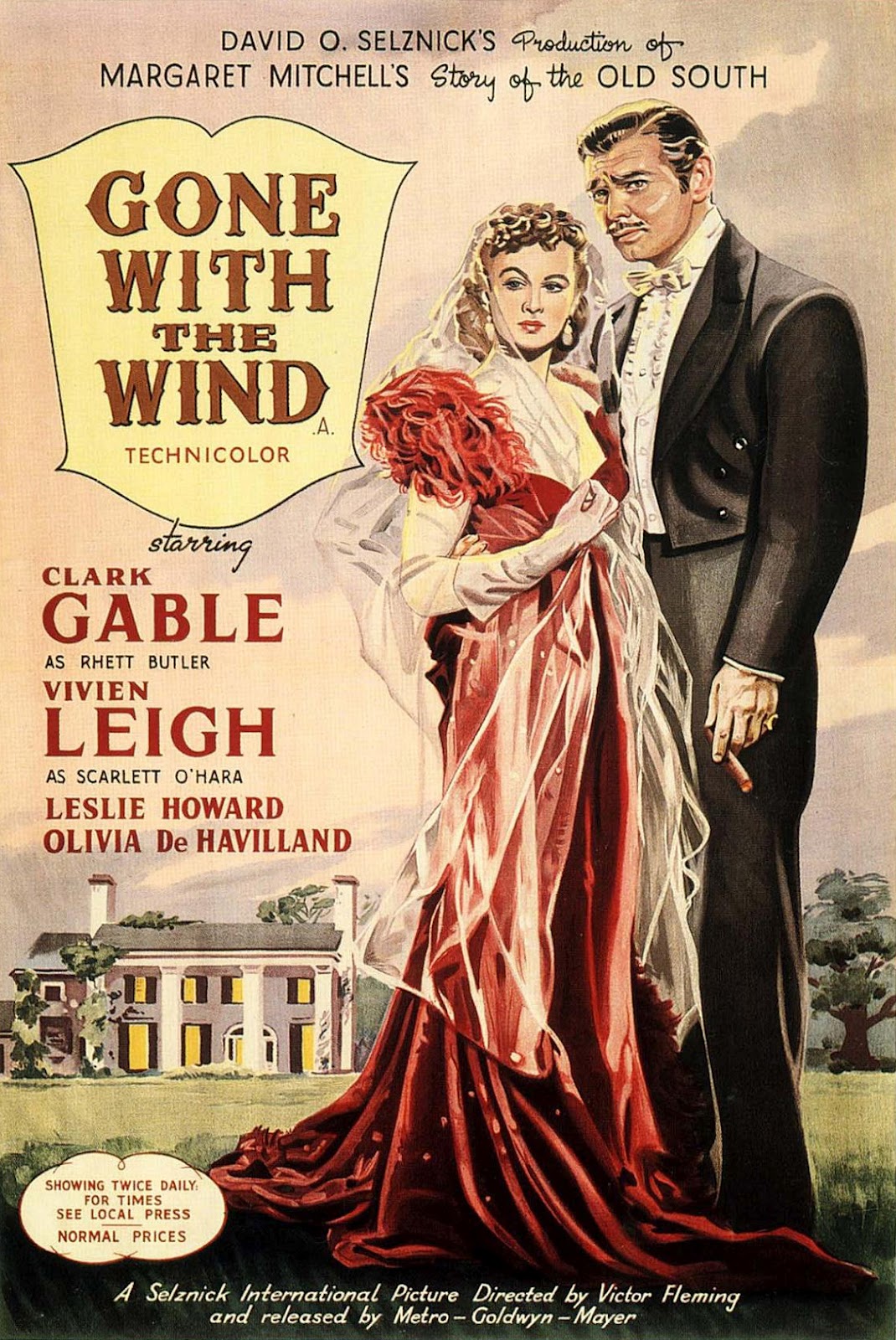
Gone with the wind 1939 - One of the greatest achievements in film history


IMDB Link
IMDB rating: 8,2


Director: Victor Fleming (George Cukor)
Main Cast: Vivien Leigh, Clark Gable, Leslie Howard, Olivia de Havilland, Thomas Mitchell, Hattie McDaniel, Evelyn Keyes, Ann Rutherford


"As epic as the 1,000-plus-page Margaret Mitchell bestseller on which it was based, David O. Selznick's production of Gone With the Wind (1939) went through three directors, a well-publicized search for Scarlett O'Hara, and a then-enormous four-million-dollar budget, resulting in one of the all-time highest-grossing movies. Sparing no expense on sets and costumes, Selznick aimed to produce the ultimate Technicolor blockbuster, faithfully adapting the book's Civil War era travails of Southern belle Scarlett and her roguish match, Rhett Butler. While the film is grand in scale (and length), its cast, especially relative unknown Vivien Leigh as Scarlett and MGM king Clark Gable as Rhett, made the narrative as engrossing as the spectacular recreation of the burning of Atlanta (in which old sets were torched). Premiering first in Atlanta, Gone With the Wind delivered on the promise of the hype, breaking box-office records. Earning an unprecedented 13 Oscar nominations, Gone With the Wind won eight statuettes and two special awards, taking Best Picture in Hollywood's 'miraculous' year, as well as Best Director for Victor Fleming, and Best Actress for Vivien Leigh. Best Supporting Actress Hattie McDaniel became the first African-American actor to win an Oscar.
The film grossed nearly 192 million dollars, assuring that, just as he predicted, Selznick's epitaph would be 'The Man Who Made Gone With the Wind'." - www.allmovie.com

DVD links:


Goodbye Mr. Chips 1939 - Donat gives one of the best performances in movie history


IMDB Link
IMDB rating: 7,7


Director: Sam Wood
Main Cast: Robert Donat, Greer Garson, Terry Kilburn, John Mills, Paul Henreid


"Goodbye, Mr. Chips (based on James Hilton's novel) is another classic from 1939, featuring a performance by Robert Donat that is one of the most fondly remembered in 20th century filmmaking. A crisp and intelligent film in all aspects, it avoids the maudlin sentimentality that often hinders films of this sort. It has held a continuing influence on filmmakers - for example, both Dead Poets Society and Mr. Holland's Opus would seem to be direct spiritual descendants. The film is at its most powerful when evoking an appealing view of the past, when manners and honor were primary values, and when spending one's life in service to others was a noble art. Donat was the recipient of a Best Actor Oscar for his portrayal of the title character, and the film features the debut performance of a young Greer Garson.While its two remakes have substantial merit, the original version remains the best. It may, however, be too old-fashioned to appeal to some of today's moviegoers." - www.allmovie.com

DVD links:


Stagecoach 1939 - Lifting the Western genre and John Wayne up to A-movie status


IMDB Link
IMDB rating: 7,9


Director: John Ford
Main Cast: John Wayne, Claire Trevor, Andy Devine, John Carradine, Thomas Mitchell


"Although there were Westerns before it, Stagecoach quickly became a template for all movie Westerns to come. Director John Ford combined action, drama, humor, and a set of well-drawn characters in the story of a stagecoach set to leave Tonto, New Mexico for a distant settlement in Lordsburg, with a diverse set of passengers on board.
Relegated to B-movie status by the mid-1930s, the western was regenerated most prominently by John Ford's Stagecoach in 1939. Ford and screenwriter Dudley Nichols artfully balanced the genre's standard action with the character studies and quality production values of prestigious 1930s films. In the microcosm of the stagecoach, the confrontation between 'civilization' and 'savagery', Western future and Eastern past, is played out among characters journeying through hostile Apache territory, with honor-bound outlaw Ringo fighting valiantly for a society that shuns him. Though not the top-billed player, and then a B-movie actor, John Wayne as Ringo became the star hero from the moment that Ford introduces him with a rare kinetic flourish. Ford here introduced his signature Western setting of Monument Valley, lending Stagecoach a realism that set it apart from studio-bound films; and his deep focus interiors preceded Citizen Kane by two years. When he made Citizen Kane, Orson Welles claimed that he learned everything about directing movies from watching Stagecoach more than 40 times.
A critical and commercial success, Stagecoach offers plenty of cowboys, Indians, shootouts, and chases, aided by Yakima Canutt's remarkable stunt work and Bert Glennon's majestic photography of Ford's beloved Monument Valley. It also offers a strong screenplay by Dudley Nichols with plenty of room for the cast to show its stuff. John Wayne's performance made him a star after years as a B-Western leading man, and Thomas Mitchell won an Oscar for what could have been just another comic relief role. Thousands of films have followed Stagecoach's path, but no has ever improved on its formula." - www.allmovie.com

DVD links:


Of mice and men 1939 - Steinbeck's classic invisioned perfectly


IMDB Link
IMDB rating: 7,7


Director: Lewis Milestone
Main Cast: Lon Chaney Jr., Burgess Meredith, Betty Field, Charles Bickford


"This 1939 film version of John Steinbeck's classic novel was a surprising choice for comedy producer Hal Roach; in fact, Roach had no intention of filming the property until forced to do so as a result of a lawsuit brought by director Lewis Milestone. Milestone was a filmmaker of many parts - in the silent era, he had been known for his skills as a director of comedies, while with the dawn of sound films, he was responsible for one of the most enduring and serious dramas of the time, All Quiet On The Western Front (1930), which is among the earliest sound films that is considered easily watchable by modern audiences; and across the 1930's, he moved between romantic comedies (The Captain Hates The Sea) and serious, topical dramas (The General Died At Dawn). But it was with Of Mice And Men in 1939 that he came into his own as a stylist and he ended up with one of the most prestigious movies ever to come out of Hal Roach Studios, nominated for four Academy Awards. This adaptation of John Steinbeck's short novel, appearing just two years after the book's publication, was released in the same year as John Ford's more prestigious and star-powered adaptation of the author's The Grapes Of Wrath, and yet it still managed to impress critics and audiences. The performances by Burgess Meredith as George and Lon Chaney, Jr. as Lenny (a role he had to maneuver and campaign for to earn a shot at) possess and immediacy that makes them seem like finely-honed theater work. And Milestone also got superb performances out of a supporting cast that included Bob Steele (essaying his first 'serious' role, after years of playing in B-westerns), Betty Field, Charles Bickford, Noah Beery, Jr., Leigh Whipper, and Roman Bohnen. For many of those concerned, this movie would be some of the best work they ever did; with just a few lines in a very spare script, all of these players create memorable and finely-etched characters, that audiences know and understand in just a few frames, their work filling out the corners and background of this story in fine, full dramatic form. Composer Aaron Copland, then 39 years old and coming into the production on the late end (as film composers usually do), also rose to the occasion, on his first opportunity to score a movie. The result was a poetic and lyrical film that was perhaps a little less bravura than Ford's masterpiece, but no less haunting in its nuances and its overall impact. Milestone later tried to repeat the artistic success, working as an independent producer/director under the auspices of Republic Pictures, on The Red Pony, with slightly less impressive results.
 Of Mice and Men retains its raw dramatic power. On its initial release, however, it proved a bit too powerful for many filmgoers, and it lost money.
The 1981 TV remake of Of Mice and Men starring Robert Blake and Randy Quaid, was a virtual scene-for-scene remake of the 1939 version. The 1993 theatrical remake, starring Gary Sinise (who also directed) and John Malkovich, is perhaps closer to the source than its predecessors, but only time will tell if it attains the classic status of the Lewis Milestone version." - www.allmovie.com

DVD links:


The four feathers 1939 - 'When war was war and men were men!'


IMDB Link
IMDB rating: 7,7


Director: Zoltan Korda
Main Cast: John Clements, Ralph Richardson, C. Aubrey Smith, June Duprez


"This was the first sound production of A.E.W. Mason's classic adventure novel, which was brought to the screen three times in the silent era. Zoltan Korda's 1938 The Four Feathers was the last and best traditional patriotic film of the pre-World War II era. The movie benefited from glorious Technicolor photography and unique location shooting: Korda and his second unit crew, under Osmond H. Borradaile, not only shot the action scenes where the battles really took place but also included among the extras people who'd actually seen the fighting (and participated in it) 45 years earlier. Coupled with Korda's skills as an action director (he'd been a cavalry officer, and he knew how to move men and their mounts quickly and to good effect), the result was a movie that captured the imagination of the public on the eve of World War II with its vision of self-sacrifice and gallantry. The movie is a reminder of a time when it was possible to believe that armies could liberate peoples from tyranny, and that the use of force could be a good thing. The film is not unquestioning in this belief, as attested by its brutally humorous treatment of the aging general played by Sir C. Aubrey Smith ('Those were the days when war was war, and men were men'), but ultimately it comes down on the side of action as opposed to inaction. Korda's and Borradaile's African footage was so good that it has been reused in dozens of other movies (including remakes of this one).
The Four Feathers was a great critical and commercial success and received an Academy Award nomination for Best Cinematography.
Follow That Camel, by the British Carry On company, was a direct and savage satire of The Four Feathers." - www.allmovie.com

DVD links:


Destry rides again 1939 - Pure gold from the golden age


IMDB Link
IMDB rating: 7,7


Director: George Marshall
Main Cast: James Stewart, Marlene Dietrich, Mischa Auer, Charles Winninger, Brian Donlevy


"Destry Rides Again was a huge critical and box-office success in 1939, a year that had many critical and box-office successes and that is often considered to have produced more great films than any other year of the 20th century. Max Brand, the author of the source novel, is little remembered today, but in his era he was a prolific and popular writer who created such memorable screen successes as the Doctor Kildare series. Sadly, Brand was killed at the height of his career, while serving as a war correspondent in Italy during World War II. Brand's story was considerably changed for the screen, and as a result there are occasional inconsistencies of characterization for Destry, who sometimes seems a bit too inclined to fight for a pacifist. Yet, in Tom Destry, James Stewart creates one of the screen's most likable characters, and the film's success revived the career of Marlene Dietrich, who had been dumped from her studio contract by Paramount because of her temperamental behavior and perceived weak box-office appeal. The problem, though, proved to be not that audiences had tired of Dietrich but that they had tired of her in the melodramatic films that Paramount put her in. Free of Paramount, Dietrich found a broader range of work and once again became a bankable star." - www.allmovie.com

DVD links:


Monday, February 20, 2012

Babes in arms 1939 - Let's put on a show!


IMDB link: http://www.imdb.com/title/tt0031066/?ref_=nv_sr_1
IMDB rating: 6,6


Director: Busby Berkeley
Main Cast: Mickey Rooney, Judy Garland, Charles Winninger, Guy Kibbee


"Babes in Arms is a prime example of the 'let's put on a show' musical popular in the 1930s and 1940s. The nominal plot is little more than a means of connecting the elaborate production numbers; the supporting cast are little more than props for stars Mickey Rooney and Judy Garland. Busby Berkeley's direction is able and functional: like the audience, he's just eager to get to the next dance set. MGM had other priorities at the time of Babes' production - most notably Garland's classic The Wizard of Oz, on which the studio lost money, and the expensive, lucrative Gone With the Wind - so the budget for the Berkeley musical was surprisingly low. What Babes in Arms lacks in production grandeur, however, it amply compensates with the captivating star turns from Rooney and Garland." - http://www.allmovie.com/movie/babes-in-arms-v3541/

DVD links:


The Mikado 1939 - Gilbert & Sullivan on the screen


IMDB link: http://www.imdb.com/title/tt0031650/?ref_=fn_al_tt_1
IMDB rating: 6,7


Director: Victor Schertzinger
Main Cast: Kenny Baker, John Barclay, Martyn Green, Jean Colin, Constance Willis


"Though it boasts an American director and star, this Technicolor cinemadaptation of Gilbert and Sullivan's comic operetta The Mikado is a faithful record of what it must have been like to attend a performance of Britain's D'Oyly Carte opera company. Rradio tenor Kenny Baker stars as Nanki-Poo, the wand'ring minstrel who wanders into a curious set of situations in the Japanese village of Titi-Pu. D'Oyly Carte perennial Martyn Green plays the leading role of Ko-Ko, the timorous Lord High Executioner who must perform one execution per day or he'll lose his job-and his own head. Ko-Ko finds a likely candidate for decapitation in the form of Nanki-Poo, who feels mighty suicidal when it seems as though his sweetheart Yum-Yum (Jean Cola) is out of his reach. Unbeknownst to Ko-Ko, Nanki-Poo is the son of none other than The Mikado, played with a combination of pomp, circumstance and Noel Cowardlike waspishness by Sydney Granville. Most of the satirical Gilbert & Sullivan songs have been retained, including 'The Lord High Executioner', 'Three Little Maids from School are We', 'Tit Willow', 'Here's a How-de-Do', and 'The Object Most Sublime'. Musical accompaniment is provided by the London Symphony Orchestra." - http://www.allmovie.com/movie/the-mikado-v32631

DVD links:


The rains came 1939 - Exotic melodrama with a great spectacle


IMDB link: http://www.imdb.com/title/tt0031835/?ref_=fn_al_tt_1
IMDB rating: 7,0


Director: Clarence Brown
Main Cast: Myrna Loy, Tyrone Power, George Brent, Brenda Joyce, Nigel Bruce, Maria Ouspenskaya, Joseph Schildkraut, Mary Nash, Jane Darwell


"Devotees of Louis Bromfield's novel that provides the basis for The Rains Came - even any such devotees there still are - will be disappointed by the film version of the novel, but they're likely to be the only ones. True, Rains simplifies the book in the most basic way, stripping it of its social context and commentary and leaving little more than the love story and the plot outline. But Rains works like gangbusters on film, precisely because of this treatment. Modern audiences, more accustomed to this sort of tragic romance, will perhaps find it a bit familiar, but they'll be swept up in the story and won over by the struggle of Man against Nature. They may be less won over by the casting of white-only performers in the lead Indian roles, but this was standard practice at the time. As the chief 'Indian', Tyrone Power turns in a delicious performance, the kind of movie star turn that the film requires. Even better is the delectable Myrna Loy, back in her old 'not-so-good girl' territory and having a blast, while at the same time spreading her special celluloid magic over the whole proceedings. George Brent is so-so, but young Brenda Joyce is vivaciously refreshing and old Nigel Bruce gets a chance to stretch beyond his traditional Doctor Watson persona and does so notably. There's also a nice, characterful turn from Maria Ouspenskaya as the Maharini. Clarence Brown directs with assurance and flair, and he makes the most of the earthquake/flood sequence that is the film's undeniable highlight. This is truly spectacular and impresses even today, in the world of CGI effects. Thrilling and engaging, Rains is dynamite fun." - http://www.allmovie.com/movie/the-rains-came-v107209

DVD links:


Gulliver's travels 1939 - The characters of Jonathan Swift's immortal fantasy come to life!


IMDB link: http://www.imdb.com/title/tt0031397/?ref_=nv_sr_3
IMDB rating: 6,9


Director: Dave Fleischer


"For the first animated feature by the Fleischer studio, Jonathan Swift's Gulliver's Travels seemed a natural fit. Oversimplification of the story aside, Gulliver's Travels is lively entertainment that retains a great deal of charm. It is also filled with some genuinely enjoyable moments, especially the Lilliputians' initial encounter with Gulliver, and their subsequent attempt to tie him up. The film is further aided by the scenery which evokes the magical appeal of an ancient, tiny kingdom. Unfortunately, in most other areas it becomes obvious that Gulliver's Travels was made in a rush. The songs, including the Oscar-nominated 'Faithful Forever', are far from memorable, the writing is sloppy and creates the impression that the first draft was the final draft, and worst of all, the animation is wildly inconsistent. For instance, the Lilliputians and their Blefuscu counterparts are the closest to the Fleischer tradition and the most cartoonish, drawn in a very fluid manner as absurdly shaped humans with exaggerated features. But for some unknown reason, Prince David, Princess Glory, and Gulliver himself are drawn in a much more "natural" fashion and as a result look as if they are from an entirely different movie. On the plus side, there are some slight gags tossed in to bring humor to the story. For example, when the hideout of Sneak, Snoop, and Snitch is burning, one of the spies takes the opportunity to make shadow puppets; and earlier, as the Lilliputians are panicking when they think Gulliver is going to invade, one villager seen fainting in her window bears an unmistakable resemblance to Snow White. Gulliver's Travels falls far short of its potential, and despite its worthwhile moments, probably just served to solidify Disney's domination of the animated-feature market." - http://www.allmovie.com/movie/gullivers-travels-v21099/

Download links:


Intermezzo 1939 - Ingrid Bergman's impressive American debut


IMDB link: http://www.imdb.com/title/tt0031491/?ref_=nv_sr_1
IMDB rating: 6,8


Director: Gregory Ratoff
Main Cast: Leslie Howard, Ingrid Bergman, Edna Best, John Holliday, Cecil Kellaway, Ann Todd


"The film that introduced Ingrid Bergman to an adoring American public, Intermezzo is pure, old-fashioned melodrama. Were it to be attempted today, the result would be pure schmaltz, but Intermezzo succeeds because its creators seem to believe in its story, and therefore make the audience care about it too. They also know that this kind of story works best if the viewer doesn't have time to think too carefully as he or she is watching it, and so they keep it to an incredibly brief 70 minutes. Director Gregory Ratoff keeps the pacing swift and turns in some of his best work here. He is helped immeasurably, of course, by Bergman. Radiant, exuberant, and totally mesmerizing, Bergman combines stunning beauty and dramatic intelligence with an intuitive sense of 'movie star' acting, to give a performance that is a pleasure to watch. She practically glows in every scene, her joy in simply appearing onscreen coming through in every frame. Leslie Howard has a hard time keeping up with her, and on the whole, his performance is rather perfunctory; however, there is a chemistry between the two stars and that makes up for his otherwise bland portrayal. Bergman's career stalled somewhat after Intermezzo, with several films that didn't capitalize on her unique talents, but it was jump-started again in 1942 with Casablanca." - http://www.allmovie.com/movie/intermezzo-v25072/

Download links: