Have a good time learning about and watching these classic movies and if you can, buy the DVD! (You can keep movies alive and support this blog this way!)
DVD links will be added movie by movie - from where you can pick your own favorite one. (Isn't it wonderful to have your own?)
And please take a look at my other blogs too! (My Blog List below)

Search this blog

Showing posts with label Mervyn LeRoy. Show all posts

Friday, October 31, 2014

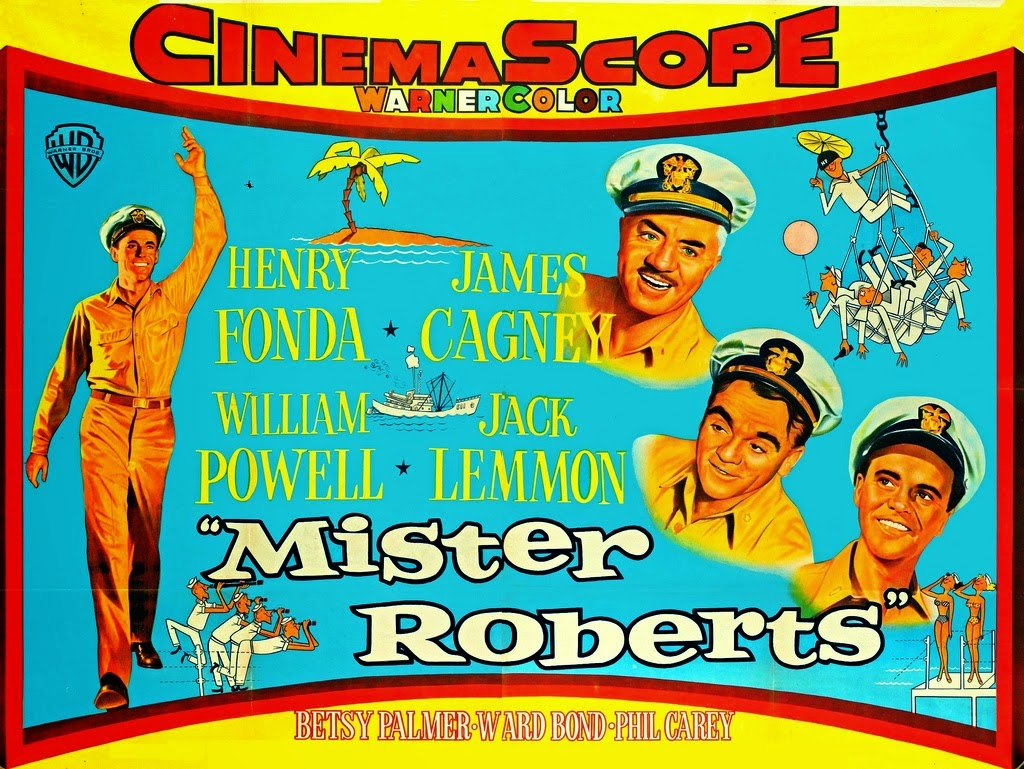
Mister Roberts 1955 - Petty tyranny and the man who fights it


IMDB Link
IMDB Rating: 7,9


Directors: John Ford, Mervyn LeRoy
Main Cast: Henry Fonda, James Cagney, William Powell, Jack Lemmon, Betsy Palmer, Ward Bond, Philip Carey


"Mister Roberts was one of the more thoughtful, reflective films from the 1950s to deal with World War II. It was a reflection of the distance filmmakers as well as the public had come from the war, a distance which allowed for a more sophisticated dramatic treatment of the conflict and the people involved. Other films during this era also reflected the new maturity, among them, The Caine Mutiny, Between Heaven and Hell, and The Naked and the Dead. Mister Roberts was the most successful of them all, and for good reason - though getting it made properly took real work. It stood to figure that John Ford was ideal for the project, since he loved the United States Navy more than almost anything else in his life (he retired from the reserves as a rear admiral). With Mister Roberts, however, Ford may have been too close to his subject to do justice to the script, and he butted up against the competing personality of star Henry Fonda. Fonda had scored a huge hit on Broadway in the stage version of Mister Roberts, but he'd given up hope of ever doing the movie, since he hadn't been on-screen in eight years and major studios weren't convinced that he was still a box office draw. As a condition of directing the film, Ford insisted on Fonda to star - but the two were at loggerheads from the beginning of the production, mainly over the director's tendency to inject rough-house comedy into his movies. Such an approach breathed life into Ford's somber cavalry movies, such as Fort Apache, but Mister Roberts was a character-driven story with very little real action, and Fonda thought the director's emphasis on laughs would destroy the integrity of the material. Ford's demanding, dictatorial directing style - exacerbated by his excessive drinking - created tension between the two, which erupted into a fistfight after only a few weeks' work. Ford left the production and was replaced by Mervyn LeRoy, who essentially asked the cast to use their best judgement and make the kind of movie Ford would've made. The end result is a finely textured character study that captured the best dramatic moments of the play as it interspersed an effective, new comic element. Fonda, who'd previously performed in four films for the director, would never work with Ford again; the director would only make one more navy film after Mister Roberts, the successful Donovan's Reef.
One of the finest service comedies ever made, Mister Roberts spawned a less amusing sequel, Ensign Pulver (1964), as well as a 1965 TV sitcom." - www.allmovie.com

DVD links:


Tuesday, April 22, 2014

They won't forget 1937 - An emotionally gripping piece of American history


IMDB Link
IMDB rating: 7,4


Director: Mervyn LeRoy
Main Cast: Claude Rains, Gloria Dickson, Edward Norris, Otto Kruger, Allyn Joslyn, Lana Turner


"This hard-hitting Warner Bros. courtroom drama begins with the usual 'Any resemblance to actual persons, living or dead, is coincidental' disclaimer. Filmgoers with long memories, however, recognized Robert Rossen and Aben Kandel's screenplay as a blow-by-blow recreation of the Leo Frank-Mary Phagan case of 1915. Phagan, a 14-year-old employee in a Marietta, GA pencil factory, was found murdered. The bulk of the evidence pointed to a black janitor (who actually confessed to the crime years after the fact), but race-baiting Atlanta newspaper publisher Tom Watson decided to go after Leo Frank, the Northern Jew who owned the factory where Mary worked. 'We can lynch a nigger any time', the politically ambitious Watson is alleged to have said, 'but when do we get a chance to hang a Yankee Jew?' Thanks largely to Watson's 'guilt by headline' campaign, and to Fulton County's cooperative solicitor general, Frank was found guilty and sentenced to death. Georgia Governor John M. Slaton, who all along smelled something fishy in the case, commuted Frank's case to life imprisonment (and was ruined politically as a result). En route to prison, Frank was abducted by a mob and lynched, an incident that boosted the prestige of the Georgia Ku Klux Klan.
Aben Kandel dramatized this appalling miscarriage of justice in his novel Death in the Deep South, which served as the basis for They Won't Forget. In Mervyn LeRoy's film version, Lana Turner (in a star-making turn) plays Mary Clay, a teen-aged typing school student who dresses garishly and flirts with every man she meets. Mary is later found murdered; the last person to see her alive was her teacher, recently arrived Northerner Robert Hale (Edward Norris). Once more, a black janitor (played as a superstitious moron by Clinton Rosemond) is the most likely suspect, but the ambitious district attorney (Claude Rains) seems sincere in his belief that Hale is guilty. Once Hale is sentenced to death, the governor, played by Paul Everton, commutes his sentence, serene in the belief that, once his career is finished, he'll be able to retire peacefully (real-life governor Slaton did not go down so benignly).
Except for the removal of the original case's anti-Semitic elements, They Won't Forget is stark, powerhouse filmmaking, one of the best of Warners' 'social protest' films of the 1930s. 25 years would pass before Hollywood would return to Southern racism with To Kill a Mockingbird in 1962. Viewed outside its historical context, They Won't Forget succeeds as a motion picture due to the passion of its director Mervyn LeRoy, and the fine performances of Claude Rains, Edward Norris, and Lana Turner. The film's socially conscious screenwriters, Robert Rossen and Abel Kandel, were hardly rewarded for their efforts: Rossen was among the first people blacklisted in the 1950s, while Kandel spent much of that era writing low-budget horror films under a pseudonym.
It was remade as the 1987 TV movie The Murder of Mary Phagan starring Jack Lemmon, Kevin Spacey, Peter Gallagher, and Charles S. Dutton (as well as as the unsuccessful 1998 Broadway musical Parade)." - www.allmovie.com

DVD links:


Friday, April 11, 2014

I am a fugitive from a chain gang 1932 - A film experience that is hard to forget


IMDB Link
IMDB rating: 8,0


Director: Mervyn LeRoy
Main Cast: Paul Muni, Glenda Farrell, Helen Vinson, Noel Francis, Preston Foster, Allen Jenkins


"Warner Bros.' hard-hitting chain-gang movie was a faithful adaptation of the similarly titled autobiography of Robert Elliot Burns (the publication of Burns' book led to the abolishment of that system and an erasure of Burns' sentence). A movie as grim as I Am a Fugitive from a Chain Gang was hardly a sure bet at the box office, then or now: based on the memoirs of a man who was still a wanted fugitive from a Georgia work gang, it represented a brave and potentially dangerous attack on a corrupt penal system that created more criminals than it cured. Director Mervyn LeRoy made his work camps (conveniently located in an unnamed state) as dirty, back-breaking, and soul-destroying as the screen would permit in 1932, and many prison films made later under more lenient circumstances were not nearly as brutally effective. Just as significant, Le Roy and screenwriters Howard J. Green, Brown Holmes, and Sheridan Gibney indicted the shabby treatment of America's returning veterans after World War I and damned a society that would put an innocent man behind bars and turn him into a criminal. LeRoy had an ideal leading man in Paul Muni, who made James Allen decent but flawed, making clear that, but for fortune, this story could happen to anyone." - www.allmovie.com

DVD links:


Sunday, April 6, 2014

Five star final 1931 - One of the best newspaper movies


IMDB Link
IMDB rating: 7,5


Director: Mervyn LeRoy
Main Cast: Edward G. Robinson, Marian Marsh, H. B. Warner, Anthony Bushell, George E. Stone, Ona Munson, Boris Karloff


"Adapted from the stage play by former newspaperman Louis Weitzenkorn, Five Star Final is an uncompromising look at the consequences of journalistic irresponsibility. Nominated for an Oscar as the year's best film, Five Star Final was the prototypical newspaper movie which was widely imitated in the 1930s and 1940s. It features many of the aspects of such films that would later become cliches, including a hard-bitten newspaper editor (played by Edward G. Robinson), an unscrupulous reporter (played by the great villain Boris Karloff) and a cast of crusty journalists and outraged citizens. It's a thorough condemnation of yellow journalism and sets forth the same kind of tensions and themes that many decades later could be found in such newspaper films as All the President's Men and Absence of Malice. Like all such films, there is redemption in exposing hypocrisy and pursuing truth. Prolific director Mervyn LeRoy was at the helm. Five years later, the plot was recycled, with the setting shifted to a radio station, in Two Against the World, starring Humphrey Bogart." - www.allmovie.com

DVD links:


Saturday, April 5, 2014

Little Caesar 1931 - The first 'talkie' gangster movie


IMDB Link
IMDB rating: 7,4


Director: Mervyn LeRoy
Main Cast: Edward G. Robinson, Douglas Fairbanks Jr., Glenda Farrell, William Collier Jr., Sidney Blackmer


"The rise of Al Capone to the head of America's criminal class inspired this Edward G. Robinson vehicle. Appearing just as talking pictures were finding their feet, Robinson's gravelly snarl and sociopathic disdain for human conventions became the template for countless future gangster anti-heroes. In fact, virtually every aspect of Little Caesar, from the seedy settings and rough-hewn slang to the pinstriped suits and ever-present Tommy Gun, became part of the language of the genre. Little Caesar sprints by in a brisk 77 minutes, powering through the rapid rise and inevitable descent of its flawed and ambitious protagonist as if a getaway car were waiting outside. The film insightfully plays on the Horatio Alger ideal of the all-American self-made man to examine this impulse's darker, anti-social implications, while offering a tragic arc of Greek proportions. The story's violence is discernibly in your face, and the performances are about as subtle as the gangster's suits. Ironically, the film, which purportedly aimed to expose the dark underbelly of the gangster life, was so riveting that it wound up glamorizing its targets, a fact not lost on movie censors of the time. Little Caesar was followed quickly by Public Enemy (1931) and Scarface (1932); the three films ushered in a legion of imitators to follow, but they were also, at least for a time, the last 'true' gangster movies, as their ambiguous representation of glamorous criminals brought down the much stricter 1934 content restrictions of Joe Breen's Production Code Administration." - www.allmovie.com

DVD links:


Monday, April 2, 2012

Broadminded 1931 - A Joe E. Brown vehicle with scenes stealing presence of Lugosi


IMDB Link
IMDB rating: 5,9


Director: Mervyn LeRoy
Main Cast: Joe E. Brown, Ona Munson, William Collier Jr., Marjorie White, Margaret Livingstone, Thelma Todd, Bela Lugosi


"Comic Joe E. Brown scores another hit in this very humorous little Pre-Code film which gives him free rein to engage in his madcap capers. Here he plays the supposedly responsible young man chosen to chaperone his highly libidinous cousin after the latter is forced to beat a hasty retreat from a Big City scandal. Brown, of course, proves remarkably capable of causing trouble wherever they travel, thus providing the film with much of its plot. With his large rubbery face & huge mouth a constant source of amusement, Brown enters the movie with much hilarity - costumed as a bawling infant at the baby party which opens the film. Further on, the scene where he finds himself locked out of his hotel room in his underwear is particularly jovial.
Most of the cast is on hand to provide support during Brown's antics: William Collier Jr. as his frisky cousin; Holmes Herbert as Collier's stern New York City father; Margaret Livingston as Collier's vindictive former flame; Ona Munson as Collier's new heart throb; Grayce Hampton as her frightful aunt.
Even perky little Marjorie White, as Brown's new gal pal, is not given much to do. The two major exceptions are statuesque Thelma Todd, delightful as a compliant actress eager to help the boys out of a nasty jam, and marvelous Bela Lugosi - the same year he would become an international star as Count Dracula - lending his malevolent presence as the fierce Gentleman From South America who menaces Brown throughout the film."

DVD links:


Friday, March 2, 2012

Show girl in Hollywood 1930 - Blanche Sweet steals the show


IMDB link: http://www.imdb.com/title/tt0021371/?ref_=fn_al_tt_1
IMDB rating: 7,1


Director: Mervyn LeRoy
Main Cast: Alice White, Jack Mulhall, Blanche Sweet, Ford Sterling


"This wonderful Warner Bros. epic was one of the earliest talkie musicals with a Hollywood background - and the last of its kind until 1933's Sitting Pretty. Alice White stars as pert chorine Dixie Dugan, a character she'd played in 1928's Show Girl (and one which would spin off into a long-running comic strip). This time, Dixie is brought to Hollywood to appear in a music titled The Rainbow Girl. Thanks to the urgings of her egotistical director (John Miljan), the normally down-to-earth heroine begins acting like a haughty screen queen. Her temperamental behavior causes a shut-down of the production, ruining the comeback attempt of fading star Donna Harris (played by Blanche Sweet, who at 36 looks far younger than her 'over-the-hill' character, who's supposed to be 32!) When Donna nearly commits suicide, Dixie realizes what a jerk she's been, and the show - er, the movie - goes on. A surprisingly accurate scene from Show Girl in Hollywood, showing a musical number 'in production' on the sound stage has since been excerpted in several TV documentaries on the early sound era. The film originally ended with a Technicolor sequence depicting the premiere of the fictional The Rainbow Girl, with several Warner Bros. employees (Al Jolson, Ruby Keeler, Loretta Young and Walter Pidgeon) in attendance.
A distinguished early talkie with acceptable tunes by Buddy Green and Sammy Stept, include: 'I've Got My Eye on You' (sung by Alice White); 'There's a Tear for Every Smile in Hollywood' (sung by Blanche Sweet); 'I've Got My Eye on You' (reprise) and 'Hang on to the Rainbow' (Alice White).
Blanche Sweet (1895-1986), a long time veteran actress of the silent screen dating back to 1909, is quite effective as a drifting movie queen who becomes Dixie Dugan's guide through the studio system. Her vocalizing to a sentimental tune revealing the happiness and hardship of Hollywood comes very much as a surprise as does her character, limited somewhat in the photo-play yet crucial to the story. Film buffs would also delight in witnessing the behind the scenes activity of movie making, then called 'Vitaphoning'." - http://www.allmovie.com/movie/show-girl-in-hollywood-v110018

DVD links:


Thursday, February 2, 2012

Anthony Adverse 1936 - A huge best-seller adapted in only 141 minutes screen time


IMDB link: http://www.imdb.com/title/tt0027300/?ref_=fn_al_tt_1
IMDB rating: 6,6


Director: Mervyn LeRoy
Main Cast: Fredric March, Olivia de Havilland, Donald Woods, Anita Louise, Edmund Gwenn, Claude Rains, Louis Hayward, Gale Sondergaard


"When David O. Selznick produced the film version of the 1000-plus page novel Gone with the Wind, he declared he could not make a film running any less than 222 minutes. When Warner Bros. adapted the even longer Hervey Allen best-seller Anthony Adverse, the studio managed to pack everything - except the most censorable passages, which had made Allen's novel a best-seller in the first place - into 141 minutes. Surprisingly, the film version of Anthony Adverse moves rather smoothly, though it is nowhere near as involving (or as much fun) as Gone with the Wind.
Anthony Adverse is a handsomely made film, albeit one with considerably less passion than its best-selling source novel merits. Despite a talented cast, the acting is uniformly sterile and the story is ploddingly presented in by-the-numbers fashion. What shines through is Anton Grot's elegant production design and the fine orchestral score of Erich Wolfgang Korngold. The usually superb Fredric March can only be as good as the formulaic script allows him to be. The film attempts to cram too many incidents into too little story space and offers only expurgated versions of what occurs in the richly structured novel. The result is a story that is more of a highlight reel than a compelling dramatic narrative. Nonetheless, the film has compensating virtues and represents a step forward on the road toward the more compelling epic storytelling of Gone With the Wind. The geographically diverse 19th century settings are generously re-created, and Tony Gaudio's cinematography effectively alters the atmosphere as needed. Anthony Adverse received seven Academy Award nominations, including Best Picture, winning four awards, including for Gaudio's cinematography, Korngold's score, and Gale Sondergaard's supporting performance (the first ever in that category)." - http://www.allmovie.com/movie/anthony-adverse-v2606/

Download links:


(rar, 1 GB, English audio with French hardsubs):

http://rapidgator.net/file/f2a3c3f3ed58f35f4c2b0dfa028510e2
Thursday, November 10, 2011

Gold diggers of 1933 (1933) - The show of a thousand wonders


IMDB link: http://www.imdb.com/title/tt0024069/
IMDB rating: 8,2


Director: Mervyn LeRoy
Main Cast: Warren William, Joan Blondell, Ruby Keeler, Dick Powell, Ginger Rogers


"The second talkie version of the Avery Hopwood's theatrical war-horse The Golddiggers of Broadway, Gold Diggers of 1933 was the second of three back-to-back 1933 Warner Bros. musicals benefiting from the genius of Busby Berkeley. Gold Diggers of 1933 adroitly intertwined a light-hearted yet gritty look at backstage shenanigans involving unemployed showgirls and potential moneymen with choreographer Busby Berkeley's outrageously lavish production numbers, replete with fluid camerawork and overhead compositions. Using the Great Depression rather than ignoring it, Mervyn LeRoy's crisply directed story hinged on survival in hard times, as romance blooms when the pragmatic chorines use their 'assets' to charm backers for a new show. Berkeley's 'We're in the Money', featuring coin-clad chorus girls and Ginger Rogers singing in pig Latin, and the cheekily smutty 'Pettin' in the Park' indicate the movie's dual focus on fiscal troubles and carnality. The downbeat finale, 'Remember My Forgotten Man', keeps the film rooted in 1930s reality, despite the escapism offered by Berkeley's visually innovative set pieces and the sweet Ruby Keeler-Dick Powell love story. Other Berkeley-staged musical highlights include the neon-dominated 'Shadow Waltz', all written by the prolific Harry Warren and Al Dubin. As spectacular as Gold Diggers of 1933 was, it would be topped by the last of Berkeley's 1933 trilogy, Footlight Parade." - http://www.allmovie.com/movie/gold-diggers-of-1933-v20140

DVD links: